

So, what exactly is a real estate Inside Sales Agent, or ISA?
At its core, an ISA is a specialist. Their entire world revolves around engaging new leads, figuring out who's serious, and teeing up solid appointments for the rest of the team. They're the first voice a potential client hears, making that critical first impression.
Your Team’s Secret Weapon for Growth
Ever get that sinking feeling of staring at a CRM full of fresh internet leads, knowing you just don't have the hours in the day to call them all? That's the exact pain point an ISA is built to solve.
Think of them as the air traffic controller for your entire sales pipeline. Their job is to sit in the tower, manage the constant flow of inbound inquiries, and skillfully separate the "just browsing" from the "ready to move." Once they spot a truly motivated buyer or seller, they guide them in for a smooth landing right onto an agent's calendar.
In a business where speed-to-lead is king, having a dedicated ISA means no opportunity slips through the cracks. It frees up your licensed agents to get back to what they do best: meeting clients, showing homes, and closing deals.
What Does an ISA Actually Do?
The ISA role is all about creating focus and efficiency. While a buyer's agent is out on showings and a listing agent is negotiating offers, the ISA has one laser-focused mission: turn a cold click into a warm handshake. That specialization is how top teams scale without burning out their agents.
This role really took off when online lead generation exploded in the early 2010s. Fast forward to 2020, and research showed that over 40% of high-performing real estate teams in the US had integrated ISAs to manage their lead flow. If you're interested in diving deeper into how team structures have evolved, you can find some fascinating data in this global wealth report.
An ISA isn’t just making calls; they’re protecting your marketing dollars. They make sure every single lead you paid for gets the attention it deserves, squeezing every last drop of ROI from your ad spend.
The Real Estate ISA Role at a Glance
To give you a clearer picture, let's break down the ISA's primary duties and the value they deliver in a simple table.
| Core Function | Key Benefit | Essential Tools |
|---|---|---|
| Rapid Lead Response | Connects with leads within minutes, dramatically increasing contact and conversion rates. | CRM with auto-dialer and SMS |
| Lead Qualification | Filters out unmotivated leads, ensuring agents only meet with with serious prospects. | Proven scripts and qualifying questions |
| Appointment Setting | Fills agent calendars with high-quality buyer consultations and listing appointments. | Shared calendar software and CRM |
| Long-Term Nurturing | Manages follow-up for "not right now" leads, building a future pipeline. | Email and text drip campaigns |
In short, the ISA handles the high-volume, often repetitive work at the top of the funnel so that licensed agents can focus on the high-value, relationship-based work at the bottom.
What are the main responsibilities of a real estate ISA?
So, what does this look like day-to-day? Here’s a quick rundown of an ISA's main responsibilities:
- Immediate Lead Response: The moment a new lead hits the CRM, the ISA is on it. Their goal is to make contact within the first five minutes—the golden window for engagement.
- Lead Qualification: They're not just calling to say hello. They use well-honed scripts to dig into a lead's motivation, timeline, and financial situation. Are they really ready?
- Appointment Setting: This is the ultimate goal. A successful call ends with a qualified consultation—be it for a buyer or a seller—booked directly onto an agent's calendar.
- Long-Term Nurturing: Not everyone is ready to buy or sell today. For those "6-12 months out" leads, the ISA places them on thoughtful follow-up plans to keep your team top-of-mind until the time is right.
A Day in the Life of a Top-Performing ISA
So, what does a real estate ISA actually do all day? If you’re picturing someone just smiling and dialing, you’re missing the bigger picture. The best ISAs operate with the focus of a project manager and the persuasive touch of a seasoned salesperson. Their entire day is built around creating qualified opportunities.
This isn’t about making random calls; it's a highly structured routine. Mornings are almost always dedicated to what we call "money time"—prospecting. This means hitting the freshest, hottest leads right away, because getting in touch within the first five minutes can boost contact rates by a staggering 800%. This is speed-to-lead in action, and it’s non-negotiable for a high-performer.
Once that initial wave is handled, the day shifts gears. The ISA then pivots to scheduled follow-ups with warmer leads—the folks they've already spoken to who are a bit further down the road. This is where the real skill comes in. It's about building genuine rapport, navigating objections, and digging deep to understand what’s really motivating a buyer or seller.
The ISA Workflow in Action
As the day rolls on, every single call, text, and email is logged in the team’s CRM. This isn't just busywork; it's mission-critical intelligence. Detailed notes on a lead’s timeline, their kids’ school district, or their biggest fears about selling are what turn a cold handoff into a warm, successful meeting for a field agent.
This simple flow chart breaks down the core process every ISA masters.
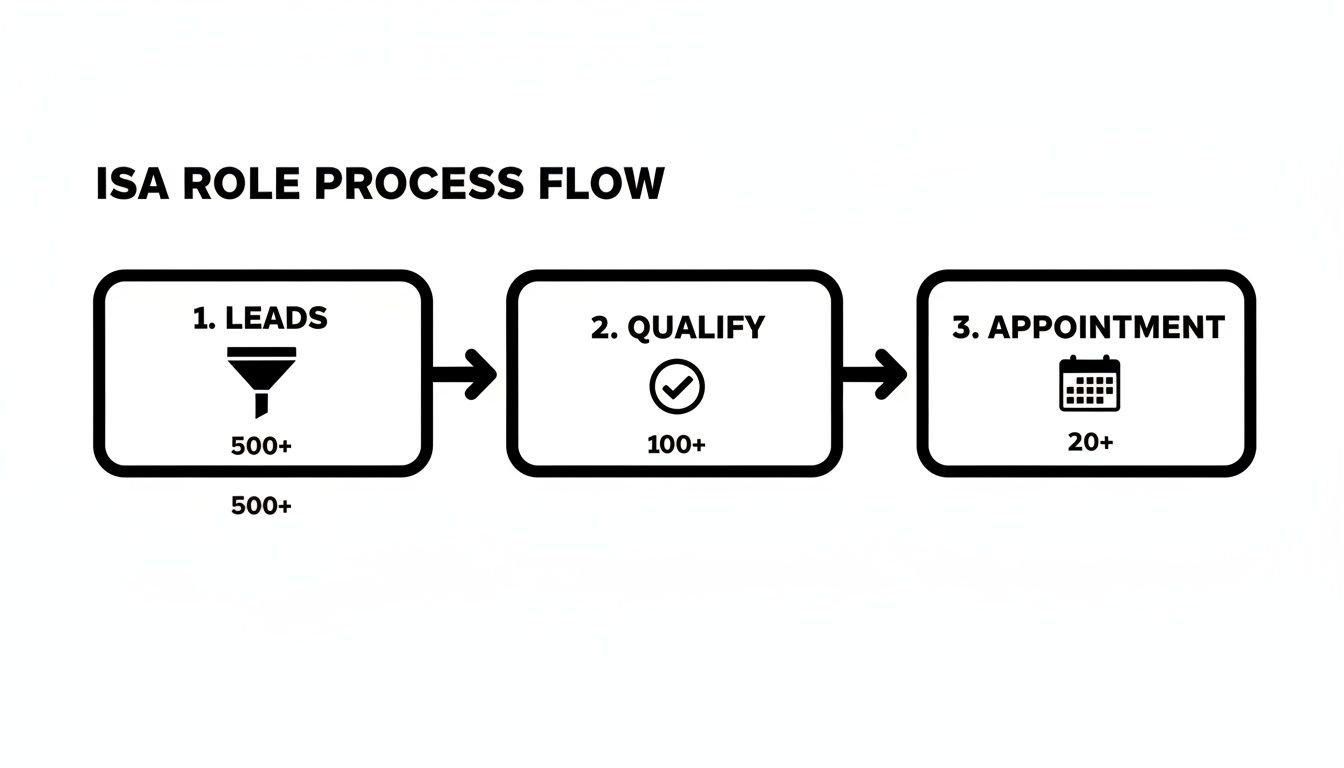
As you can see, the whole point is to filter a high volume of raw leads into a small, curated list of high-intent appointments.
The afternoon is often set aside for nurturing the "not right now" leads. These are the folks who are months, or even a year, away from transacting. A great ISA uses a multi-channel approach—a mix of calls, personalized emails, and helpful texts—to stay top-of-mind without being annoying. They know patience is key, and consistent, value-driven follow-up is what gets their team the call when that lead is finally ready to move.
A great ISA isn't trying to sell a house. They're selling the next step: a conversation with a trusted expert. Their entire day is engineered to earn that conversation.
Ultimately, an ISA’s daily grind is a powerful blend of high-octane prospecting, patient nurturing, and disciplined data entry. This relentless focus is what frees up agents to do what they do best: meet with truly motivated clients and close deals. It's how a real estate business stops chasing and starts scaling.
How an ISA Fits Into Your Team Structure
Bringing an Inside Sales Agent onto your team can feel like a major shift, and it’s natural to wonder exactly where they slot in. The easiest way to think about an ISA is as a specialist—the dedicated point guard of your real estate team. While other players are focused on scoring (closing deals), the ISA’s entire job is to run the offense, control the ball, and create the perfect assist for your agents.
Their role isn't about replacing anyone. It’s about making everyone else more effective. By taking on the heavy lifting of sifting through and qualifying new leads, they create a clean handoff for your licensed agents. This means your agents only get involved when a lead is actually motivated and ready to talk, creating a much smoother experience for everyone, especially the client.
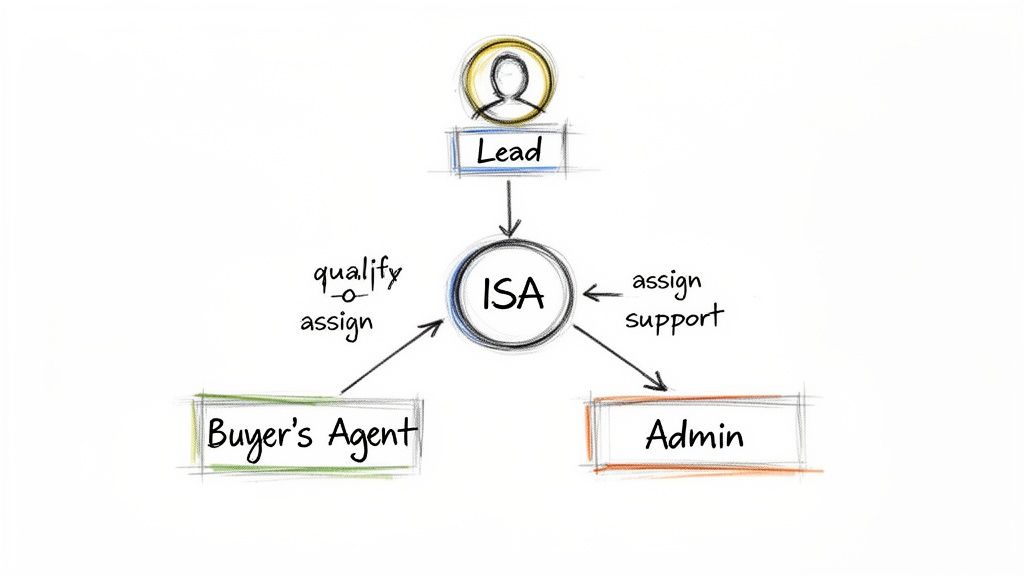
This structure makes sure every stage of the process, from a lead’s first click to the closing table, is managed by an expert. It's a non-negotiable part of any scalable https://dbmarketingco.com/real-estate-lead-generation-system/ built for growth.
How does an ISA differ from other real estate roles?
Okay, so where does the ISA’s job end and another role's begin? This is probably the most common point of confusion. People often lump ISAs in with buyer's agents or admin assistants, but their core functions couldn't be more different.
At the end of the day, an ISA’s success comes down to one thing: setting qualified appointments. That’s it.
A buyer's agent is out in the field showing properties, writing up offers, and negotiating deals. An admin is the backbone of the office, wrangling paperwork and keeping the trains running on time. The ISA, however, is the critical link between your marketing efforts and your sales team, making sure no lead ever falls through the cracks. To see how tech can help with the very first touchpoint, check out some of the best real estate chatbots, which can handle instant responses before your ISA even steps in.
The ISA owns the top of your sales funnel. Their goal isn’t to sell a home; it's to sell the appointment with the agent who will. This distinction is everything if you want to scale.
Let's break it down side-by-side to make it perfectly clear.
Real Estate Team Roles Compared
This table cuts through the noise and shows exactly how these roles are different. Notice how each has a unique responsibility, goal, and compensation structure—this is what allows them to work together without getting in each other's way.
| Role | Primary Responsibility | Main Goal | Typical Compensation |
|---|---|---|---|
| Inside Sales Agent (ISA) | Prospecting, qualifying leads, and nurturing the pipeline. | Set a high volume of quality appointments for agents. | Base salary + performance bonus per appointment set/closed. |
| Buyer's Agent | Showing homes, writing offers, and guiding clients to closing. | Convert appointments into closed buyer-side transactions. | Commission-only or a small draw against future commission. |
| Admin/Assistant | Managing paperwork, coordinating schedules, and handling office tasks. | Ensure smooth operational workflow and agent support. | Hourly wage or a fixed salary. |
This kind of specialization is precisely why teams with a dedicated ISA often see their conversion rates leap from the industry average of 1% to as high as 5-7%. When everyone is focused on doing what they do best, the entire business becomes more efficient and, ultimately, way more profitable.
The Metrics That Truly Define ISA Success
You can't measure an ISA's value on a gut feeling. It's not about how busy they sound or how many calls they make; their true impact is spelled out in the data. Tracking the right numbers—the right Key Performance Indicators (KPIs)—is the only way to know for sure how an ISA is performing and what they're contributing to your bottom line.
Think of it this way: the numbers tell a story. A high volume of appointments that never close isn't a win. It's a sign that something is off, maybe the qualification scripts are too loose or the agents need better coaching on how to handle those specific leads. The data points you to the problem.
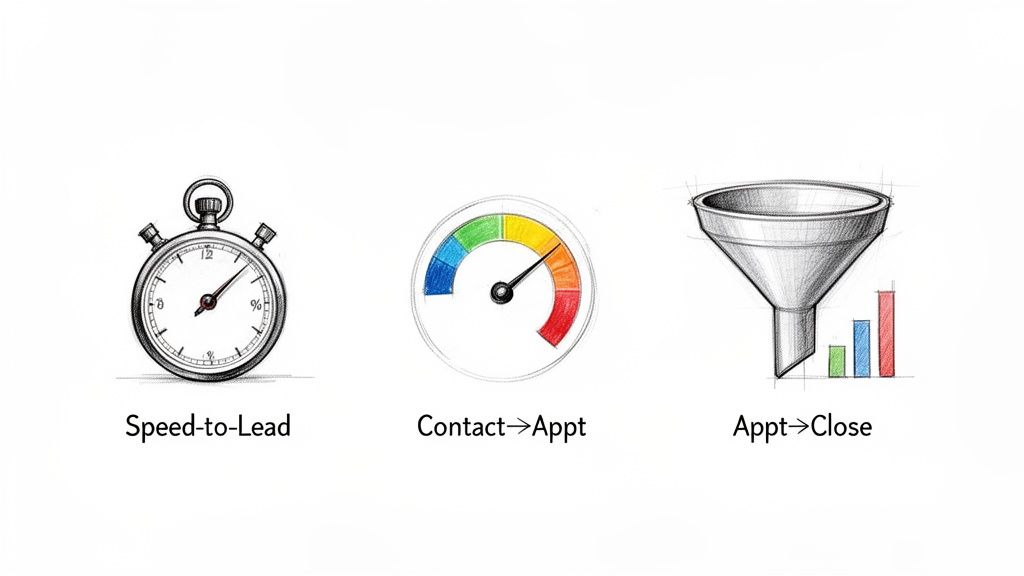
What KPIs should I track for a real estate ISA?
To get a complete picture, you need to track a lead’s entire journey from the moment they hit your CRM to the day they sign on the dotted line. These are the absolute must-haves:
- Speed-to-Lead: How fast does your ISA get on the phone with a new lead? The goal is under five minutes. Seriously. This is the single biggest lever you can pull to make contact.
- Contact Rate: Out of all the new leads that come in, what percentage does the ISA actually have a conversation with? If this number is low, you might have a lead quality problem or need to rethink call timing.
- Contact-to-Appointment Rate: This one’s huge. Of the people they do talk to, how many turn into qualified appointments for your agents? This KPI directly measures your ISA's skill in qualifying and persuading.
- Appointment-to-Close Rate: The moment of truth. What percentage of the appointments set by the ISA actually result in a closed deal? This tells you everything about the quality of the appointments being handed off.
A great supporting metric for digging into an ISA's efficiency is their Average Handle Time (AHT). It helps you see how they're managing conversations and where you can optimize their process without sacrificing quality.
Connecting the Dots to Real ROI
Okay, so how do these metrics actually make you money? The math is surprisingly simple, and it all comes back to speed and conversion.
Studies have shown that calling a new lead within 5 minutes can result in 8–10 times higher contact rates compared to waiting just 30 minutes. Let's play that out. Say your team gets 1,000 leads a year and closes 1.5% of them (that's 15 deals). An effective ISA who nails the speed-to-lead could easily double your contact rate, pushing your close rate to 3% (30 deals). Depending on your market, that could mean an extra $120,000–$180,000 in gross commission income.
When you track the right KPIs, you stop guessing and start engineering your success. It gives you a rock-solid framework for measuring performance, providing targeted coaching, and proving the direct financial impact your ISA has on the business.
Figuring out the exact right time to hire an ISA can feel like a guessing game, but honestly, the signs are usually staring you right in the face. It’s not about hitting some magic number of leads. It’s about recognizing the bottlenecks that are silently killing your team’s growth.
If you’re constantly feeling buried under a mountain of new leads, you're probably at that tipping point.
The most glaring sign? When good leads start falling through the cracks. You shelled out good money for them, they landed in your CRM, and then… crickets. Days go by before anyone has a chance to make a real follow-up call. By that point, your lead has already chatted with three other agents. Game over.
Another huge red flag is when your top-producing agents are spending more time dialing for dollars than they are sitting at a listing appointment. Your agents are closers, not chasers. If their calendar is packed with prospecting instead of face-to-face meetings, you're misusing their most valuable skills.
When Is It Time for a Real Estate ISA?
So, how do you know for sure that you've hit that tipping point? It usually comes down to a few painful truths that almost every team leader runs into. If any of these sound a little too familiar, it’s probably time to get serious about hiring an ISA.
- You have the leads, but not the time. Your marketing is on point and the leads are flowing in, but your follow-up is sporadic at best.
- Your agents despise prospecting. Let's be real—most agents didn't get into this business to make hundreds of calls a day to cold leads. It's just not in their DNA.
- Your conversion rate is flatlining. The industry average for online leads sits at a painful 1%. If that's where you're stuck, an ISA is your best bet for breaking through that ceiling.
- You feel like you're just burning ad money. Every single lead that isn’t properly nurtured is cash straight down the drain.
The real cost of waiting isn’t on your P&L sheet. It's invisible. It's all the deals you lose without ever knowing you were in the running—the leads who ended up buying or selling with another agent simply because you didn't have a system to connect with them fast enough.
Choosing the Right ISA Model
Once you’ve made the call to hire, you’ve got a few different paths you can take. Each has its own set of pros and cons, so the best choice really comes down to your budget, how many leads you're handling, and how much time you have for management.
1. In-House Employee
This is the classic approach and gives you the most direct control. You hire them, train them, and manage them yourself, making them a true part of your team's culture. It’s an excellent choice for bigger, more established teams, but it’s also the most expensive route when you factor in salary, benefits, and the need for office space.
2. Virtual ISA
A virtual or remote ISA offers a lot more flexibility and is generally a more budget-friendly option. They can work for you full-time or part-time, but you absolutely need to have rock-solid systems for managing and holding a remote employee accountable. Without that, it can fall apart quickly.
3. Third-Party Service
Think of this as the "plug-and-play" solution. Companies like ours provide you with professionally trained ISAs who are ready to integrate directly into your existing CRM and systems. It’s hands-down the fastest way to get up and running and completely removes the headache of recruiting, hiring, and training. This makes it perfect for teams that need expert help, right now.
Agents Are Asking… Here's What You Need to Know
Thinking about bringing an ISA on board? It's a big step, and of course, you've got questions. We hear these all the time from agents and team leaders, so let's get you some straight answers.
"Can an ISA Really Represent My Brand as Well as I Can?"
This is probably the number one concern we hear, and it's a good one. You've spent years building your reputation.
Here's the thing: a great ISA doesn't replace your personal touch; they scale it. They work from scripts you approve and go through intense training to learn your brand's specific voice and values. Think of them as an extension of you.
Their job is to handle the heavy lifting of that first contact and qualification. By the time a lead gets to you, they've already been introduced to your value and are warmed up for your expertise. It all comes down to building a solid partnership and setting clear expectations from day one.
Your ISA becomes your brand's ambassador for that first critical conversation. They're trained to mirror your professionalism, making sure that first impression is a knockout and tees you up for a smooth handoff.
"Is an ISA Affordable for a Solo Agent or Small Team?"
You don't need a mega-team budget to get in the game. While hiring a full-time, in-house person is a serious commitment, there are other flexible options that are perfect for solo agents and smaller teams.
Look into fractional or virtual ISA services. These models let you pay for exactly what you need—maybe it's just a few hours a week or even a per-lead cost. You get all the benefits without the overhead of a full-time salary and benefits.
The best way to think about it is ROI. If an ISA helps you close just one or two extra deals a year, they've more than paid for themselves. The math on that is pretty hard to argue with.
"What’s the Difference Between an ISA and an Autoresponder?"
Automation is amazing for speed, but a robot can't build a real relationship. An autoresponder can fire off a text in two seconds flat, but it can't listen for hesitation in a seller's voice, uncover their true motivation, or navigate a tricky objection.
That's where a human ISA comes in. They bring empathy and genuine conversation to the table—something technology just can't do. An ISA can pivot based on a lead's tone and ask the smart follow-up questions an automated sequence would completely miss.
Honestly, the most powerful approach combines both:
- Automation for Speed: An instant text goes out, so the lead never feels ignored.
- ISA for Connection: A real person follows up shortly after to have a human conversation, build rapport, and actually book the appointment.
"How Do I Make Sure the Handoff From the ISA to Me Isn't Awkward?"
A clunky handoff is a deal-killer. It makes you look disorganized and erodes the trust the ISA just built. The fix? A bulletproof process built around your CRM and a shared calendar.
The ISA’s job isn't done until they've logged detailed notes on every single conversation. We're not just talking about whether they're pre-approved. We're talking about the little things that matter.
The handoff notes absolutely must include:
- Motivation: Why are they actually moving? New baby, job transfer, want to be closer to the grandkids?
- Timeline: Are they ready to go now, or are they just dipping their toes in the water?
- Personal Details: Did they mention their dog, their kids' school, or their love for a specific neighborhood? This is rapport-building gold.
When that appointment hits your calendar, all this context should be right there in the notes. A great handoff feels less like a transfer and more like picking up a conversation with an old friend. It ensures your new client feels heard and understood from the very start.
At DB Marketing Co., we specialize in breaking through the bottlenecks that stop real estate businesses from growing. From instant lead response systems to fully managed ISA services that put qualified appointments right on your calendar, we give you the leverage to focus on what you do best: closing deals. Learn more about how we can help you scale your business.