
Let's be honest, as a real estate agent, you can't be everywhere at once. You're showing properties, negotiating deals, and meeting clients. So what happens when a new lead comes in at 10 PM on a Tuesday? That's where marketing automation software comes in.
Think of it as your digital assistant—one that works 24/7 to catch, nurture, and organize every single lead. It ensures no opportunity slips through the cracks, freeing you up to do what you do best: build relationships and close deals.
What Is Real Estate Marketing Automation, Really?
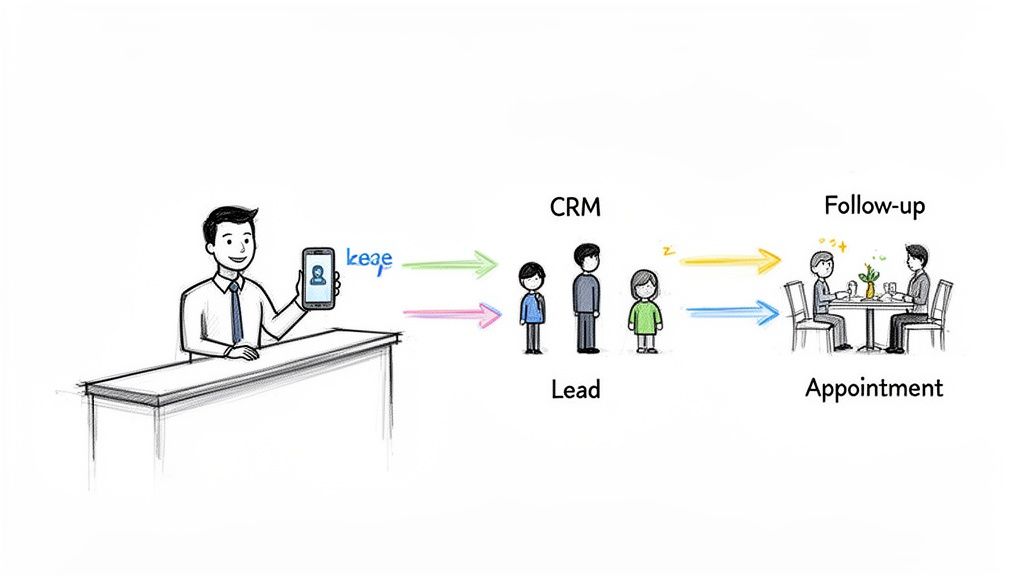
Forget the technical jargon for a minute. Imagine your business is a super popular restaurant on a Saturday night. Leads are like customers flooding through the door, all wanting your immediate attention. If it's just you, it’s chaos. You're trying to greet people, find tables, and take orders all at the same time. Inevitably, someone gets ignored and walks out.
Marketing automation software is like your perfectly trained front-of-house staff. It's the host who instantly greets every single person who walks in, whether they came from your website, a Facebook ad, or a Zillow inquiry. It doesn't matter if they show up at 2 PM or 2 AM—the response is always immediate, personal, and professional.
How It Unclogs Your Workflow
This "digital host" does a lot more than just say hello. Its main job is to handle those crucial first steps of the client journey on autopilot. This lets you step in when it's time for the high-value conversations that actually lead to a commission check.
Here’s what that looks like in the real world:
- Instant Replies: The software pings a lead with a human-sounding text or email the second they reach out. The stats don't lie: responding within five minutes makes you 100 times more likely to actually connect with them.
- Smart Questions: It can automatically ask simple qualifying questions like, "Are you looking to buy or sell?" or "What’s your ideal timeline?" This gives you a snapshot of their intent before you even dial their number.
- Seamless Organization: After that first touchpoint, it neatly places the lead into your CRM, tagging them based on where they came from (e.g., "Facebook Lead," "Website Inquiry"). No more manual data entry.
The point of automation isn't to replace your personal touch; it's to make sure you have time for it. It handles the frantic first few minutes so you can step in at the perfect moment for a meaningful, human conversation, without anyone ever feeling ignored.
Why This Is a Game-Changer for Agents
So, what does all this really mean for your bottom line? It comes down to consistency and the ability to scale.
Let's face it, manually chasing every single inquiry just isn't sustainable if you want to grow. One missed call or a delayed email response can literally be a lost commission. This tech ensures every lead gets the same prompt, professional experience, building trust from that very first touchpoint.
It’s the difference between a chaotic scramble and a smooth, well-oiled machine that makes clients feel seen and valued. For a deeper dive into how these systems work, this AI for Real Estate Marketing: Your Ultimate Guide is a fantastic resource. Ultimately, automation gives you back your most precious asset: your time.
The Core Features Every Agent Needs to Know
So, you're hearing a lot about real estate marketing automation software, but what does it actually do? When you strip away all the jargon, a truly great platform comes down to just a handful of features that are absolute game-changers. These aren’t just bells and whistles; they’re the engine that can take your chaotic, manual process and turn it into a well-oiled machine for growing your business.
Let's break down the must-have components and see how they solve the exact headaches you probably deal with every single day.
Automated Lead Capture and Organization
Picture this: a new lead fills out a form on your latest Facebook ad. What happens next? The old way involved you getting an email, stopping whatever you were doing, and manually copy-pasting their info into a spreadsheet or your CRM. It’s slow, tedious, and when you’re busy, leads inevitably fall through the cracks.
With automation, that same lead submits the form, and the software instantly snags their details, creates a new contact in your system, and even tags them as a "New Facebook Lead." It all happens in a blink, 24/7. No more lost leads, no more data entry errors. This one feature alone cleans up the messiest part of lead generation.
Instant Lead Response and Nurturing
Here’s a stat that should get your attention: you are 100 times more likely to connect with a lead if you respond within the first five minutes. But who can possibly do that manually? This is where automation shines.
The moment a lead comes in, the system can fire off an automated first touch—usually a quick text or a welcome email. It’s an instant "hello" that makes the lead feel heard. After that, automated nurturing sequences kick in. These are pre-written series of messages that go out over days or weeks, keeping you top-of-mind and building trust until they're actually ready to talk.
Think of it this way: Automation handles the initial "hello" and the persistent follow-ups, so you can step in for the meaningful handshake.
Seamless CRM Integration
Your CRM is the command center for your client relationships. Your automation software should plug right into it, no questions asked. A seamless integration means these two systems are constantly talking to each other.
When a lead is captured, gets a text, and opens an email, your automation platform should be updating their contact record in your CRM in real-time. This gives you a single, reliable place to see every single interaction. It’s the key to staying organized and knowing exactly where every lead is in your pipeline.
Why These Features Are Becoming Standard
This isn't just some passing fad. The move toward automation is a massive shift in how the real estate game is played. The market for this kind of software was valued at USD 1.12 billion in 2024 and is on track to explode to USD 4.26 billion by 2034. That kind of growth tells you one thing: agents who aren't using these tools are going to get left behind. You can see more data on this trend in the latest market analysis on market.us.
To really drive home the difference, let’s look at a side-by-side comparison of your day with and without these tools.
Manual Tasks vs. Automated Workflows
| Manual Task | Automated Workflow Solution | Time Saved Per Week |
|---|---|---|
| Manually copy-pasting lead info from Facebook, Zillow, etc. | Software auto-captures lead data and sends it to the CRM with a source tag. | 2-3 hours |
| Calling new leads hours (or days) after they inquire. | An instant, personalized text is sent the moment a lead comes in. | 1-2 hours |
| Sending one-off follow-up emails from memory. | Pre-built email/text sequences nurture leads based on their status (new, cold, etc.). | 3-4 hours |
| Forgetting to update a lead's status in the CRM. | The automation system updates the CRM record after each interaction. | 1-2 hours |
When you automate these foundational tasks, you're doing more than just saving a few hours. You’re building a scalable business that gives every single lead a professional and consistent experience, freeing you up to do what you do best: build relationships and close deals.
Supercharge Your Lead Generation and Nurturing
Look, having the right software is just the first step. The real magic happens when you use it to build a predictable, growing business. This is where you connect the dots between your cool new tools and a steady flow of qualified clients who are actually ready to talk. It's all about creating a smooth journey for every lead, from the second they click on your ad to the moment they book a call with you.
With the right automation in place, you can build a system that replies instantly and nurtures leads intelligently, making sure you never let a good opportunity slip through the cracks. This isn’t about sounding like a robot; it’s about being consistently responsive and relevant on a scale you could never achieve manually. It frees you up to have the high-value conversations that actually close deals.
What Is an Instant Response System?
Think of an instant response system as your 24/7 digital receptionist. Here’s a wild stat: responding to a new lead within five minutes makes you 100 times more likely to actually connect with them. Your automation software makes this happen by immediately engaging leads, no matter where they come from.
This means you can set up automated, human-sounding replies for things like:
- Website Forms: Someone requests a home valuation at 2 AM? They get an instant text confirming you got it and will be in touch shortly.
- Social Media Messages: A prospect slides into your DMs on Facebook about a new listing? An immediate reply with more details goes right back to them.
- Missed Calls: You're in a meeting and miss a call. The system can instantly text them, "Hi, this is [Your Name]. Sorry I missed you. I'll call you back in 15 minutes."
That first, immediate touchpoint is everything. It shows the lead you're on top of it, makes them feel heard, and sets the tone that you're a professional they can count on.
This diagram shows the difference between the old, chaotic way of handling leads and the streamlined, automated approach.
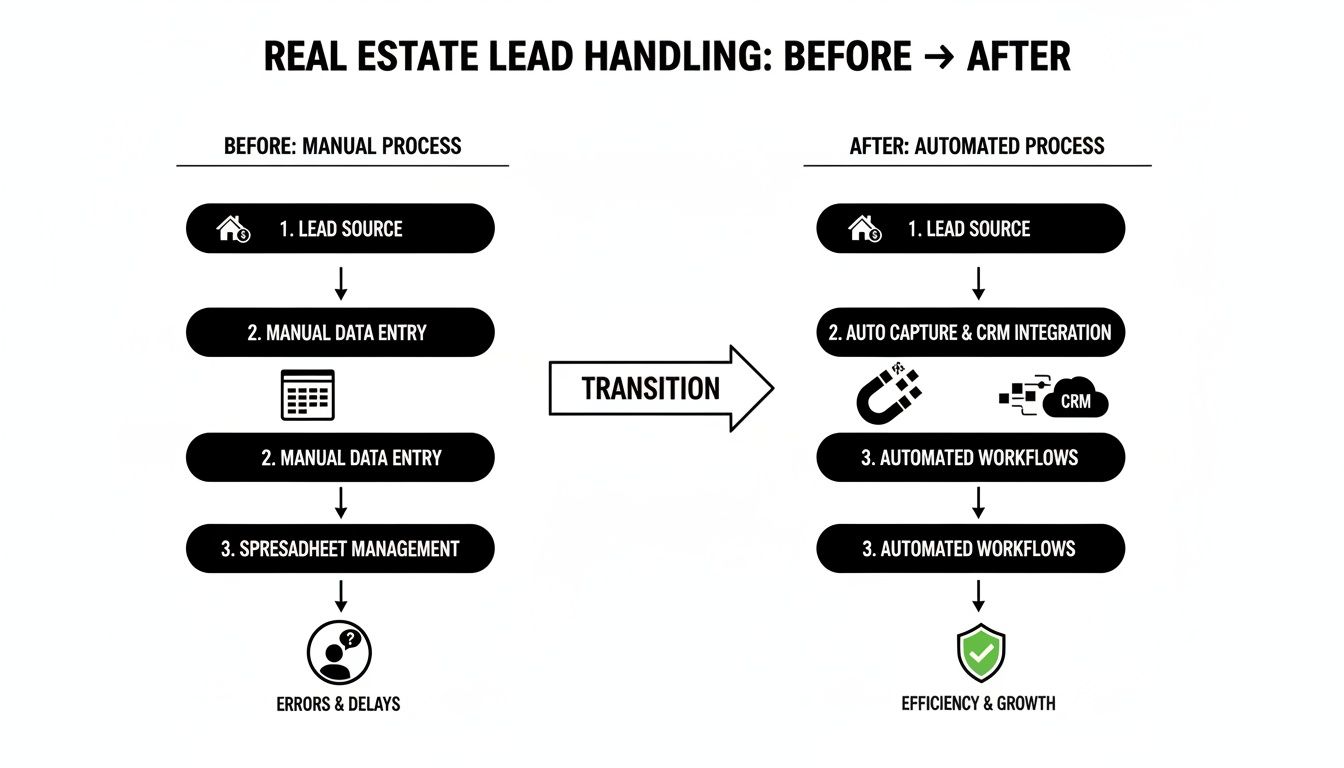
The big takeaway here is the shift from playing catch-up to having a proactive system where every single lead is captured and engaged from the get-go.
How Do Automated Drip Campaigns Work?
Okay, so you've captured the lead and sent that initial quick response. Now the real nurturing begins. Automated drip campaigns are just pre-built sequences of emails and texts that keep you top-of-mind without you having to lift a finger. The best part? You can create different campaigns for different kinds of leads.
Automation isn’t a "one-size-fits-all" solution. It’s a tool for delivering the right message to the right person at the right time, consistently.
For example, your campaigns might look something like this:
- Cold Leads: For those folks who are months away from buying, a long-term campaign could send a monthly market update or helpful blog posts. It's all about building your authority over time.
- Warm Leads: For people actively looking, a more frequent sequence could share new listings that match what they want, offer a free buyer’s guide, and nudge them to book a consultation.
- Past Clients: Want more referrals? An anniversary campaign can send a "Happy Homeiversary!" message each year, along with a friendly ask for a review or referral.
Each of these workflows makes sure no one is ever forgotten. To see how these systems fit together, check out our guide on lead generation software for real estate for a deeper dive into the tools that make this possible. By sorting your audience and tailoring your messaging, you turn your database from a simple contact list into a powerful asset that works for you around the clock.
Picking the Right Automation Platform for Your Business
With so many tools out there, picking the right real estate marketing automation software can feel like a chore. But this isn't just about buying another subscription; it's about choosing a genuine partner for your business's growth. What works for a solo agent just getting their feet wet is going to be completely different from what a high-volume team needs to stay on top.
The trick is to look past the flashy sales pitches and focus on what will actually save you time and help you close more deals. It's about finding a system that fits where you are today but also has the legs to grow with you down the road.
Key Criteria for Selecting Your Software
Before you pull out your credit card, you need to vet any platform against a few non-negotiable criteria. These are the factors that will make the difference between a tool becoming your secret weapon or just another expensive, frustrating headache.
Think of it like buying a car. You wouldn't just look at the paint color, right? You'd check the engine, see if it fits your family, and make sure it’s reliable.
Here’s what you absolutely need to look for:
- Ease of Use: If you need an engineering degree to figure it out, you won't use it. Plain and simple. Look for a clean, intuitive interface that you can get up and running without a massive learning curve. You're a real estate pro, not a software developer.
- Integration Capabilities: Your automation tool has to play nice with the other systems you already rely on, especially your CRM. If the integration is clunky, you'll end up doing more manual work, which completely defeats the purpose of automation.
- Scalability: The platform you choose today should be able to keep up with you tomorrow. It needs to have a clear path from simple, foundational features (like instant text-backs) to more advanced moves (like full lead qualification) as your business scales.
- Real Estate-Specific Features: Generic marketing software just doesn't get our world. You need a system built for real estate—one that understands things like MLS data, and has ready-to-go campaigns for buyers, sellers, and your past clients.
The goal is to find a system that simplifies your life, not one that adds another layer of complexity. The best software should feel like a natural extension of your workflow, handling the repetitive tasks so you can focus on building relationships.
Should You Buy Software or Hire a Service?
This is the big question. Do you go the Do-It-Yourself (DIY) route with software, or do you bring in a Done-For-You (DFU) service? The right answer really boils down to your available time, your comfort level with tech, and your ultimate business goals.
Going DIY gives you total control, but it also demands a huge time investment to learn, set up, and manage everything. You’re the one building the campaigns, troubleshooting the glitches, and figuring out how to make it all work.
On the other hand, a DFU service, like what we do here at DB Marketing Co., takes all that technical heavy lifting off your plate. This is perfect for agents who want the powerful results of automation without having to become tech gurus themselves. A service can handle everything from setting up your lead capture to qualifying new leads and even booking appointments right on your calendar.
There’s a reason this space is booming. The North American real estate software market, fueled heavily by automation, was estimated at USD 3.5 billion in 2024 and is on track to hit USD 9.1 billion by 2035. And while 84% of businesses say they have no budget limits for automation that actually works, a whopping 66% admit they struggle to find the right solution for their needs. This gap is exactly where a tailored service can be a game-changer.
Ultimately, you need a solution that plays to your strengths. If you love tinkering with tech, DIY could be a great fit. But if you’d rather spend your time with clients, a service is probably the smarter investment. To help narrow down your options, you might want to review the 12 Best Marketing Automation Tools for Small Business.
Measuring Your Success and Calculating ROI
Shelling out for real estate marketing automation software isn't just another business expense—it's an investment that should be paying for itself over and over again. But how do you actually know if it's working? It all comes down to the numbers.
When you track the right metrics, you stop relying on gut feelings and start proving the value of your system with cold, hard data. You're no longer just guessing where the next deal might come from; you can literally see which automated campaigns are booking appointments and putting money in your pocket.
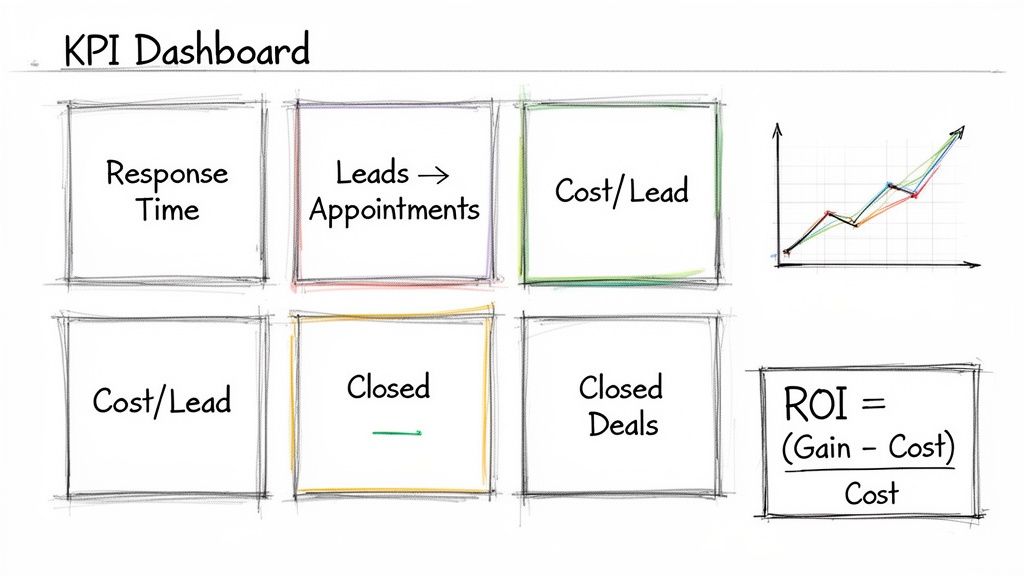
Key Performance Indicators That Actually Matter
Forget about getting lost in a spreadsheet full of confusing data points. For real estate agents, there are only a handful of key performance indicators (KPIs) that truly tell you if your automation is a success. These are the numbers that connect the dots between your software and your bottom line.
Here’s what you should be laser-focused on:
- Lead Response Time: How fast does your system jump on a new lead? A solid automation platform should get this down to under five minutes. That’s the magic window for making a real connection.
- Lead-to-Appointment Conversion Rate: What percentage of leads nurtured by your system end up booking a meeting with you? This tells you if your follow-up campaigns are actually compelling people to take the next step.
- Cost Per Qualified Lead: This number reveals how much you're spending to get a good lead in the door. It helps you figure out if your ad spend and automation are attracting the right crowd or just tire-kickers.
- Deals Attributed to Automation: This is the big one. How many closed deals can you trace directly back to an automated text, email drip campaign, or an instant follow-up?
The goal isn't just to be busy; it's to be profitable. Tracking these specific KPIs helps you prove that your investment in automation is directly contributing to your commission checks, making it easy to justify to yourself or your brokerage.
How to Calculate Your Return on Investment
Calculating your Return on Investment (ROI) is how you make the value of automation real. It turns abstract ideas like "time saved" into a clear dollar amount, and the formula is probably simpler than you think.
Let's walk through a quick, real-world example:
- Your Investment: You spend $300 a month on an automation service that captures and nurtures leads for you.
- The Result: That system books you five extra appointments a month that you likely would have missed otherwise.
- The Closing: You close just one of those five appointments, earning a sweet $9,000 commission.
Now for the fun part. Your profit is your $9,000 commission minus the $300 you spent, which leaves you with $8,700. To get the ROI, you just divide that profit by your initial cost and multiply by 100. In this scenario, your ROI is an incredible 2,900%.
That’s the kind of impact a well-oiled automation strategy can have. And it’s not just a fluke; the data consistently shows that companies get an average of $5.44 back for every $1 invested in marketing automation. It's these kinds of proven financial results that are driving the real estate software market, which was valued at USD 12.86 billion in 2024. If you want to dive deeper into this trend, check out the full real estate software market report on skyquestt.com.
Got Questions About Real Estate Automation?
Jumping into the world of real estate marketing automation software can feel a bit overwhelming. I get it. A lot of agents I talk to wonder if it's going to be too complex, or worse, if it'll make their client interactions feel robotic. These are totally fair questions.
So, let's clear the air and tackle some of the most common things agents ask me. My goal is to give you straight answers, cut through the marketing fluff, and help you see where these tools could actually fit into your business.
Is Marketing Automation Too Complicated for a New Agent?
Not even close—and that’s probably the biggest myth out there. Think of automation as a ladder. You don’t have to teleport to the top rung on day one.
For a brand-new agent, that first step is usually something simple but incredibly powerful. It could be as basic as setting up an instant text-back for any missed calls or website leads. Seriously, that one small tweak is a complete game-changer. It guarantees no lead ever gets that dreaded silence.
The point isn't to become a tech guru overnight. It's about using a simple tool to make sure every single person who reaches out gets an immediate, professional reply. As your business grows, you can start climbing the ladder—maybe adding automated ad campaigns or a system to qualify leads. You start small and build up.
Will Automation Make My Marketing Feel Impersonal?
This is a huge one, especially for agents who build their business on relationships. The answer is a hard no—if you do it right. Good automation is built to amplify your personal connection, not erase it.
Here’s how to think about it: automation handles the frantic, repetitive, time-sensitive stuff so you can jump in faster for the real, human conversations. It’s the perfect assist.
Automation is there to handle the frantic first five minutes so you can deliver the perfect personal touch when it matters most. It’s about being faster, not colder.
For instance, an automated text that says, "Hi [Lead Name], just saw your inquiry on 123 Main St. I'm with a client right now but will call you in about 5 minutes. – [Your Name]" feels anything but robotic. It's fast, it sets an expectation, and it shows you’re on top of things. That's the perfect blend of high-tech efficiency and high-touch service.
How Much Does Real Estate Marketing Automation Cost?
This is always a top question, and the honest answer is: it's all over the map. You can find basic, do-it-yourself tools for a small monthly fee, all the way up to massive, all-in-one platforms that run into the hundreds or thousands.
But the real key is to stop thinking of it as a cost and start seeing it as an investment. The better question is, "What's just one missed deal worth to me?"
If a simple automation system helps you grab and close just one extra deal this year, it has likely paid for itself several times over. The smart move is to find a solution that scales with your business. You can start with a basic plan and add more horsepower as your income grows, ensuring the tool is always putting money back in your pocket.
What Is the Difference Between a CRM and Marketing Automation Software?
This is a fantastic question because these two are often sold together or get confused, but they play very different—and equally important—roles on the same team.
Here's a simple analogy I use all the time:
- Your CRM is your digital filing cabinet. It’s where you store everything you know about your leads, clients, and past deals. It’s the single, organized source of truth for every contact you have.
- Your Marketing Automation Software is the engine that acts on that information. It’s the system that sends the instant texts, runs the long-term email campaigns, and follows up with leads for you.
They work best when they're talking to each other seamlessly. The automation software is the "doer"—it executes the marketing tasks you tell it to. Then, it reports back to the CRM, updating a contact’s file with notes like "Sent welcome text" or "Opened new listing email." This keeps your digital filing cabinet perfectly organized and up-to-date, so you always know exactly where every relationship stands.
Ready to see how a simple, effective automation system can fit into your business without all the complexity? At DB Marketing Co., we offer a clear "ladder" of services designed to grow with you. Whether you just need to ensure every lead gets an instant response or you’re ready for a fully managed lead qualification and appointment booking system, we have a plan that fits. Find out how we can help you close more deals.