

So, what exactly is a real estate lead generation system? It’s basically an automated process built to consistently capture, respond to, nurture, and convert potential clients. This isn't about running a few ads here and there or just waiting for referrals. It’s about creating a predictable, scalable pipeline for your business.
Why Your Old Lead Strategy Is Failing You
Let's be real for a minute. The old way of drumming up real estate leads is a total rollercoaster. If you're relying on referrals and sporadic ads, you know the "feast or famine" cycle all too well. One month, you’re drowning in closings; the next, you're scrambling to find your next deal. This guide is your way off that ride.
We’re not talking about just buying leads. We're building a true real estate lead generation system—a machine that works for you around the clock, putting you back in control of your growth.
The Four Pillars of a Modern Lead System
To get those predictable results, you have to master four key stages: Capture, Respond, Nurture, and Convert. Each step is crucial for turning a stranger on the internet into a happy client. If you let any one of these pillars slide, the whole structure comes crumbling down.
This simple breakdown shows how these pieces fit together to create a smooth journey for every single lead.
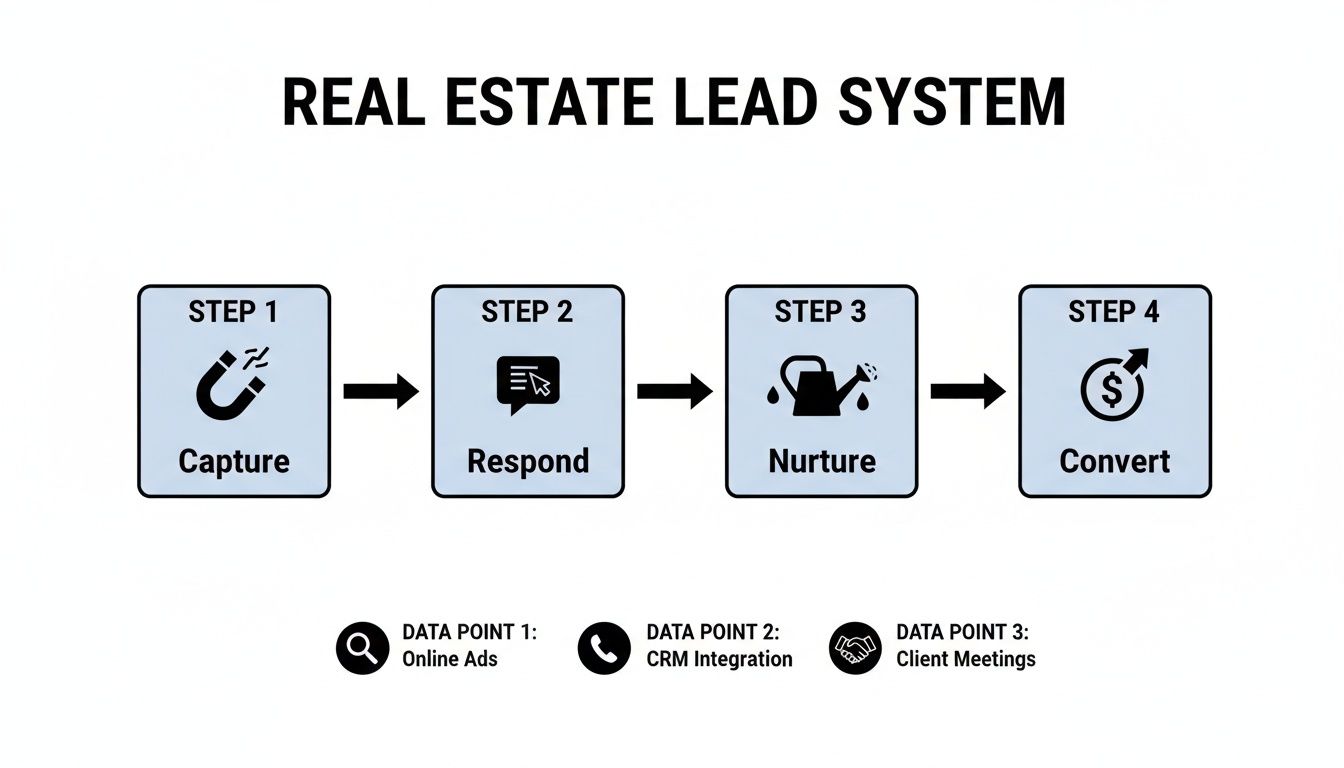
As you can see, a winning system is about more than just getting a name and a phone number. It's about having a solid plan for every interaction that comes after.
To really nail this down, I like to think of it in terms of these four essential pillars. Each one has a specific job to do.
The Four Pillars of a High-Converting Lead System
| Pillar | What It Does | Why It's Critical |
|---|---|---|
| Capture | Grabs a prospect's attention and collects their contact information. | Without a steady flow of new leads, your pipeline dries up. This is the entry point for all future business. |
| Respond | Instantly engages the new lead with an automated text or email. | A lead's interest is highest the moment they inquire. Speed is everything; a slow response kills your chances. |
| Nurture | Follows up with valuable, relevant content over weeks or months. | Most leads aren't ready to transact today. Nurturing builds trust and keeps you top-of-mind until they are. |
| Convert | Moves the lead from conversation to a booked appointment or contract. | This is where you turn your marketing efforts into actual revenue. It’s the final, and most important, step. |
Mastering these four pillars isn't just a good idea—it's the foundation of a modern, scalable real estate business.
What is the Most Important Part of a Lead System?
If there's one place agents consistently drop the ball, it's the response. A lead's interest is white-hot in the first few minutes after they submit their info. If you wait even an hour to follow up, your odds of connecting with them plummet.
The bottom line is that speed wins. A slow response doesn't just look sloppy; it tells a potential client you're either too disorganized or too busy to handle their business. An automated, instant-response is non-negotiable in 2024.
The numbers don't lie. Research shows that leads contacted within 5 minutes of their inquiry are 9 times more likely to convert. On top of that, businesses that automate their lead management see a 10% revenue bump in as little as six months. You can dig into more real estate lead generation statistics to see the full picture.
Whether you're a solo agent trying to get ahead or a team leader aiming for the next level, a systematic approach is the only way to build consistent, scalable growth in this business.
Building the Foundation for Your Lead Machine
Before you even dream of launching that first ad, we need to talk about the engine. You have to build the machine that's going to power your entire lead generation system. Think of it like the plumbing in a new house; if you don’t connect the pipes correctly, any water you pour in is just going to end up on the floor. This foundational tech stack is what turns a random click into a real, organized sales opportunity.
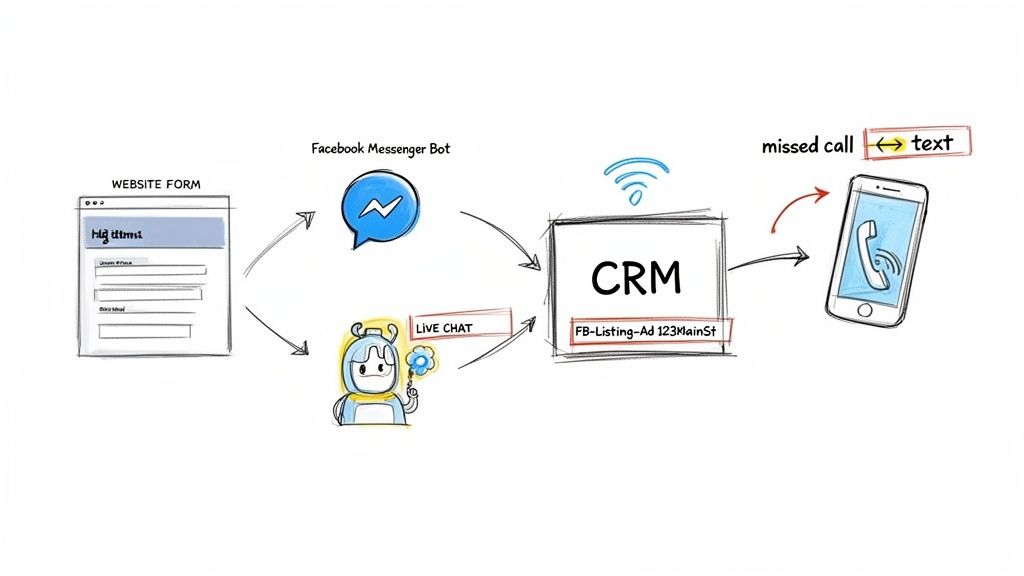
This kind of setup makes sure that no matter how a lead finds you, they slide right into a process built for speed and organization. No cracks for them to fall through.
Where Do You Capture Real Estate Leads?
Look, your website's "Contact Us" form is a start, but it's table stakes. It's nowhere near enough. To build a system that actually churns out leads, you need multiple "front doors" where potential clients can step into your world. The whole idea is to meet people where they already are, making it ridiculously easy for them to raise their hand.
Here are a few channels you absolutely need to have in place:
- Website Live Chat: This is a goldmine for catching visitors who have a quick question but aren't about to fill out a whole form. It's all about immediate engagement.
- Facebook Messenger Bots: When you're running social ads, a Messenger bot can be your best friend. It instantly greets a prospect, asks a couple of qualifying questions, and grabs their contact info right there in the app.
- Automated Missed-Call-to-Text: Let's be real—you can't answer every single call. A service that automatically texts a missed caller something like, "Hi, this is [Your Name]. Saw I missed your call. How can I help?" can save leads that would have otherwise vanished forever.
By setting up more capture points, you're essentially casting a wider net. More nets mean more fish.
Why Is Instant Response So Important?
A lead's interest has an incredibly short shelf life. It's red-hot the moment they hit "submit" and cools off with every minute that ticks by. An instant, automated response isn't just a nice-to-have; it's probably the single most important factor in converting online leads. Period.
Waiting even 30 minutes to reply is often too late. By then, the lead has already moved on, forgotten why they reached out, or—even worse—found another agent who was faster on the draw.
An automated text message that goes out within 60 seconds of a new inquiry can boost your lead conversion rates by over 300%. This isn't about being pushy. It's about being present and helpful the second their motivation is at its peak.
This first, immediate touchpoint confirms you got their message and sets the expectation for what's next. It’s the first handshake, the first step in building trust and showing them you’re a pro who has their act together.
A Real-World Example of an Instant Response
Imagine someone fills out your ad for "Homes in Austin Under $500k." Instead of hearing crickets, their phone buzzes a few seconds later with this text:
"Hey John, it's Alex with ABC Realty. Just got your request for the list of homes in Austin. Sending it over to your email now. Are you looking for a home with a specific number of beds or baths?"
This simple, automated message is brilliant. It accomplishes three things at once:
- Confirms Receipt: It proves their request didn't just disappear into the internet ether.
- Delivers Value: It tells them the info they wanted is on its way.
- Starts a Conversation: It ends with a simple, no-pressure question that invites a reply.
That’s the magic of an automated, but still human-sounding, instant response. You’ve just turned a cold lead into a warm conversation before you’ve even had a chance to pick up the phone.
What Is a Good Real Estate CRM?
A good CRM is the brain of your entire operation. It’s the command center where all your leads live, get organized, and are nurtured over the long haul. There are a ton of options out there, but platforms like Follow Up Boss are popular for a reason—they’re built from the ground up for real estate agents and teams.
But the real secret sauce is integrating your lead capture channels directly into your CRM. This means when a new lead comes in from your Facebook ad or website chat, a contact is instantly and automatically created in your CRM. No more tedious, soul-crushing manual data entry.
This is the automation that lets you scale. It frees you up from being an admin and makes sure no lead ever gets lost in the shuffle.
Better yet, a solid integration lets you automatically tag leads based on where they came from. For instance, a lead from a specific ad could get tagged 'FB-Listing-Ad-123MainSt'. This tagging system is absolutely critical for tracking which marketing campaigns are actually making you money. Without it, you're just guessing.
Let's Get Some Leads: Fueling Your System with High-Performing Ads
Alright, your tech foundation is solid. Now it’s time to open the floodgates and get some buyer leads flowing in. This is where you pour fuel on the fire, and for most agents I know, the best and most affordable fuel comes straight from Facebook and Instagram ads.
Forget any overly complicated campaign structures you might have heard about. You don't need them.
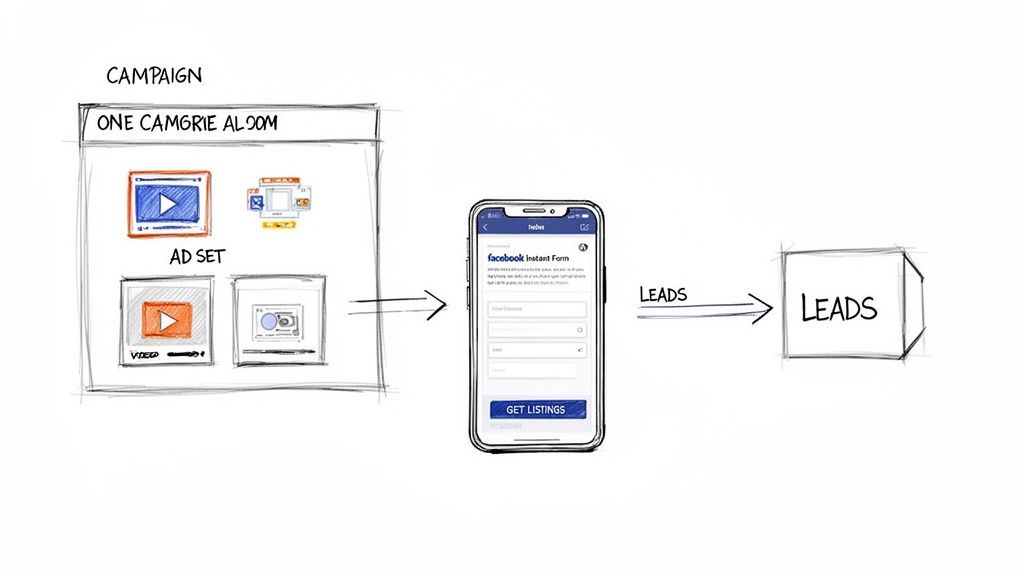
The mission here isn't to become a world-class media buyer. It's to build a simple, effective, and repeatable ad process that consistently feeds your real estate lead generation system.
Our Go-To Campaign Structure
To keep things dead simple and easy to manage, we swear by the "1-1-2" structure.
What does that mean?
- One Campaign: The whole show lives under a single campaign. This keeps your ad account tidy and easy to read.
- One Ad Set: All your targeting and budget settings are in one place. No more hunting around to see what’s working.
- Two Ads: You'll run two different ads using dynamic creative. This is a slick feature that lets Facebook mix and match your images, videos, and headlines to automatically figure out the winning combo for you.
This approach strips away all the unnecessary junk. It lets you test what really connects with your audience without building a dozen different campaigns, making it a breeze to optimize later. We dive into other approaches in our posts on https://dbmarketingco.com/tag/real-estate-lead-generation-strategies/.
Why Are Realtors Still Using Facebook Ads?
Because they work. It's really that simple. An incredible 92% of U.S. realtors use Facebook as their main marketing platform. It's not just a fad.
Even better, 46% say social media is their highest-quality source for leads. NAR's own Technology Survey backs this up, naming social media the top lead-generator at 39%, blowing past CRMs (23%) and even the MLS (17%).
Using Facebook and Instagram ads isn't about following the crowd. It’s about meeting potential clients where they already are, scrolling away on their phones.
Frictionless Lead Capture is the Name of the Game
One of the biggest game-changers for lead gen has been Facebook Instant Forms. These are native forms that pop up right inside the Facebook or Instagram app when someone clicks your ad.
Here's the magic: the user’s information—name, email, and phone number—is usually pre-filled from their profile.
This tiny detail is a massive advantage. It makes the process so easy, it’s almost frictionless. A potential lead can go from seeing your ad to sending you their info in literally two taps, all without leaving the app or pecking out their details on a tiny keyboard. The easier you make it for them, the more leads you'll get. Period.
Writing Ad Copy That Actually Gets Clicks
Your ad copy has one job: get the right person to stop scrolling and tap "Learn More." Generic slogans like "Thinking of buying or selling?" are a waste of money. They just get ignored.
Instead, you need to lead with a specific and compelling offer. Think about what a buyer in your market actually wants right now.
Here are a few hooks that consistently pull in leads:
- "Get the updated list of homes under $500k in Austin."
- "See all the single-story homes with pools for sale in Scottsdale."
- "Just Listed: Tour this 4-bed, 3-bath Denver home with a finished basement."
See how specific those are? They target a real desire and offer an immediate solution. That’s what gets people to act. If you want to get your creative juices flowing, studying some high-converting real estate ad examples is a great way to see what’s working for other top agents.
Choosing Visuals That Stop the Scroll
You’ve got about two seconds to grab someone's attention in their feed. A nice photo of the front of a house is okay, but we can do a lot better.
Here’s what you should be testing:
- Video Tours: A simple walkthrough video shot on your phone feels authentic and grabs attention. You don’t need a professional crew—just a steady hand and some decent light.
- Carousel Ads: Let people swipe through the best 5-7 photos of a property. Always lead with the "money shot"—that stunning kitchen or the incredible backyard view—to get them hooked.
Since you're running two ads in our "1-1-2" structure, this is the perfect chance to A/B test your visuals. Pit a video against a carousel and let the data tell you what your audience really wants to see.
Pro Tip: Your ad creative—the mix of your copy and visuals—is the single biggest lever you can pull to improve your results. If your cost per lead is creeping up, the first thing you should do is test a new image or a different hook in your headline.
The Secret Weapon for Getting Leads to Answer the Phone
Okay, here’s a battle-tested trick that will dramatically increase your contact rate. As soon as a lead hits your CRM, your system needs to fire off an automated two-text sequence.
- Text 1 (Instantly): "Hey John, it's Alex with ABC Realty. Just got your request for the Austin homes list. I'm putting it together for you now and will give you a quick call in about 5 minutes to make sure it's exactly what you're looking for."
- Text 2 (4 minutes later): "Okay, about to call you now."
This little one-two punch works wonders. It pre-frames the call, tells them who you are and why you're calling, and almost guarantees they won't send you to voicemail because they think you're a spammer. It’s a simple but incredibly powerful piece of automation for any real estate lead gen system.
What Happens After the Lead Comes In? The Art of the Handoff
That little notification for a new lead? It feels like a win, but let's be real—it’s just a name and a number until you actually start a conversation. This is where the magic happens, or where it all falls apart. This is the handoff, the moment your system passes the baton to either a smart follow-up sequence or a real person.
How you handle this single moment is what separates leads that turn into commissions from names that just get lost in your CRM.
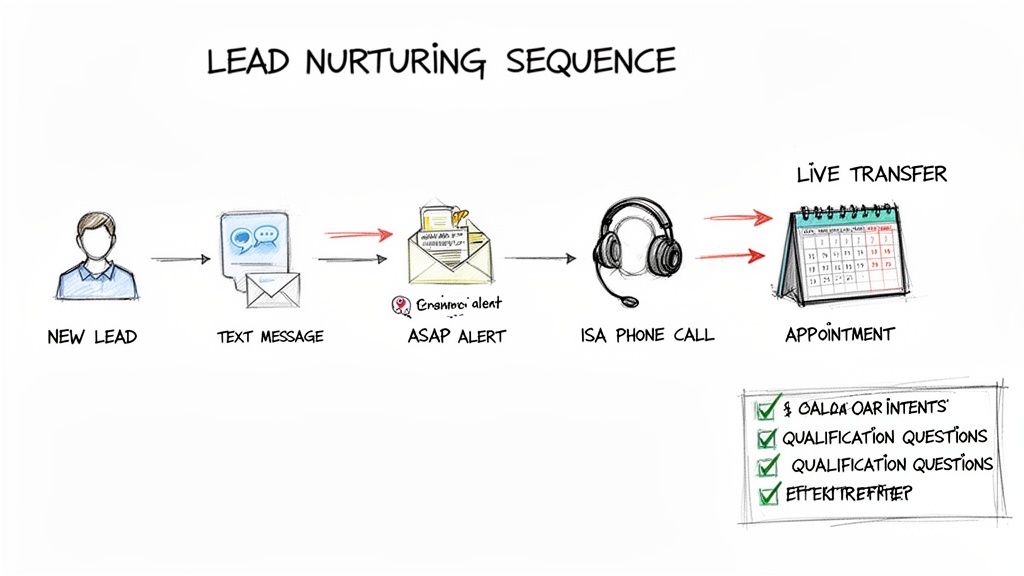
You can have the best ads in the world, but without a solid plan to nurture and track sales leads, you're just lighting money on fire. The follow-up is everything.
Simple Nurturing for the Solo Agent
If you're running your own show, you don't need some beast of a system. You need something simple and automated that works for you while you're out showing homes or sitting at the closing table. Your secret weapon here is a straightforward 5-day text and email sequence.
The goal isn't to be annoying; it’s about being persistent and genuinely helpful.
Here’s a simple flow that just works:
- Day 1 (Immediate): This is the instant text and email we talked about earlier. Get them the home list you promised in your ad, instantly.
- Day 2 (Text): Something casual and low-pressure. "Hey [First Name], just wanted to make sure you got the list of homes. Did any of them catch your eye?"
- Day 3 (Email): Now, add a little value. Send a short email with a helpful tip like, "3 Common Mistakes First-Time Buyers Make in Our Market."
- Day 5 (Text): The final check-in. "Just checking in one last time. Are you free for a quick 10-minute chat this week to talk about your home search?"
This little automated workflow makes sure every single lead gets multiple, valuable touchpoints. No more leads slipping through the cracks because you got busy.
Leveling Up: The ISA Model for Teams
Once you've got a steady stream of leads coming in, bringing on an Inside Sales Agent (ISA) can completely transform your real estate lead generation system. Think of an ISA as a specialist whose entire job is to respond, qualify, and book appointments with new leads.
This one move frees up your agents to focus on what they do best: meeting with truly qualified clients and closing deals.
That first call from the ISA is arguably the most important interaction you’ll have with a new lead. It's the moment you transition from automated messages to a real, human connection.
What Should an ISA Actually Say?
The script for this first call has to be conversational. Ditch the robotic, call-center vibe. The goal is to figure out the lead’s real motivation and timeline without making them feel like they're being interrogated.
Your ISA needs to get answers to these four essential questions:
- "Are you already working with another real estate agent?" This is your knockout question, and you ask it first. If they're committed to someone else, thank them for their time and move on.
- "What has you thinking about making a move?" This gets to the "why" behind their search. Are they just kicking tires, or do they have a serious reason to buy, like a new job or a baby on the way?
- "Have you already spoken with a lender to get pre-approved?" This tells you exactly how serious they are and where they are in the buying journey.
- "Ideally, when would you like to be in your new home?" This nails down their timeline. Is this a 30-day move or a 12-month plan?
These questions give you a complete snapshot of the lead’s readiness. From there, your ISA can tag them properly in the CRM and decide what the very next step should be.
A well-trained ISA isn't just someone making calls; they are the gatekeeper of your agents' time. Their ability to quickly qualify leads and handle common objections is what makes a high-volume lead generation system profitable.
How to Handle the "I'm Just Looking" Brush-Off
Your ISA will hear the same objections day in and day out, and "I'm just looking" is the all-time classic. A rookie hangs up. A pro knows how to reframe the conversation.
Objection: "I'm just looking."
ISA Response: "That's great! Most people are at this stage. My job is just to make your search easier. Are you looking for anything specific, like a certain neighborhood or a home with a big backyard?"
See what happened there? You validate their position, lower their guard, and then gently steer them right back into a productive real estate conversation.
Nailing the Appointment Booking Flow
Once the ISA has a qualified, motivated lead on the phone, the mission is simple: get them on an agent's calendar. This process needs to be absolutely seamless.
- Scheduled Appointments: For leads who are ready to talk but can't do it right now, the ISA should book a consultation directly on an agent's calendar. Using a tool like Calendly is perfect for this—it kills the endless back-and-forth of scheduling.
- Live Transfers: This is the holy grail of lead conversion. If a lead is hot and ready to talk to an agent this very second, the ISA performs a live transfer, connecting them to an available agent on the spot. This creates an incredible client experience and dramatically boosts your chances of turning that lead into a closed deal.
This two-pronged attack ensures that no matter how urgent the lead is, you have a crystal-clear and efficient path to move them forward.
Is Your Lead System Actually Working? The Numbers Don't Lie
Pouring money into ads without tracking what happens next is just gambling. You're basically driving blind, hoping you end up somewhere profitable. A truly effective real estate lead generation system isn't built on guesswork; it's built on cold, hard data.
This means we have to look past the "vanity metrics" that make you feel good but don't actually put money in your pocket. Things like "likes," "shares," and "reach" are nice, but they don't tell you if your marketing is actually working. We need to focus on the numbers that directly connect to your bank account.
The KPIs Every Realtor Needs to Watch
You don't need a complicated dashboard with a million charts. In reality, there are only a handful of numbers you need to obsess over. These key performance indicators (KPIs) tell the full story, from the moment someone clicks your ad to the day you cash the commission check.
- Cost Per Lead (CPL): This is your most fundamental health check. How much are you paying for a single person to give you their contact info?
- Lead-to-Appointment Rate: This number shows how good your follow-up is. Are you successfully turning those leads you paid for into actual, scheduled conversations?
- Appointment-to-Close Rate: This one is all about quality and skill. Of the appointments you set, how many are turning into signed clients?
- Return on Ad Spend (ROAS): This is the big one—the ultimate report card. For every single dollar you spend on ads, how many dollars in GCI are you getting back?
Knowing these four numbers gives you x-ray vision into your entire sales funnel, making it easy to see exactly where things are breaking down.
How to Use KPIs to Spot Problems
Let's walk through a real-world example. You pull up your weekly report and see your Cost Per Lead (CPL) shot up from a comfortable $15 to a painful $30. What happened? This points directly to a problem at the top of your funnel—the ads themselves. It’s time to look at your ad creative, tweak your copy, or refine your audience targeting.
Now, let's flip the script. Imagine your CPL is fantastic, but your Lead-to-Appointment rate has fallen off a cliff.
This is a huge red flag. It tells you the problem isn't your ads; it's what happens after the lead comes in. Maybe your automated text message isn't firing, or your ISA's script has gone stale. Your ads are doing their job perfectly, but the handoff is fumbled.
By isolating the metric that's out of whack, you know precisely where to focus your attention instead of just changing random things and praying for a different result.
To keep things simple, here are the essential KPIs you should be tracking every single week. This discipline allows you to spot trends, fix leaks before they become floods, and make smart, data-driven decisions that consistently grow your business.
Essential Real Estate Lead Generation KPIs
Track these key performance indicators to diagnose the health of your lead generation system and optimize for profitability.
| Metric (KPI) | What It Measures | Industry Benchmark |
|---|---|---|
| Cost Per Lead (CPL) | The direct cost to acquire one new lead from a specific ad campaign. | $10 – $40 for Facebook/Instagram leads, but can vary widely. |
| Lead-to-Appt Rate | The percentage of raw leads that are converted into a scheduled appointment. | A good starting point is 5% – 10%. Elite systems can hit 15%+. |
| Appt-to-Close Rate | The percentage of held appointments that result in a signed client agreement. | Strong agents often see 25% – 50%, depending on lead source. |
| ROAS | The gross commission income generated for every dollar spent on advertising. | Aim for at least 3x – 5x. Anything over 10x is exceptional. |
You don't need a math degree for this. A simple spreadsheet is all you need to get started. By building the habit of tracking these numbers weekly, you’ll quickly develop an intuitive sense for the rhythm of your business and gain total control over your pipeline.
Where Most Agents Go Wrong (And How You Can Get It Right)
Look, even the most perfect-on-paper lead gen system can fall flat. It happens all the time. Building a predictable pipeline of deals isn't a "set it and forget it" thing; it's about avoiding the common traps just as much as it is about picking the right tech. Let's break down the mistakes I see agents make over and over again.
The biggest one? "Shiny object syndrome." We've all been there. You hear about a new CRM on a podcast or see a guru touting a "game-changing" ad strategy, and suddenly you feel the urge to drop everything and switch. While staying curious is great, constantly jumping ship kills all your momentum. The real wins come from consistency.
I'll let you in on a secret: the top producers I know don't have some magic tool. They have a system they've committed to. They stick with it, learn its quirks, and spend months, not days, making it better. A predictable process is the only way to get predictable results.
The Follow-Up Black Hole
So, what's the number one killer of online leads? It's painfully simple: inconsistent follow-up. You get busy with a closing, a lead doesn't pick up the first time you call, and poof—they vanish into the depths of your CRM, never to be seen again. You literally just paid for those leads and then left them in the shopping cart.
The global lead generation market is projected to swell to USD $15.55 billion by 2031. But here's the kicker: only about 21% of leads ever convert to a sale, and a tiny 1.5% actually make it to the closing table. That massive gap is almost always caused by a breakdown in consistent, long-term nurturing. If you want to dive deeper into the numbers, you can explore these real estate lead generation statistics.
The fix is non-negotiable: every single new lead needs to be dropped into an automated follow-up sequence. This is your safety net, ensuring no one falls through the cracks, even on your busiest days.
Forgetting About the "Not Right Now" Crowd
Here’s another critical mistake: having zero plan for the people who aren't ready to move tomorrow. A huge chunk of your leads won't be ready to buy or sell for six, twelve, or even eighteen months. If your entire follow-up strategy is front-loaded into the first week, you're walking away from the majority of your future business.
Here's how you sidestep that landmine:
- Split Your Database: Right away, create lists for your "hot" leads (ready in the next 0-90 days) and your "long-term nurture" leads (everyone else).
- Automate Monthly Value: Set up a dead-simple automated monthly email with something genuinely useful, like a local market snapshot or a seasonal home maintenance checklist. It keeps your name in their inbox without being annoying.
- Schedule Quarterly Check-ins: For that long-term list, set a recurring task to personally text or call them once a quarter. No sales pitch. Just a simple, "Hey, just checking in to see how things are going."
Your CRM is a Mess
Finally, messy data will quietly sabotage your entire operation. If you're not tagging leads correctly the second they come in, you'll have no clue which ad campaigns are actually making you money and which ones are just burning cash. A disorganized CRM is like trying to read a report card that's been through a paper shredder.
The solution is straightforward but requires discipline from day one. Set up ironclad tagging rules. Every lead must be automatically tagged with its source (e.g., 'FB-Austin-Homes-Ad') and its current status (e.g., 'Nurture,' 'Appointment-Set'). This one habit transforms your CRM from a glorified address book into a powerful tool that tells you exactly what's working in your business.
Still Have Questions? Here's What Most Agents Ask
Jumping into building a lead generation system from scratch always brings up a few common "what ifs" and "how to's." Let's tackle the questions I hear most often from agents who are right where you are now.
How Much Should I Actually Spend on Ads?
When you're just starting out, a safe and effective budget is somewhere in the $15-$25 per day range. You don't need to break the bank.
This amount is the sweet spot—it’s enough to get your ads seen by enough people to start learning what works, but it won't have you stressing over a huge initial investment. Keep a close eye on your Cost Per Lead (CPL). Once you see that you're getting a solid return, you can feel confident turning up the dial on your ad spend.
What’s the One Thing I Absolutely Can’t Mess Up?
If you only get one thing right, make it speed of follow-up. It's everything.
A lead's interest is white-hot for the first five minutes after they hit "submit." An automated, instant text message and email is the single most powerful tool you have to turn a name on a screen into a real conversation. Without that immediate engagement, even the most perfect ads will go to waste.
The hard truth is, if you're not the first agent to respond, you've probably already lost. A lead who has to wait even five minutes has likely already heard from a competitor or just moved on.
Should I Go After Buyer or Seller Leads First?
For agents building their first system, I almost always recommend starting with buyer leads. Here’s why: they are typically cheaper and easier to generate online, especially on platforms like Facebook and Instagram.
This gives you a higher volume of leads to work with, allowing you to dial in your follow-up and conversion process. Once you’ve built a well-oiled machine for buyers, you can take everything you've learned and apply those same principles to the more competitive (and expensive) world of seller leads.
How Long Does This Take to Actually Work?
You'll see fresh leads hitting your inbox within 24-48 hours of launching a campaign. That part is fast.
But turning those leads into commission checks is a marathon, not a sprint. Realistically, you should expect to see your first appointments being set within a week or two. The first closings from those leads? Plan on 90-120 days, give or take, depending on the typical sales cycle in your market. It's all about consistency—that's what builds a predictable pipeline.
Ready to build a lead system that brings in predictable business without all the trial and error? DB Marketing Co. specializes in creating and managing the exact systems we've detailed here—from instant response automation to fully managed ISA services. Learn how we can help you scale.