

When we talk about real estate agent lead generation, we're really talking about building a machine. It’s a predictable system designed to find and grab the attention of potential home buyers and sellers. The goal is to finally get off the referral rollercoaster and create a reliable stream of new business through your website, social media, and smart follow-up.
Building a Lead Generation System That Actually Works
Let's be real—constantly chasing down your next deal is draining. It’s time to stop hunting for leads and start building a system that brings them right to you. A powerful lead generation machine isn't about having a huge budget; it’s about having a smart strategy that uses today's tools to your advantage.
The whole idea is to create a digital safety net that catches every single prospect, no matter where they come from. By automating the grunt work, you get to spend your time on what truly matters: talking to clients and closing deals.
What Is a Lead Capture System?
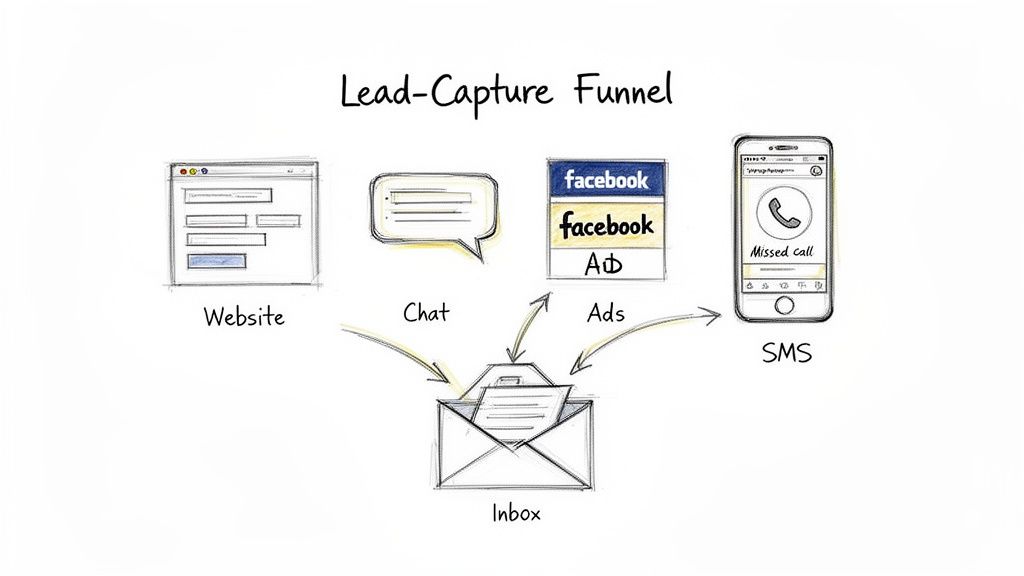
Think of a lead capture system as the different ways you collect a prospect's contact info. It's your digital storefront. This could be as simple as a form on your website or as direct as a lead ad on Instagram.
The best systems don't rely on just one method. They use multiple capture points to meet people where they're at, making sure you never miss out on a good lead just because they prefer chat over a phone call.
Every agent should have these four capture points working for them:
- Smart Website Forms: Don't just stick a "Contact Us" form on your site and call it a day. Offer real value, like a downloadable neighborhood guide or a free home valuation, in exchange for their name, email, and phone number.
- Live Chat: This gives website visitors an instant way to get their questions answered. It’s a low-pressure way for you to start a conversation and capture their details.
- Facebook & Instagram Instant Forms: Honestly, these are a game-changer. They pre-fill a user's information, so they can send you their details with just a couple of taps, all without leaving the app. The conversion rates are fantastic.
- Missed-Call Text-Backs: This simple automation is incredibly effective. When you can't get to the phone, an automatic text goes out, engaging the caller immediately and letting them know you'll be in touch. It shows you're on top of your game.
This diagram breaks down how a lead flows from that initial capture point into your automated system.
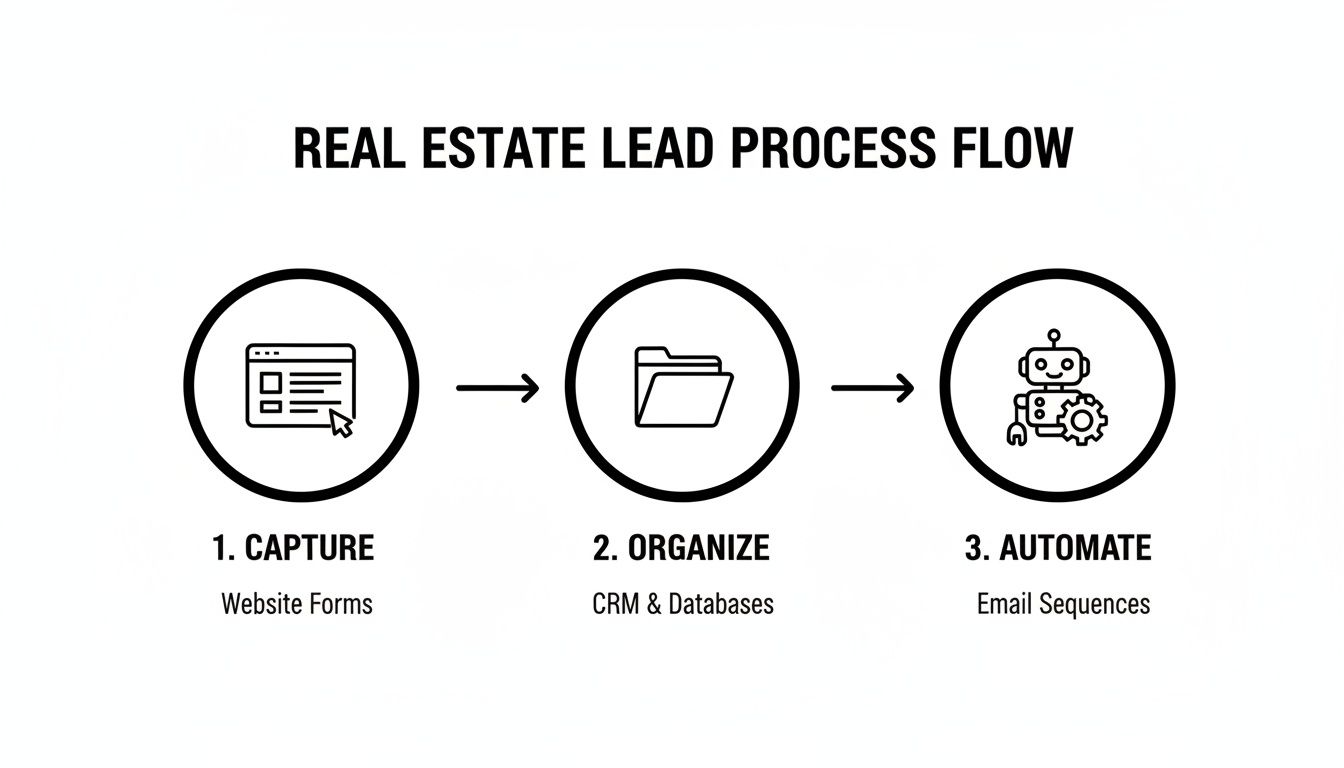
This is how you turn casual interest into organized, actionable opportunities you can actually work with.
Can I Build This on a Small Budget?
Yes, absolutely. This is the number one question I get from agents, and the answer is you don't need a massive war chest to make this work. A recent survey found that 63.7% of realtors spend less than $1,000 per month on all their marketing and lead gen.
That stat really shines a light on how most agents are bootstrapping their businesses. And while it proves success is possible on a tight budget, it also hints at a bigger problem. To stretch those dollars, it's critical to understand the full range of real estate marketing materials available.
The same study showed 63.8% of agents try to do everything themselves to save money, which inevitably leads to burnout from manually sifting through unqualified leads. This is exactly why an automated system is such a smart investment.
The secret isn't spending more money—it's spending the money you have more intelligently. An automated capture and response system often costs less than a couple of print ads but delivers a much bigger, and completely trackable, return.
The Power of Instant Follow-Up and Automation
In real estate, speed isn't just a nice-to-have—it's everything. A lead who has to wait for you to get back to them is a lead you’re probably going to lose. It’s that simple.
Think about it from their perspective. When someone fills out a form on your website or Zillow, they're at their absolute peak of interest. That interest starts to fade with every minute that ticks by. This is where a killer automated response system becomes your secret weapon, letting you engage prospects the second they reach out.
I'm not talking about some cold, robotic "Thanks for your inquiry" message. This is about setting up a series of natural-sounding texts and emails that start building a real connection for you, 24/7.
Why Speed Is Your Unfair Advantage
The numbers are pretty staggering. Study after study shows that agents who respond to a new lead within five minutes have a massively higher chance of converting them. In fact, some data suggests that 78% of buyers work with the very first agent they speak to.
When a potential buyer or seller hits "submit," they aren't just contacting you; they're likely reaching out to a handful of agents. The first one who sends a helpful, personal message immediately gets framed as the proactive expert. Waiting even an hour can mean the difference between booking a meeting and getting that dreaded "Thanks, but I'm already working with someone" text.
Crafting the Perfect First Touch
That first automated message is your digital handshake—it sets the tone for everything that follows. The goal is to feel personal, set expectations, and get a real conversation started. Ditch the generic templates and create something that sounds like you just whipped out your phone and typed it yourself.
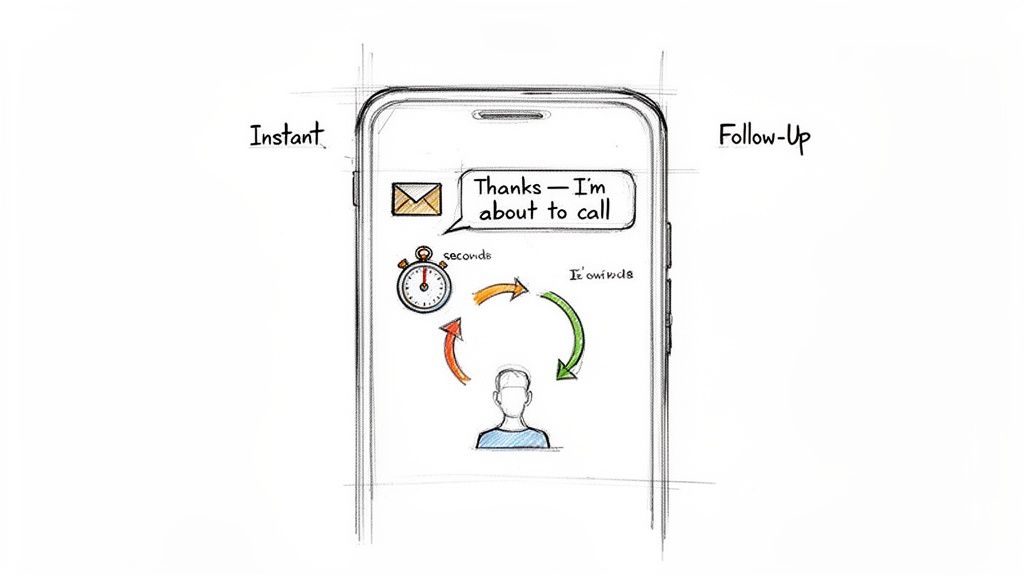
One of the most powerful moves I've seen is the "I'm about to call" text. As soon as a lead hits your CRM, an automation should fire off a text that goes something like this:
"Hey [First Name], this is [Your Name]. Just got your info from my website. I'm wrapping something up right now, but I'll give you a quick call in about 5-10 minutes to chat about [Property Address/Neighborhood]. Talk soon!"
This little message is pure gold. It does three critical things:
- It instantly confirms you got their request (huge peace of mind for them).
- It introduces you by name, so the incoming call doesn't look like spam.
- It sets a clear expectation for when you’ll call, making them way more likely to actually pick up the phone.
Here's a breakdown of common lead sources and the optimal automated first response to maximize engagement.
Effective Automated Responses for Common Lead Sources
| Lead Source | Automated Action | Why It Works |
|---|---|---|
| Website "Contact Us" Form | Instant "I'm about to call" text, followed by a personal email with your vCard. | The text preps them for your call, and the vCard makes it easy to save your contact info. |
| Facebook/IG Lead Ad | Instant text referencing the ad: "Hey [First Name], just saw you were interested in the list of homes under $500k from our Facebook ad. I'll call you in 5 to see if I can help." | It directly connects your response to their action, which feels relevant and immediate. |
| Zillow/Realtor.com | Immediate text and email confirming receipt and asking a simple, open-ended question like, "What about that property on 123 Main St. caught your eye?" | It moves beyond a simple confirmation and encourages them to start a dialogue right away. |
| Missed Call/Voicemail | Automated text: "Hi, this is [Your Name]. Sorry I missed your call! I'm with a client but will call you back as soon as I'm free. What was your call regarding?" | It shows you're responsive even when busy and gives them a low-friction way to tell you what they need. |
Pairing the right message with the right source makes your automation feel less like a machine and more like a highly efficient assistant.
Building an Automated Follow-Up Sequence
A single text is great, but it’s not a full strategy. You need a well-thought-out sequence to nurture that lead over the first few hours and days, gathering info and keeping your name top-of-mind. The best sequences mix texts and emails, with each message serving a clear purpose.
Here’s a sample flow you can steal and adapt:
- Instant Text: The "I'm about to call" message we just covered.
- Follow-up Call: You (or an ISA) make the promised call.
- Post-Call Email (If you connect): Send a quick recap of your chat, including any links or info you promised.
- "Sorry I Missed You" Text (If no answer): If they don't pick up, an auto-text goes out. "Hey [First Name], tried calling but looks like you were busy. No worries! When's a better time to connect for a few minutes?"
- Value-Add Email (Day 2): Send something genuinely helpful. Think a neighborhood guide, a list of similar homes, or a great blog post about the buying process.
- Check-in Text (Day 3): Keep it simple and low-pressure. "Morning, [First Name]! Just wanted to see if you had any questions about the info I sent over yesterday."
This multi-touch approach keeps you on their radar without being annoying. Every message feels helpful and gives them an easy way to reply when they’re ready. To get more ideas on building out your campaigns, check out our guide on other effective real estate lead generation strategies that work perfectly with a solid follow-up system.
Combining lightning-fast speed with smart, human-sounding automation is how you warm up leads for a real conversation. It will dramatically boost your connection rates and, ultimately, help you turn more of those expensive inquiries into closed deals.
Using Social Media to Turn on a Faucet of Buyer Leads
If you’re just boosting posts on Facebook and calling it a day, you’re missing the plot. Seriously, you're leaving a massive pile of commission checks on the table. It's time to stop treating Facebook and Instagram like digital billboards and start using them for what they are: powerful lead-generation machines.
A well-built ad campaign isn't about getting likes; it's about creating a predictable, steady stream of buyer leads flowing straight into your CRM. The trick is to stop thinking about brand awareness and go all-in on direct-response ads that actually capture contact info. The absolute best tool for this? Facebook and Instagram's Instant Forms. They are a total game-changer.
Why You Should Be Obsessed with Instant Forms
So, what are Instant Forms? They're basically little forms that pop up right inside the Facebook or Instagram app when someone clicks your ad. The magic is that they come pre-filled with the person's name, email, and phone number straight from their profile.
Think about that for a second. With just two taps, they can send you their details. No more kicking them out of the app to a clunky, slow-loading website where they have to manually type everything on their phone. You're removing all the friction, and that's how you get your conversion rates to skyrocket.
The Simple Two-Ad Campaign That Crushes It
Running just one ad is a rookie mistake. People get sick of seeing it, your results tank, and you start thinking "Facebook ads don't work." A much smarter way to play the game is to always have a simple two-ad campaign running.
Here’s the setup I use:
- Ad #1: The Performer. This is your proven winner, your control. It's the ad that’s bringing in leads at a cost you're happy with. You let this one run as long as it's doing its job.
- Ad #2: The Challenger. This is your test. You duplicate your Performer and change just one thing—maybe a new picture, a different headline, or tweaked ad copy. The goal is to find something that beats your best ad.
If the Challenger outperforms the Performer for a solid week, it graduates. It becomes the new Performer. You then turn off the old one and create a brand new Challenger to test against it. This constant A/B testing is how you keep sharpening your edge and lowering your lead cost over time.
I always get asked, "How much do I need to spend?" You don't need a crazy budget. Honestly, even $15-$20 per day is enough to get a consistent trickle of leads, test your ads, and start building some real momentum.
Zeroing In on Motivated Buyers
The real power of social media ads is the targeting. You can get laser-focused and put your message right in front of the people who are most likely ready to make a move.
For a buyer campaign, I start by drawing a 15-mile radius around my main city. Then, the fun begins. You layer on interests to find people who are practically raising their hands. Target users who've shown interest in:
- The Big Portals: Think Zillow, Trulia, and Realtor.com.
- Mortgage Stuff: People looking into "mortgage loans," "pre-qualification," or playing with "mortgage calculators."
- Big Life Moments: Facebook’s "likely to move" category can be pure gold.
This makes sure your budget is spent on people who are actually in the market, not just everyone in your zip code.
It’s no wonder a staggering 92% of U.S. realtors are on Facebook. The platform just works for real estate, with 46% of agents saying social media is their best source for high-quality leads. But here’s the catch: success depends on being fast. Getting in touch with a new lead within five minutes can make or break the deal. That's why pairing these powerful ads with the instant, automated follow-up we talked about is the secret to turning those leads into closings. If you want to dive deeper, you can check out more eye-opening realtor marketing statistics.
How to Craft Ads That People Actually Click
Your ad creative is everything. It’s what has to grab someone’s attention and stop their thumb from scrolling. You need two things: a scroll-stopping visual and copy that makes an irresistible offer.
For visuals, pretty house pictures are fine, but video is king. A simple slideshow video showcasing "The Top 5 Most Affordable Homes in [Your City] This Week" can absolutely kill it.
When it comes to the words, focus on the hook. What are you giving them in exchange for their info? Don't be generic. "Contact me to find your dream home" is a guaranteed way to be ignored. Instead, get specific and offer real value:
- "Get a free list of every home in [City] with a pool for under $600k."
- "Download our complete First-Time Homebuyer's Guide to the [Neighborhood] area."
- "Want to see the 10 best deals on the market right now? Drop your email."
This is how you shift from passively "being on social media" to actively running a predictable, scalable lead-generation engine for your business.
How to Actually Organize Your Leads with a Smart CRM
Getting a flood of new leads feels incredible, right? But that high-five moment can quickly turn into chaos. Without a central hub to track everything, you're running your business on a prayer, a spreadsheet, and a pile of sticky notes. This is exactly why a good Customer Relationship Management (CRM) system needs to be the brain of your entire operation.
Think of a smart CRM as your command center. It's not just a digital Rolodex; it's a living, breathing picture of your sales pipeline. The whole point is to turn that messy jumble of names and numbers into an organized, actionable list you can actually work through.
Kiss Manual Data Entry Goodbye
Seriously, how much of your day is wasted copying and pasting lead info from one place to another? A modern lead system should automatically zap every new prospect—from your website, a Facebook ad, Zillow, you name it—straight into your CRM.
This one simple piece of automation saves you hours of soul-crushing work. More importantly, it kills the risk of human error. No more typos in an email address or forgetting to log a call. Everything is captured the second it happens, so you can spend your time having conversations, not doing data entry.
So, How Should I Tag My Leads in the CRM?
This is where your CRM goes from being a simple database to a powerful intelligence tool. Tagging is how you bring order to the madness. When it’s automated, you can slice and dice every lead the moment they arrive, giving you instant context without having to read a novel's worth of notes.
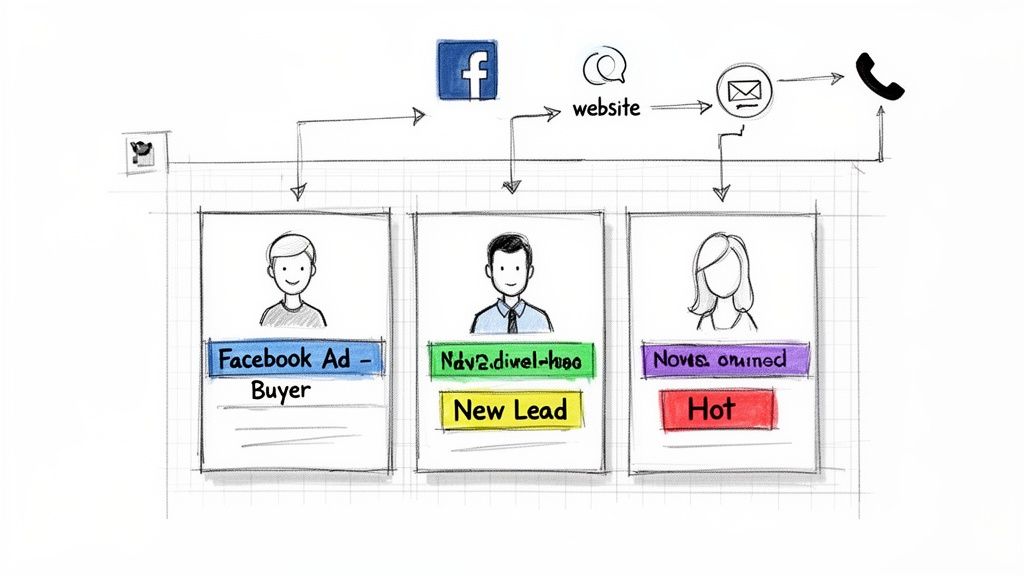
I get this question all the time, and my answer is always the same: keep it simple but make it powerful. Your tags should tell you three things at a glance:
- Source: Where did they come from? You need to know this to track your marketing ROI.
- Status: Where are they in your pipeline? This shows you who needs your attention right now.
- Intent: What are they after? This helps you frame the very first conversation.
Using this simple framework, you can build a clean, organized pipeline that gives you a true bird's-eye view of your business.
A Practical Tagging System You Can Steal
Let’s make this real. Imagine a new lead comes in from a Facebook ad you're running for a "Homes with Pools" list. Here’s how an automated tagging workflow would instantly sort them out:
-
Source Tag:
Facebook Ad - Pool Homes- Right away, you know exactly which campaign brought them in. If you see this tag popping up a lot, you know that ad is working and it might be time to put more money behind it.
-
Status Tag:
New Lead- Simple but crucial. This tag drops the lead into a bucket for immediate follow-up. Your daily workflow can be as easy as, "Okay, let's clear out all the 'New Lead' tags."
-
Intent Tag:
Buyer- This immediately tells you what they're looking for. When you call, you can skip the awkward "Are you looking to buy or sell?" and jump right into a relevant conversation about what they need.
This combination—Facebook Ad - Pool Homes, New Lead, Buyer—tells you the lead's entire story in a split second.
By automatically tagging every single lead, you turn your CRM from a passive list of contacts into an active, strategic weapon. You'll know exactly where your best business is coming from, who to call next, and what's actually working.
This level of organization is the absolute foundation for scaling. It means that as your lead volume grows, your ability to handle it effectively grows right along with it. No one falls through the cracks, and every opportunity gets the attention it deserves.
When to Scale with an Inside Sales Agent (ISA)
If you've followed this playbook, you'll eventually run into a great problem: too many leads. Your phone buzzes constantly, your inbox is overflowing, and you feel that nagging pressure to respond to everyone right now. This is the ceiling. It’s the point where your personal bandwidth is the only thing holding your business back.
This is exactly when you bring in an Inside Sales Agent, or ISA.
Think of an ISA as a specialist who breaks that ceiling for you. They’re trained to handle the critical, time-sucking first steps of lead engagement. They take over the initial calls, texts, and qualification grind, freeing you up to do what you do best—meet with serious clients, show homes, and close deals.
What's the Tipping Point for Hiring an ISA?
So, how do you know it's really time? Forget a magic number. The real signal is that feeling of being perpetually behind.
If you’re consistently pulling in 10-15 new leads a day and you know deep down that some are slipping through the cracks, you’re there. You've hit the tipping point.
Another dead giveaway is when follow-up starts feeling like a chore instead of an opportunity. You know you need to call that new lead back, but you're in the middle of an inspection or scrambling to write up an offer. An ISA’s entire job is to give every single lead the immediate attention they need to convert.
Building a Seamless ISA Workflow
The dream here is a smooth, hands-off process. A lead comes in from an ad, the ISA works their magic, and a qualified appointment just… appears on your calendar.
Here’s what that actually looks like:
- Instant Hand-off: A new lead from Facebook hits your CRM, and the ISA is immediately notified.
- Rapid Engagement: Within minutes, the ISA is on it—calling, texting, and following a proven script to make contact.
- Sorting and Sifting: They ask the right questions to figure out motivation, timeline, and financial readiness.
- Booking the Win: If the lead checks out, the ISA books a consultation directly onto your calendar, working around your availability.
- Context is King: They update the lead’s profile in the CRM with detailed notes, so you walk into every call fully prepared.
This system transforms the chaotic firehose of leads into an organized line of people who are actually ready to talk business.
Key Qualifying Questions Every ISA Should Ask
A good ISA doesn't just dial numbers; they filter. Their job is to protect your most valuable asset—your time—by weeding out the tire-kickers from the truly motivated movers.
An effective ISA ensures you only spend your energy on conversations that have a real shot at ending with a commission check.
Their script needs to be conversational but surgical, quickly getting answers to these core questions:
- The "Why": "So, what's prompting the move?" This gets straight to their motivation.
- The "When": "In a perfect world, when would you like to be in your new home?" This separates the 'now' buyers from the 'someday' dreamers.
- The "How": "Have you had a chance to connect with a lender yet?" It’s a polite, professional way to gauge if they're financially ready.
- The "Who": "Are you currently under contract with another real estate agent?" This is a non-negotiable question to make sure you're not stepping on anyone's toes.
Getting these answers is what turns a name and number into a genuine, qualified opportunity.
The Power of a Live Transfer for Hot Leads
Every so often, you get a lead who is ready to go right now. For these moments, the live transfer is your secret weapon.
Here’s the play: The ISA is on the phone with a red-hot, fully qualified lead. Instead of booking a meeting for tomorrow, they ask, "My agent partner actually has a few minutes free right now. Would you like me to connect you?"
If they say yes, boom—the ISA patches the call directly to you. This move is pure gold. It capitalizes on motivation when it's at its absolute peak and can slash the time from lead to client. For high-intent leads, it's often the play that seals the deal.
As you grow, you might even find that a dedicated lead prospector virtual assistant is a smart way to handle this critical function without adding full-time staff.
Bringing an ISA into your world is the final piece of the puzzle. It’s what makes a lead generation system truly automated and scalable, allowing you to build a business that isn’t limited by the number of hours you have in a day.
Your Top Questions, Answered
Jumping into a real system for real estate agent lead generation always stirs up a few questions. Building a machine that works for you is a journey, not a flip of a switch, so let's tackle the big ones I hear from agents all the time.
How Much Should I Spend on Ads to Start?
This is, without a doubt, the number one question. And the answer is probably less than you think. You don’t need to mortgage your house to get this thing off the ground. In fact, starting small is the only way to go.
I always recommend starting a buyer lead campaign on Facebook or Instagram with $15 to $20 per day. That’s it.
This gives you just enough budget to get a steady trickle of new leads. More importantly, it gives you priceless data on which ads, images, and offers are actually resonating in your local market. You get to test and learn without a ton of risk.
Key takeaway: The goal isn't to outspend everyone. It's to spend smarter. Once you find a winning ad that reliably brings in leads at a good cost, that's when you hit the gas and scale the budget.
Should I Just Buy Leads Instead?
Buying leads from the big portals can feel like a tempting shortcut. For a brand new agent, it can seem like the fastest way to get the phone to ring. But you have to know what you’re really buying into.
Those leads are almost always sold to a handful of other agents. This kicks off a frantic, speed-to-lead race where the first person to call usually wins. It's a tough, high-pressure game.
Building your own lead generation machine gives you the ultimate unfair advantage: exclusivity.
Every single lead that comes from your ads and your website is yours and yours alone. They reached out to you because of your brand and your message, which makes them way warmer and easier to connect with.
What’s More Important: The Leads or a Good CRM?
That’s like asking what’s more important in a car, the gas or the engine? You can't get anywhere without both.
Think of it this way: a flood of new leads with no CRM to manage them is pure chaos. You'll lose track of people in a heartbeat. On the flip side, the world's most perfect CRM with no leads flowing in is just a really expensive, empty spreadsheet.
Your lead generation (the ads) is the fuel. Your CRM is the engine that turns that fuel into organized, nurtured, and closed deals. They are a team. Set them both up from day one, and you'll build a system that doesn't let a single opportunity slip through the cracks.
Ready to stop chasing leads and start building a predictable system that actually closes deals? At DB Marketing Co., we build the exact systems we talk about in this guide, from automated follow-up to having our trained ISAs qualify and book appointments for you. See how we can help you grow.