

Real estate lead generation software is your secret weapon for automatically capturing, engaging, and organizing potential clients. Think of it this way: instead of manually chasing down every website click or social media message, these tools build a system so no opportunity ever slips through the cracks. This frees you up to focus on what you do best—closing deals.
Choosing the Right Real Estate Lead Generation Software
Let's be real for a second. The market for real estate software is incredibly noisy and, frankly, overwhelming. The trick isn't to find the platform with the longest feature list; it's to find one that solves your most immediate problems while giving you room to grow.
Are you a solo agent who can't possibly respond to every inquiry the second it comes in? Or maybe you're a team lead trying to standardize how new leads get assigned and followed up with. The best approach is to map your daily headaches to specific software solutions. That’s how you find a system that genuinely makes your life easier and your business more profitable.
What Exactly Is This Software?
At its heart, lead generation software is a system that automates those critical first few touchpoints with a potential client. It acts like a digital front desk that’s on duty 24/7, making sure you catch every single buyer or seller who shows interest.
But this is way more than just a fancy contact form on your website. Modern tools work across all the channels where your clients are actually hanging out:
- Website Forms: Instantly engage visitors who fill out a "more info" request.
- Live Chat: Answer questions on the spot and grab their contact details in real-time.
- Social Media: Pull leads directly from Facebook and Instagram ads or direct messages.
- Missed Calls: Automatically send a human-sounding text back so a warm call never goes cold.
The explosion of these tools points to a massive shift in how real estate works. The global lead capture software market is expected to hit a staggering USD 5.69 billion by 2035. This huge growth is being fueled by agents who are tired of manual follow-up and are embracing automation to get ahead.
What Features Actually Matter?
It's easy to get distracted by flashy bells and whistles that you'll never use. Instead, focus on the features that solve the biggest daily headaches for an agent. The absolute must-haves are seamless CRM integration, the ability to capture leads from multiple channels, and automated follow-ups that sound personal, not like a robot wrote them. When you're looking, it's also smart to check out specialized tools like the best AI receptionist for real estate agents, which are built specifically for our industry's unique needs.
The goal isn't just to collect names and numbers. It's to start a conversation the moment someone shows interest. In real estate, the first agent to respond is almost always the one who gets the business.
When you nail it, the right software becomes a true extension of your business, making sure every single lead gets a prompt, professional response. If you're weighing your options, our guide on the top real estate lead generation companies breaks down some of the best players out there.
Essential Features for Different Agent Levels
Your needs change as your business grows. A solo agent doesn't need the same complex system as a high-volume brokerage. This table breaks down the must-have features based on where you are in your career.
| Feature | Solo Agent | Growing Team | High-Volume Brokerage |
|---|---|---|---|
| CRM Integration | Must-Have (e.g., Follow Up Boss) | Must-Have (with lead routing) | Critical (with custom fields & API access) |
| Multi-Channel Capture | Must-Have (Website, Social) | Must-Have (All channels + Zillow, etc.) | Critical (All channels + direct mail, portal integrations) |
| Automated Workflows | Recommended (Basic texts/emails) | Must-Have (For assignment & nurturing) | Critical (Advanced, multi-step campaigns) |
| Instant Response | Must-Have | Must-Have | Critical |
| Reporting/Analytics | Basic (Lead source tracking) | Recommended (Team performance metrics) | Critical (ROI, conversion rates, forecasting) |
| ISA/Assistant Handoff | Nice-to-Have | Recommended (Automated notifications) | Must-Have (Seamless task/lead transfer) |
Choosing the right features from the start saves you from the painful process of migrating systems down the road. Use this as a guide to focus on what will deliver the most value for your business right now.
Building Your Instant Response System
In real estate, speed isn't just a goal; it's the whole game. I’ve seen it a thousand times: the agent who responds first gets the business. If a lead waits even 30 minutes, they’ve probably already connected with someone else. This is why you need an instant response machine working for you around the clock.
The idea is to build a system that never sleeps, ensuring every single person who reaches out gets an immediate, human-sounding reply. This isn't just about grabbing a name and number. It's about starting a conversation and building rapport before your competition even gets the notification.
So, What Exactly Is An Instant Response System?
Think of it as an automated workflow that connects your lead sources—like your website or Zillow—directly to your phone. When a new lead comes in from any channel, it automatically triggers a personalized message via text or email.
Here’s what this looks like in the real world:
- A buyer fills out a form on your website and their phone buzzes a second later: "Hey [Name], thanks for reaching out about [Property Address]. I'm just wrapping up with a client, but are you free for a quick call in 15 minutes?"
- A missed call from an unknown number triggers an immediate text back: "Hi, this is [Your Name]. Sorry I missed your call! How can I help?"
- A lead from a Facebook Ad gets an instant email with the property info they wanted, followed by a text asking when a good time to chat would be.
This system guarantees no lead ever feels ignored. Right from the first touchpoint, you've positioned yourself as the agent who is on top of their game.
This simple diagram breaks down how to think about finding the right tools. It's all about matching your biggest headaches to the specific software features that solve them.
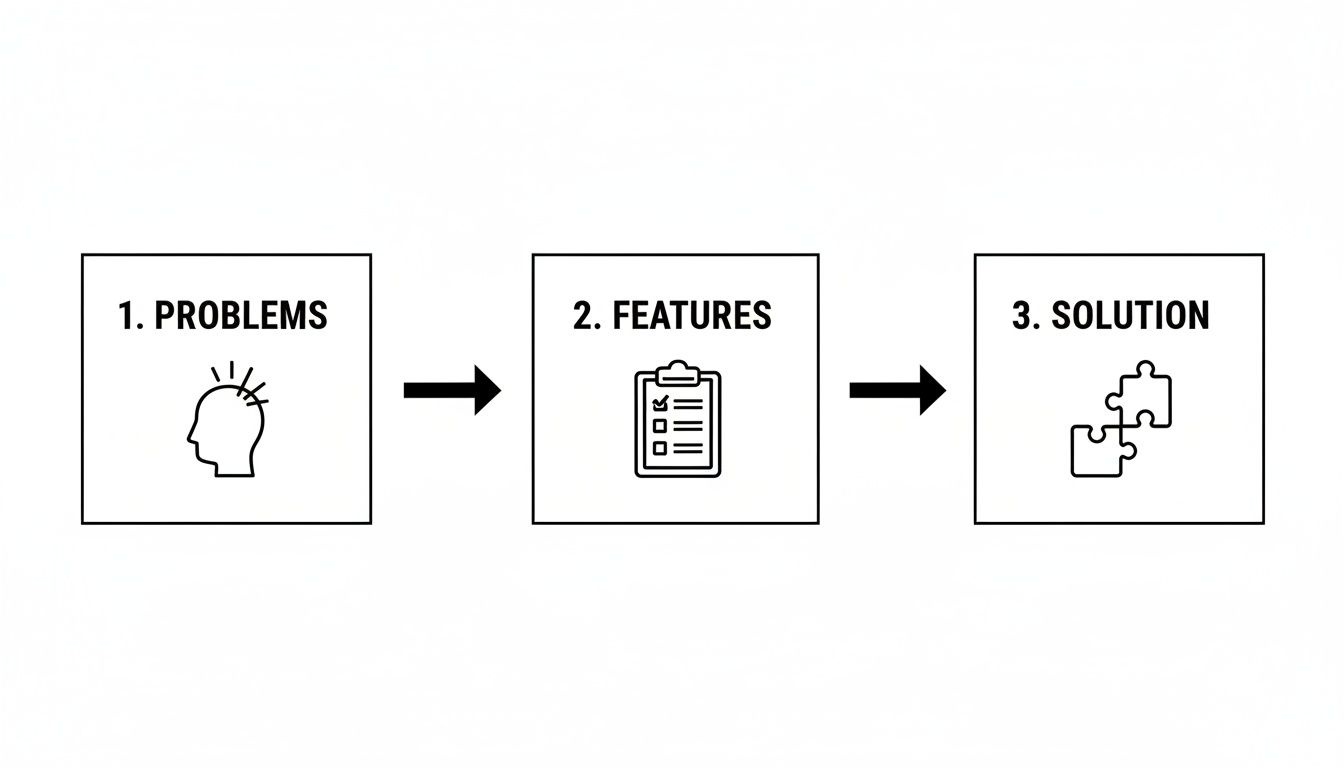
As you can see, the process isn't about finding the fanciest software. It's about finding the one that directly fixes what's broken in your current process.
How Do I Actually Set This Up?
Getting this running is easier than you think. Most modern lead generation software for real estate comes with built-in automation or workflow builders. The first step is to connect your lead sources—your website, Zillow, Facebook Lead Ads, you name it—directly into the software.
From there, you just create simple "if this, then that" rules. For example, the "if" (or trigger) might be "New lead from Facebook." The "then" (the action) would be "Send SMS Template #1."
My biggest tip: Your first text should always ask a simple, open-ended question. The goal is to get a reply, not to sell them a house in the first 160 characters. A question like, "Are you looking to move in the next 3 months?" works so much better than a long-winded introduction.
What Should That First Message Say?
That initial automated text is your digital handshake. You want to be helpful and make it easy for them to reply.
Here are a few questions I've seen work really well to get the conversation rolling:
- For a specific property inquiry: "Hi [Name], thanks for your interest in 123 Main St. Are you hoping to schedule a tour this week?"
- For a general website inquiry: "Hey [Name], I got your message on my site. What's the best time for a quick 5-minute chat about your home search?"
- For a broad Facebook lead: "Hi, I saw you were looking at homes in the [Neighborhood] area. What are the top 3 things you're looking for in your next home?"
By setting up these simple automations, you build a powerful system that engages leads the second they show interest. It helps you filter out the tire-kickers and ensures you spend your valuable time on conversations that actually lead somewhere.
Making Your Software Talk: Connecting to Your CRM and Social Media
Your lead generation software is out there finding people, but your CRM is where you build relationships. If these two systems aren't talking, you’re creating a logistical mess for yourself. Manually copying and pasting lead info from your email into your CRM? That's a surefire way to let good opportunities slip right through your fingers.
The whole point is to build a seamless, automated handoff. A new lead comes in, and poof, it instantly shows up in your CRM, tagged and ready for you to work your magic. This isn't just a time-saver; it’s about keeping your pipeline clean and reliable. It’s the only way to get a real, honest look at your business and make sure every single lead gets the follow-up they deserve.
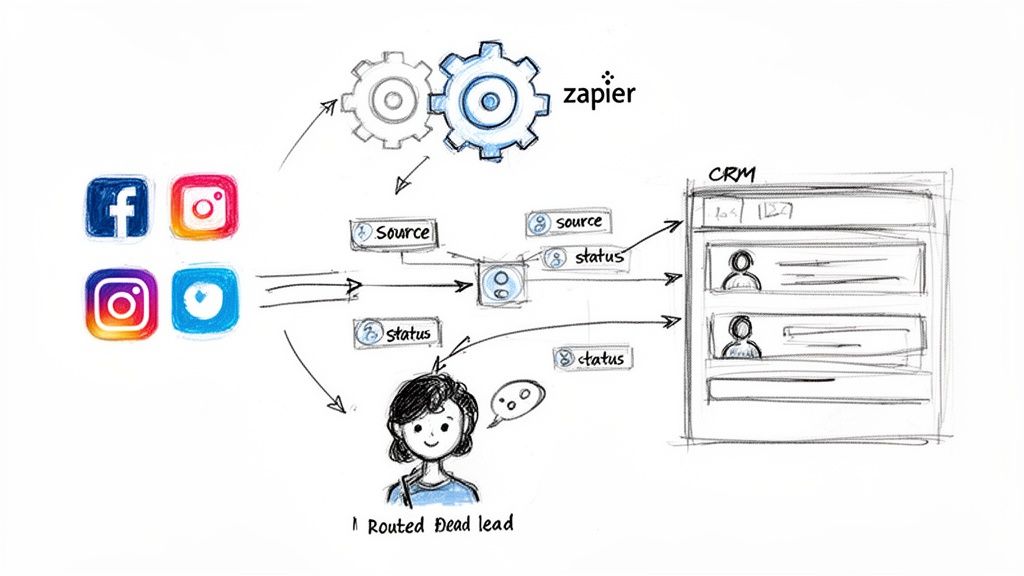
Getting this connection right is no longer a "nice-to-have." The global real estate software market is expected to hit USD 33.98 billion by 2032, and the CRM piece makes up almost 25% of that pie. Think about this: a staggering 79% of leads never convert simply because they aren't nurtured properly. That stat alone tells you why a system connecting lead capture to your CRM is non-negotiable. You can see for yourself how these trends are shaping the industry and why your competitors are taking this seriously.
What’s a Native Integration?
In a perfect world, you'll find a native integration. This just means there’s a direct, pre-built connection between two platforms. For example, your lead tool might have a one-click setup to send leads straight to a popular real estate CRM like Follow Up Boss or LionDesk. This is the gold standard.
When you have a native connection, data just flows. It's instant and reliable. A new lead from a Facebook Ad can land in your CRM in seconds, already tagged with "New Facebook Lead – Buyer." That kind of speed is what makes immediate follow-up possible.
When Do I Need a Tool Like Zapier?
But what if your favorite lead software doesn't play nicely with your CRM? That’s where a tool like Zapier becomes your best friend. Think of Zapier as the universal translator for your apps.
It lets you create little automated recipes called "Zaps." You can build a simple rule that says:
- Trigger: When a new lead fills out my Facebook Lead Ad…
- Action: …create a new contact in my CRM with all their info.
While a native integration is almost always faster and a bit more solid, Zapier is an incredibly powerful plan B. It makes sure all your tech can work in harmony, no matter what.
The single most important question to ask before you buy any lead generation software for real estate is this: "How does this tool send leads into my CRM?" If the answer involves you manually exporting a CSV file, turn around and run.
How Does This Work for Teams?
For a team, this automation goes from critical to absolutely essential. Manually assigning leads is slow, messy, and a breeding ground for arguments over who got what. A solid integration lets you set up automatic lead routing rules.
This means you can divvy up leads automatically based on rules you create:
- Round-Robin: Each new lead goes to the next agent in line, keeping distribution fair and even.
- Source-Based: You could send all Zillow leads to your top converter for that platform, while website leads go to a newer agent.
- Zip Code: Leads are automatically assigned to the agent who specializes in that neighborhood.
By setting up smart routing, you get the right lead to the right agent instantly. This simple step can dramatically slash your team's speed-to-lead time and give your conversion rates a serious boost.
Fueling Your System with Paid Ads and ISAs
Alright, so you’ve built out your instant-response system. Think of it as a high-performance engine, polished and ready. Now, you need to fuel it up. This is where paid advertising, mixed with a smart human touch, turns your business from a passive, hope-for-the-best operation into a predictable, scalable lead machine.
This isn't some secret formula; it's the exact model top producers use to grow their business year after year. They aren't just sitting around waiting for referrals. They've built a machine that generates leads on demand. The whole point is to pour leads into the top of your funnel so your software can kick in, start conversations, and tee up qualified prospects for you.
Generating Leads with Facebook and Instagram Ads
Even with all the new platforms popping up, Facebook and Instagram are still the heavyweights for finding real estate clients. The trick is making it dead simple for someone to raise their hand and show interest. That’s where Instant Form campaigns are absolute gold.
Instead of kicking people over to your website and making them wrestle with a clunky contact form, Instant Forms do the work for them. They pre-populate a user's contact info right inside the app. Two taps, and their details are on the way to you. This tiny bit of friction removal can make a massive difference in your lead volume.
To get these ads cooking, you need a compelling, straightforward offer. Think simple and valuable:
- List of Homes: "Get a free list of all homes in South Austin with a pool under $750k."
- Home Valuation: "Curious what your home is worth in today's market? Get a free, no-obligation home value estimate."
- First-Time Buyer Guide: "Download our free guide to buying your first home in Denver."
These simple, value-first ads are the starting line. They create the consistent flow of new opportunities you need to feed your system.
Why You Absolutely Need an Inside Sales Agent (ISA)
Once your ad campaigns start humming, you'll hit a new "problem": you have too many leads. Seriously. Trying to personally call every single Facebook lead while juggling showings, closings, and everything else is a one-way ticket to burnout. This is where an Inside Sales Agent (ISA) completely changes the game.
An ISA is a specialist. Their one and only job is to respond to, qualify, and nurture all those new leads pouring in. They act as your first line of defense, sifting through the noise to find the truly motivated buyers and sellers. This frees you up to spend your time where it matters most: on appointments with people who are actually ready to sign on the dotted line.
An ISA’s job isn't to sell a house. It’s to book a qualified appointment. They handle the speed-to-lead and the initial filtering so you can focus on what you do best.
This combination of paid ads and automation is a powerhouse. For instance, did you know Facebook Messenger ads can get 242% higher open rates than email in real estate? And firms that lean into automation often see an 80% increase in lead volume. It’s not magic; it’s just a proven formula. You can discover more about the impact of automation on lead generation to see just how much it's shaping the industry.
What Questions Should an ISA Be Asking?
An ISA’s script needs to be sharp and to the point. The goal is to quickly figure out who’s a talker and who’s a doer.
Here are the four make-or-break questions every ISA should be asking:
- Motivation: "So, what's prompting the move?"
- Timeline: "In a perfect world, when would you like to be in your new home?"
- Agent Relationship: "Are you currently under contract with another real estate agent?"
- Financial Readiness: "Have you already spoken with a lender about getting pre-approved?"
Their answers to these questions tell the whole story. From there, the ISA can either book an appointment straight onto your calendar or slot the lead into a long-term nurture plan. It’s a simple, effective process that guarantees you're only spending your valuable time with people who are ready to make a move.
How to Measure and Optimize Your Lead Flow
Getting your lead generation software up and running is a huge first step, but it's definitely not the finish line. Treating it as a "set it and forget it" tool is one of the fastest ways to burn through your ad budget and leave deals on the table. The real pros know that the best systems are always a work in progress, constantly being tweaked and improved.
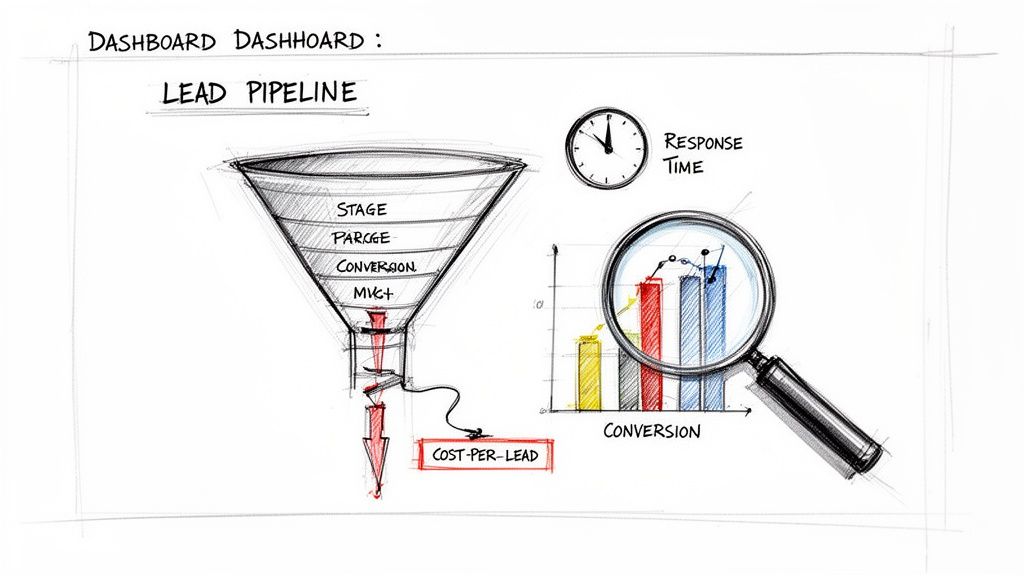
This means you’ve got to get comfortable looking at the data. I’m not talking about fluffy vanity metrics like how many people liked your Facebook post. I mean the hard numbers—the Key Performance Indicators (KPIs)—that tell you whether you're actually making money or just spinning your wheels.
What Are the Most Important Metrics to Track?
You can easily get lost in a sea of data, so let’s keep it simple. There are a handful of core metrics that paint a crystal-clear picture of what's happening inside your lead funnel. These numbers will show you exactly where things are working and, more importantly, where they’re falling apart.
To get started, zero in on these four game-changers:
-
Lead Response Time: How long does it take for a new lead to get a real response from you or your system? Every minute counts. Your goal should be under five minutes, but honestly, the closer to instant, the better your chances.
-
Connection Rate: Of all the leads that come in, what percentage do you actually end up having a real, two-way conversation with? If this number is low, it’s a red flag that you might have bad phone numbers, weak opening texts, or leads who aren't motivated.
-
Appointment-Set Rate: This is where the rubber meets the road. What percentage of those conversations turn into a booked appointment? This metric tells you how good you (or your ISA) are at qualifying leads and closing for the next step.
-
Cost Per Qualified Lead: It's easy to track your cost per lead, but that doesn't tell the whole story. What you really need to know is how much it costs to get a qualified lead—someone who is actually ready and able to transact. This is your true ROI.
Tracking these numbers gives you a powerful diagnostic tool for the health of your entire sales process.
Key Performance Indicators You Should Be Tracking
Here’s a quick summary of the metrics that matter most. Keep an eye on these, and you'll always know how your lead-gen engine is performing.
| Metric | What It Tells You | Industry Benchmark |
|---|---|---|
| Lead Response Time | Measures the speed of your initial follow-up. Crucial for making contact. | < 5 Minutes |
| Connection Rate | The percentage of leads you successfully have a conversation with. | 20-30% (Varies by source) |
| Appointment-Set Rate | The percentage of conversations that result in a booked meeting. | 15-25% of connected leads |
| Cost Per Qualified Lead | Your true cost to acquire a lead who is ready, willing, and able. | $50 – $250+ (Highly variable) |
| Lead-to-Close Rate | The ultimate measure of success: how many leads become closed deals. | 1-3% of all raw leads |
By keeping a simple dashboard with these KPIs, you can move from guessing to knowing exactly what’s working.
How Do I Spot Bottlenecks in My System?
You don't need a fancy analytics degree for this. A simple weekly check-in is all it takes to catch problems before they become disasters. Just pull your numbers and ask yourself a few tough questions.
For instance, did your connection rate suddenly tank? It might be that new Facebook ad is attracting tire-kickers. Is your appointment-set rate in the gutter? Maybe it's time to workshop your scripts or test a different opening question.
Are leads going silent after your first message? Your second or third touchpoint might need a more compelling call to action.
Don't be afraid to experiment. Change one variable at a time—like the ad headline or the first line of your follow-up text—and watch what happens to the numbers for a week. Small, consistent improvements are what create massive results over time.
To really dial things in, you need to know which lead sources are your goldmines. The best way to do that is to perform a thorough lead source analysis to see where your best clients are actually coming from. This data-driven approach shows you where to double down on your ad spend and where to cut back, making sure every single dollar you invest is working as hard as possible.
Got Questions About Real Estate Lead Software? We've Got Answers.
As you start looking into lead generation software for real estate, you’ll find the same questions tend to crop up. Let's tackle them head-on, agent to agent, so you can feel confident you're making the right call.
How Much Should I Actually Budget for This Stuff?
The price tags on these tools are all over the map, which can be confusing. It’s better to think of this as an investment in your pipeline, not just another monthly bill.
You can find simple autoresponders for under $100 a month. But for a robust, all-in-one platform that includes CRM features or even ISA services, you could be looking at several hundred dollars.
For most solo agents or small teams, a solid system that can grab leads from all your different channels and kick off automated follow-up will probably land you in the $150-$300 per month ballpark. But here's the real bottom line: the monthly fee isn't the number to focus on. It’s all about the return.
If a piece of software helps you close just one extra deal this year, has it paid for itself? For most of us, that's a resounding yes—ten times over. Always run the numbers on your potential ROI before you pull the trigger.
Will This Play Nicely with My CRM Like Follow Up Boss?
The short answer is almost always yes. Any developer worth their salt knows that a real estate agent's CRM is their command center. Modern lead gen tools are built to connect.
The best-case scenario is a direct, native integration with popular CRMs like Follow Up Boss. This is the dream setup—data flows instantly and seamlessly without you lifting a finger.
But what if there's no direct connection? Don't panic. Most platforms can still talk to each other using a middleman service like Zapier. The key is to confirm your exact integration needs before you sign up. A quick check upfront will save you from a future filled with mind-numbing manual data entry.
What's the Real Difference Between Lead Gen Software and a CRM Anyway?
Great question. It helps to think of it like a relay race, where each tool has a specific job to do.
Your lead generation software for real estate is the sprinter out of the blocks. It’s all about that initial burst of speed.
-
Lead Gen Software's Job: Capture new leads the second they come in from your website, social media, or Zillow. Its other critical task is making instant contact to get a conversation started.
-
CRM's Job: Your CRM is the long-distance runner who takes the baton for the rest of the race. This is where you manage the entire relationship, keep an eye on your sales pipeline, and nurture that lead for weeks, months, or even years until they're ready to transact.
Some CRMs have a few basic lead capture features, and some lead gen tools have light CRM capabilities. But they're fundamentally different. They're at their most powerful when they are perfectly integrated and working as a team, not when one is trying to do the other's job.
Ready to build a predictable, scalable lead generation system without all the trial and error? DB Marketing Co. offers a clear ladder of services to help you grow, whether you're a new agent or a seasoned pro. We’ll set up your instant-response machine, generate high-quality leads, and even handle the follow-up for you. Start growing your business with a system that works.