
Think of a landing page for real estate as your digital specialist. It’s a single, laser-focused web page built for one specific purpose—maybe to capture a seller's info with a home valuation offer, or to get a buyer to download your neighborhood guide. Unlike your main website's homepage, which is a jack-of-all-trades with links everywhere, a landing page strips away all the noise. Its sole mission is to guide a visitor to take one specific action, which is why it's a game-changer for turning ad clicks into actual leads.
Why Most Real Estate Landing Pages Fail
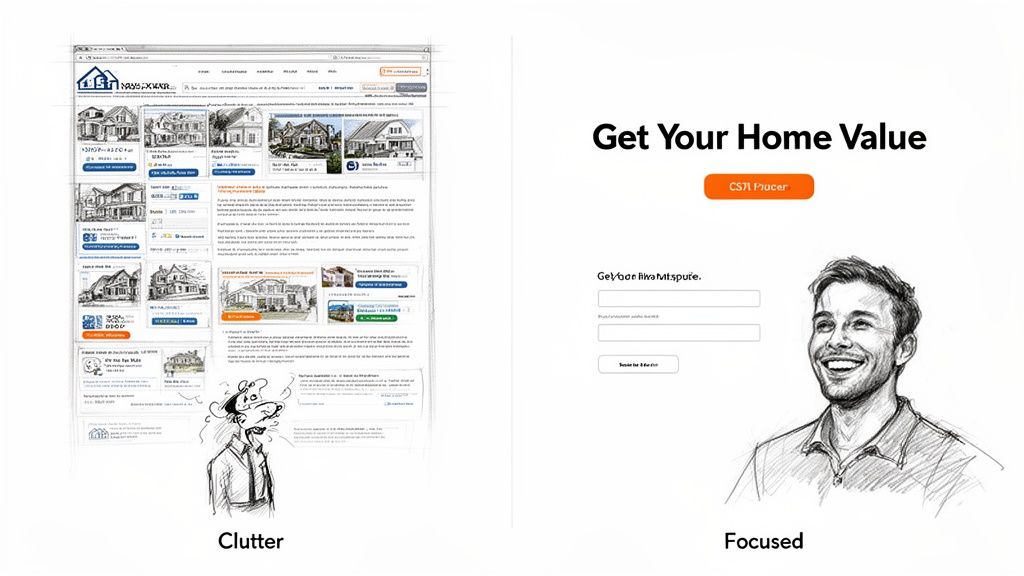
Let's be honest—most real estate landing pages just don't pull their weight. You pour good money into Facebook or Google ads, get people to click, and then… crickets. It’s not just you; the stats tell the same story.
The average conversion rate for a real estate landing page hovers around a disappointing 2.6%. That might not sound terrible, but the top agents are playing a completely different game, hitting 10% or even higher. That massive gap isn't just a number; it’s lost commissions and missed opportunities.
The data shows even small, smart changes can make a huge difference. For instance, pages that stick to a single call-to-action can boost conversions to 13.5%. If you want to see what's possible, you can explore more conversion rate insights and see the potential you're leaving on the table.
To put this in perspective, here's a quick look at what separates the average from the exceptional.
Average vs. Top-Performing Real Estate Landing Pages
| Metric | Average Real Estate Agent | Top 10% Real Estate Agent |
|---|---|---|
| Lead Conversion Rate | 2.6% | 10%+ |
| Ad-to-Lead Cost | Often inflated due to poor conversion | Significantly lower and more efficient |
| Page Focus | Multiple links, goals, and distractions | Single, clear call-to-action |
| Visitor Experience | Confusing and overwhelming | Simple, intuitive, and trustworthy |
See the difference? The top performers aren't just getting a few more leads; they're operating a much more profitable and predictable lead generation machine.
The Psychology of a High-Stakes Decision
We can't forget what we're dealing with here. Buying or selling a home is one of the biggest, most emotionally charged financial decisions anyone ever makes. It’s stressful. It’s scary. And a generic, cookie-cutter landing page completely ignores this human reality.
When a potential client hits your page, they're not just looking for information—they're looking for an expert they can trust. They need reassurance. If they land on a page with a cluttered design, confusing messages, or five different things to click on, their anxiety instantly spikes. They don’t feel guided; they feel lost. And then they're gone.
A great real estate landing page has one job: to reduce friction and build trust instantly. It must align perfectly with the ad that brought the visitor there and speak directly to their specific need at that exact moment.
Common Mistakes That Kill Conversions
So, what’s the secret sauce? What really separates the pages that print leads from the ones that just sit there? It usually comes down to avoiding a few classic blunders.
Lack of a Single Goal: This is the big one. Trying to make your page do everything is a recipe for it doing nothing. Don't ask them to get a home valuation, browse listings, and follow you on Instagram. It creates decision paralysis, and a confused mind always says no.
Vague Calls-to-Action (CTAs): Weak buttons like "Submit" or "Learn More" are conversion killers. They offer zero value. Your CTA needs to be specific and promise a benefit, like "Get My Free Home Value Report" or "Download the First-Time Buyer's Checklist."
Generic, Uninspired Copy: We've all seen it. "Find Your Dream Home" or "Expert Real Estate Services." These phrases are so overused they've become invisible. Your words need to connect with a specific person's problems and dreams.
At the end of the day, a successful landing page for real estate is a precision tool, not a blunt object. It’s designed for one ideal client, with one clear offer, making it the most powerful way to turn your ad spend into a pipeline of qualified leads.
Nailing Your Strategy Before You Build
It's tempting to jump right into designing a beautiful landing page, but that's a classic mistake. A successful landing page for real estate doesn't start with a design or a clever headline; it starts with a rock-solid strategy. Building without a plan is like trying to build a house without a blueprint—it’s a recipe for wasted time and money.
The very first thing you have to do is decide on your page's one true purpose.
What is the main goal of a real estate landing page?
The single most important action you want a visitor to take is your goal. If your page tries to be a jack-of-all-trades, it will master none. The secret is to define one, and only one, measurable goal. This isn't a vague objective; it's a specific action that pushes a potential client one step closer to working with you.
For example, if you're targeting potential sellers, your one goal should be to get them to request a home valuation. That’s it. For a page aimed at first-time buyers, you might want them to download your free neighborhood guide. This laser focus cuts through the noise and makes it crystal clear what the visitor should do next.
Know Who You Are Talking To
Once your goal is locked in, you need to get inside the head of your ideal visitor. A generic message aimed at "everyone" is a message that truly connects with no one. Think about it: a landing page for "Just Listed Luxury Penthouses" needs a completely different vibe, look, and feel than one for a "Free Home Staging Consultation." The first is all about exclusivity and prestige, while the second is about maximizing a home's sale price.
To get a head start on this, you can check out specialized real estate templates that convert. They're often designed with different client profiles in mind, giving you a solid framework to build upon.
Your landing page strategy is all about creating perfect alignment. The promise you make in your ad must be a direct match for the purpose of your page, which must then perfectly match the needs of your ideal client.
Align Your Offer With Your Audience
Now it’s time to connect your goal with your audience by creating an irresistible offer. The offer is the "what's in it for me?" that gets people to actually click the button.
Let's look at a couple of real-world scenarios:
Audience: Young families hunting for homes in a specific school district.
- Goal: Get them on your email list.
- Offer: A landing page with a "Free Guide to the Top 5 Family-Friendly Neighborhoods in [Your City]."
Audience: Empty-nesters thinking about downsizing.
- Goal: Book a consultation.
- Offer: A page that asks, "Thinking of Downsizing? Discover How Much Equity You Can Unlock. Book a 15-Minute Chat."
Getting this strategic foundation right from the start means every single element of your page—from the headline down to the final call-to-action—is working together. This is how you stop wasting ad spend and start building a predictable pipeline of qualified leads.
Designing for Trust and Action
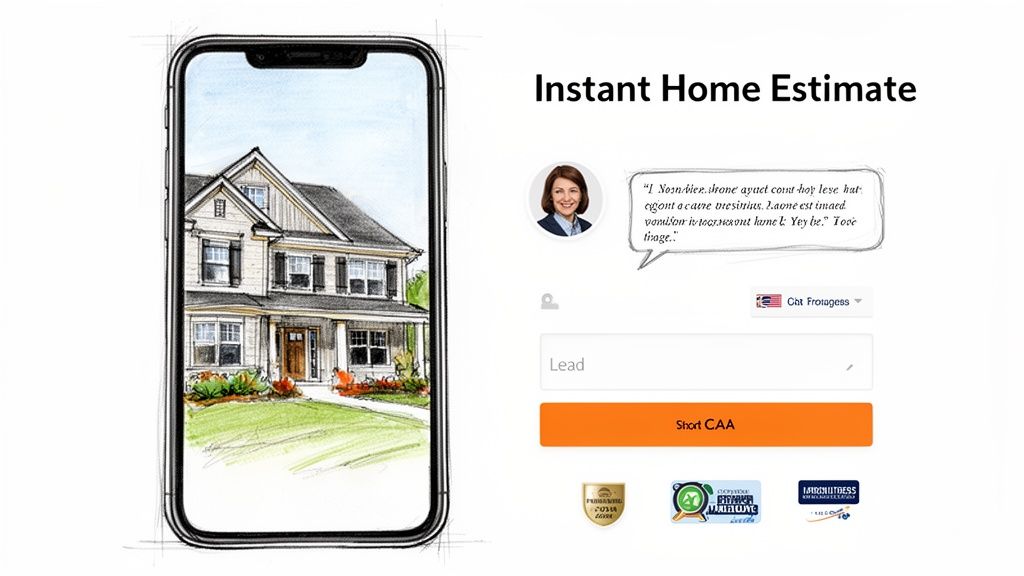
Great design isn't just about looking good. In real estate, it’s about making a visitor feel comfortable enough to give you their information. That comfort—that trust—is everything.
Think of your landing page as the digital version of a firm handshake and a confident smile. It has to make a killer first impression, guiding people from just browsing to actually taking action without hitting any snags.
What’s the Most Important Design Element on a Real Estate Landing Page?
If you only get one thing right, make it the hero section. This is the very first thing people see when they land on your page, and it has to do its job perfectly. Get this wrong, and they're gone.
To absolutely nail it, you need three things working together:
- A Powerful, Benefit-Driven Headline: Don't just say "Your Local Real Estate Expert." That's boring. Hit them with a solution to their problem, like "Discover Your Home's True Value in 60 Seconds."
- Stunning Property Visuals: This is non-negotiable. Use high-resolution, professional photos or a quick video. Visuals sell the dream way better than words ever could, so don't skimp here.
- A Clear Call-to-Action (CTA): Your main button needs to pop. Make it bright, easy to see, and tell them exactly what to do.
This trio—a compelling promise, beautiful imagery, and a clear next step—is what stops the scroll and gets people to engage.
Build for Mobile First, Not Just Mobile Friendly
Here’s a hard truth: over 58% of all web traffic now comes from mobile devices. Your page has to work flawlessly on a phone. We’re way past the days of "mobile-friendly" where people have to pinch and zoom to read anything. That’s an instant back-button click.
"Mobile-first" means you design for the small screen from the very beginning. Keep the layout clean, use plenty of white space, and make sure your buttons are big enough for a thumb to easily tap. Your forms need to be short and sweet, because nobody wants to type a novel on their phone. This approach guarantees a smooth ride for the majority of your visitors.
The real goal of your landing page design is to create a frictionless path to the lead form. Every single element, from the headline to the color of your CTA button, should work together to build trust and push them toward that goal.
How Can I Build Trust Quickly on My Page?
Trust is the currency of real estate, and you have to earn it fast. A polished design is a great start, but you need to back it up with hard evidence that you're the real deal.
Here are a few trust-builders you absolutely must include:
- Your Professional Headshot: A friendly, high-quality photo of you puts a face to the name. It shows there's a real person here to help, not some faceless company.
- Client Testimonials: Social proof is a game-changer. A strong real estate testimonial is one of the most powerful tools in your arsenal. A short quote from a happy client builds more credibility than anything you could ever say about yourself.
- Logos of Affiliations: Got your brokerage logo? The National Association of Realtors (NAR) symbol? Local awards? Show them off. These small badges add a huge layer of professional legitimacy.
When you mix a clean, mobile-first layout with these powerful trust signals, you create an experience that feels both professional and reassuring. That's how you get visitors to hand over their contact info without a second thought.
Writing Copy That Actually Turns Clicks into Clients
A slick design might get someone to stop and look, but it's your words that will get them to stay and take action. This is where we stop sounding like every other real estate agent out there and start talking like a human who genuinely understands what a buyer or seller is going through. It's about trading in those tired, generic phrases for words that make a visitor feel seen, understood, and confident that you're the one who can help.
It all starts with a killer headline. Seriously, if you get this wrong, nothing else matters. Forget boring, overused lines like "Find Your Dream Home." Instead, get right to the point and speak directly to what your audience wants or what's keeping them up at night.
For example, instead of a vague promise, give them something they can sink their teeth into:
- For Sellers: “Finally Get a Real Number: How Much Is Your Austin Home Actually Worth in Today's Market?”
- For Buyers: “Get a List of Every Home with a Pool in Northwood—Before They Even Hit Zillow.”
See how that works? You’re immediately showing them you’ve got something valuable and specific, not just another generic property search.
Stop Listing Features, Start Talking Benefits
This is a subtle but game-changing shift. Nobody wakes up in the morning excited to get a "market analysis." What they really want to know is, "how much cash will I walk away with when I sell my house?" Likewise, buyers aren't just looking for "property listings"; they're searching for a safe neighborhood with great schools where their family can finally put down roots.
An easy way to make this switch is to think "so what?" for every feature you list.
Let's imagine you're offering a free seller's guide. Instead of just saying what's in it, show them what's in it for them:
- Learn the three simple cosmetic updates that can add over $15,000 to your final sale price.
- I’ll show you my go-to staging strategy that helps my clients' homes sell 40% faster.
- Get the inside scoop on the single biggest (and most costly) mistake I see sellers make during negotiations.
It's a completely different feel, right? You’re no longer just handing over a PDF. You’re giving them a clear path to a faster, more profitable home sale.
Don't just describe what you do. Paint a vivid picture of the successful outcome your client will get by working with you. That's what builds trust and gets people to act.
That All-Important Call-to-Action
Your Call-to-Action (CTA) is the moment of truth. It's the one thing you absolutely need them to click. So why do so many agents kill their conversion rates with lazy, boring buttons like "Submit" or "Click Here"? Those words are passionless and create zero excitement.
A great CTA does two things perfectly: it tells people exactly what to do and reminds them why they should do it.
Let's make your CTA irresistible. Use active, specific language that focuses on the value they're about to receive.
- Instead of "Submit": Try "Get My Instant Home Value"
- Instead of "Download": Use "Send Me the Free Seller's Guide"
- Instead of "Sign Up": Go with "Show Me the Hidden Listings"
Just by changing a few words, you turn a dull command into an exciting invitation. It’s the final nudge they need to go from a passive visitor to an active lead in your pipeline.
Turning Leads into Appointments Automatically
A slick design and killer copy are fantastic, but they're only half the battle. Your landing page for real estate is basically just a pretty online brochure if the leads you get just sit there and go cold. We need to turn this thing into a 24/7 lead-capturing machine that does the heavy lifting for you.
And it all starts with your lead form. Seriously, the placement and complexity of this little box can absolutely make or break your conversion rate.
What Should I Ask for on My Real Estate Lead Form?
This is the million-dollar question, isn't it? You're trying to find that perfect balance—get enough info to be useful, but not so much that you spook people away. Asking for their life story right out of the gate is a surefire way to create friction and send them running.
A classic mistake is demanding a phone number on the first step. People are guarded with their phone numbers; they immediately picture getting spammed with sales calls. A much smoother approach is to just ask for the basics:
- First Name: So you can personalize your follow-up.
- Email Address: This is how you'll deliver the goods (the home valuation, the buyer's guide, etc.).
That’s it. You can always ask for the phone number on the "thank you" page or in a follow-up email once you've already given them something valuable. I’ve seen this simple tweak boost form completions by as much as 50%.
Your lead form's job is to open the door, not conduct a full interview. Keep it short, simple, and focused on getting the conversation started.
Think about how you guide a user from a vague idea to a clear action. You have to show them the benefit first, then give them a clear next step.
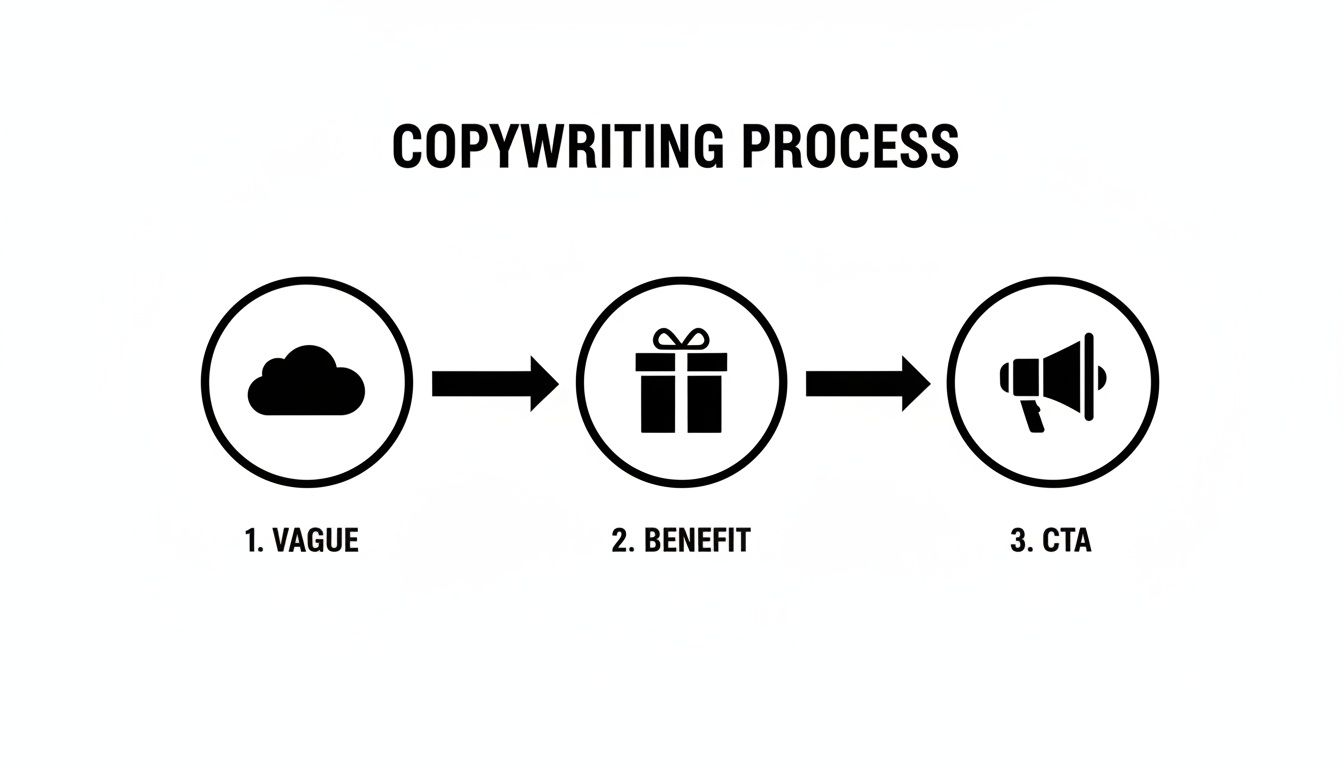
This process—moving from a general concept to a benefit-driven message and finishing with a strong call-to-action—is exactly what your landing page copy needs to do.
Adding Instant Connection Points
Of course, sometimes a lead is on fire and wants to talk right now. For these folks, you need a hotline.
Integrating tools like a live chat widget or a big, obvious "click-to-call" button for mobile visitors gives these high-intent leads a direct line to you or your team. They don't have to wait. These options cater to different personalities and can snag leads who might have bounced instead of filling out a form. It shows you're available and ready to help, which builds a ton of trust instantly.
The Power of Automated Follow-Up
Okay, here’s the real secret sauce: speed-to-lead. This isn't just a catchy phrase; it's everything. The odds of actually connecting with a new lead plummet over 100 times if you wait just 30 minutes to reach out. An automated system is the only way you can consistently win this race.
The moment someone hits "submit," your system needs to spring into action. We’re talking an automated text and email firing off within seconds to confirm their request and start a conversation. It’s not just about being fast; it’s about making an immediate, personal-feeling connection while their interest is at its absolute peak. For a deep dive on this, check out our guide on the best real estate marketing automation software.
With this kind of setup, no lead ever falls through the cracks. The best systems can even take it a step further, with a trained ISA qualifying new leads and booking appointments straight into your calendar. That’s when your landing page truly becomes an automated appointment-setting engine.
Common Questions I Hear About Real Estate Landing Pages
Even when you've got a solid plan, building a landing page that actually pulls in leads can feel a little tricky. I get it. Over the years, I've seen agents get stuck on the same few things. Let's clear up the most common questions so you can get past the roadblocks and start generating leads.
What’s the Single Most Important Thing on My Landing Page?
If I had to pick just one thing, it's your Call-to-Action (CTA). It has to be crystal clear and singular.
Every single word, image, and form field on that page should be working together to push the visitor toward one specific action. Is it "Download My Free Seller's Guide"? Or maybe "Request a Custom Home Valuation"? Whatever it is, stick to it. Pages cluttered with multiple offers or distracting links to your main site almost always flop. It just gives people decision paralysis, and they click away.
Can’t I Just Send My Ad Traffic to My Website’s Homepage?
Please don't. This is hands-down one of the biggest and most expensive mistakes I see agents make. Your main website is built for browsing—it has your bio, your blog, different neighborhoods, and a dozen other things to click on. It's designed to let people wander.
A landing page is different. It's a specialist. It’s laser-focused on delivering the exact promise you made in your ad. If someone clicks an ad for a home valuation, they expect to land on a page about… you guessed it, a home valuation. Not your "About Me" page. Matching the ad to the page creates a seamless experience and will make your conversion rates soar.
Here's how I think about it: your website is a big-box general store, but your landing page is a boutique specialist. When someone has a specific problem, they want the specialist, not the maze of a general store.
How Much Is This Going to Cost Me?
Honestly, it can range from a DIY-friendly price to a significant investment. It all depends on how you want to tackle it.
You've got a few main paths:
- DIY Page Builders: Tools like Leadpages or Unbounce are great. They typically run from $40 to over $200 a month and let you build professional-looking pages with zero coding.
- Hiring a Pro: Bringing in a freelancer or an agency can cost anywhere from a few hundred bucks to several thousand for a fully custom page. The price tag depends on how complex you want to get.
- All-in-One Real Estate Platforms: Many of the systems you might already be using, like Sierra Interactive or Chime, often bundle landing page builders into their monthly package.
Okay, I Built the Page. Now How Do I Get People to See It?
Your shiny new landing page won't do much good without traffic. For real estate agents, the fastest and most reliable way to get qualified eyeballs on your page is through paid ads on platforms like Facebook, Instagram, and Google.
Beyond ads, you can also drop the link in your email newsletter, share it organically on your social media pages, or even pop it into your email signature. The real trick is to match the traffic source to the page's offer. For example, if you're running a Facebook ad targeting potential sellers in a specific zip code, that ad must click through to a page offering a free, instant home valuation. It’s all about relevance.
At DB Marketing Co., we specialize in turning your landing pages into automated appointment-setting machines. From instant lead follow-up to a fully managed ISA service that qualifies and books appointments right into your calendar, we have a solution that fits your business. Learn how we can help you grow.