

To get a steady stream of real estate clients, you need a rock-solid system that catches every single lead—whether they come from your website, a Facebook message, or even a missed call—and shoots back a response instantly. This isn't just about being organized; it's about making sure no opportunity falls through the cracks. Building this framework is the absolute first step to creating a predictable flow of new business.
Build Your Foundation for Consistent Client Flow
Before you even think about spending a dime on ads, you need a bulletproof system to handle all the interest you’re about to generate. Seriously. Generating leads without a plan to manage them is like trying to collect rainwater in a leaky bucket. You do all the work, but the good stuff just slips away.
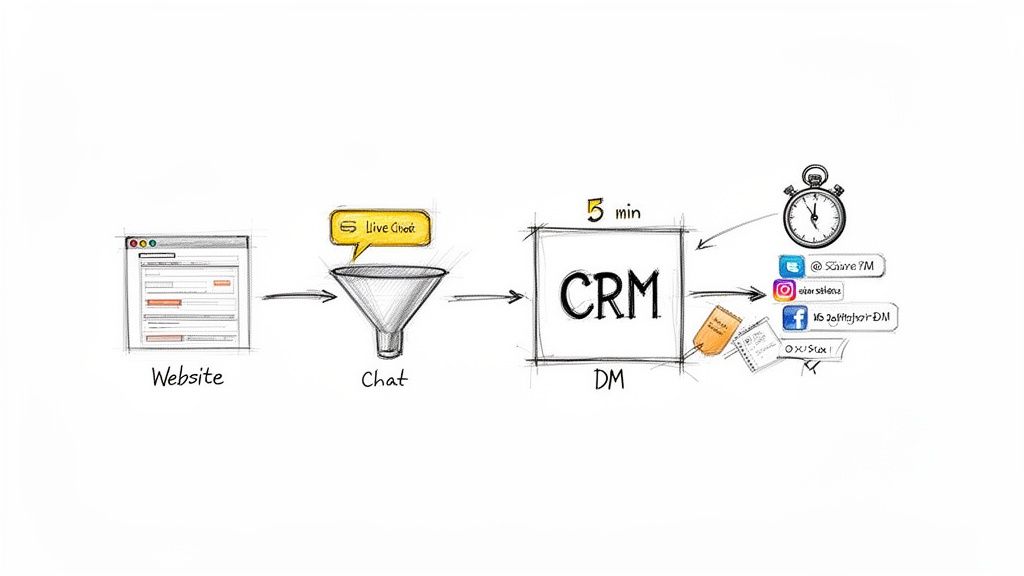
This means you need a clear, repeatable process for every single way a potential client might reach out. Think of all the digital front doors to your business.
- Website Forms: Someone fills out your "Contact Us" form. What happens immediately after they hit submit?
- Live Chat: Got a chat bubble on your site? Are you ready for a real-time conversation?
- Social Media DMs: Who’s watching your Instagram and Facebook messages?
Each one of these is a golden opportunity. The goal is to funnel every inquiry, no matter where it comes from, into one central hub where you can track and nurture it properly.
Why Speed Is Your Greatest Advantage
Let's be real: in today's market, the first agent to respond usually gets the client. The game has totally changed. People expect instant answers. Waiting a few hours, let alone a full day, just doesn't cut it anymore. That initial spark of interest is fleeting, and your ability to engage someone within minutes is everything.
Here's a stat that should get your attention: responding to a new lead within the first 5 minutes can increase your odds of qualifying them by a staggering 21 times compared to waiting just 30 minutes. That’s a massive opportunity that most agents are missing every single day.
To get a feel for how critical timing has become, it's worth exploring how different lead channels demand different response speeds.
Essential Lead Capture Channels and Response Time Goals
Here’s a quick breakdown of common lead sources and the response times you should be aiming for to stay competitive.
| Lead Channel | Example | Ideal Response Time | Key Action |
|---|---|---|---|
| Website Form | "Contact Us" or "Schedule a Showing" submission | Under 5 minutes | Automated email/text confirmation, then personal call. |
| Paid Ads (Social) | Facebook/Instagram Lead Form | Under 2 minutes | Immediate automated text to start a conversation. |
| Live Chat | On-site chat widget inquiry | Under 30 seconds | Real-time engagement or AI chatbot takeover. |
| Missed Call | Inbound call you can't answer | Instant | Automated text-back ("Saw you called, will call back in 15"). |
| Social Media DM | Direct message on Instagram or Facebook | Under 15 minutes | Acknowledge the message and move the conversation to a call. |
Treating each channel with the urgency it deserves is a non-negotiable part of a winning lead-handling strategy.
Automating Your Initial Response
So, how do you respond instantly without being surgically attached to your phone? Smart automation is the answer. A good system makes sure every new lead gets an immediate, personal-feeling acknowledgment.
The goal of automation isn't to replace you. It's to be your perfect assistant, making sure every lead feels heard the moment they reach out. This buys you the crucial time you need to follow up personally and have a real conversation.
A classic example is the missed call text-back. When a call comes in that you can't grab, an automated text can be a total game-changer. Something simple like, "Hi, this is [Your Name]. I saw you just called but I'm with a client. I'll call you back in 15 minutes. In the meantime, what's the best reason for your call?" does two powerful things: it acknowledges them right away and gets the conversation started.
This flow shows exactly how a lead should move from that first touchpoint into your organized system.
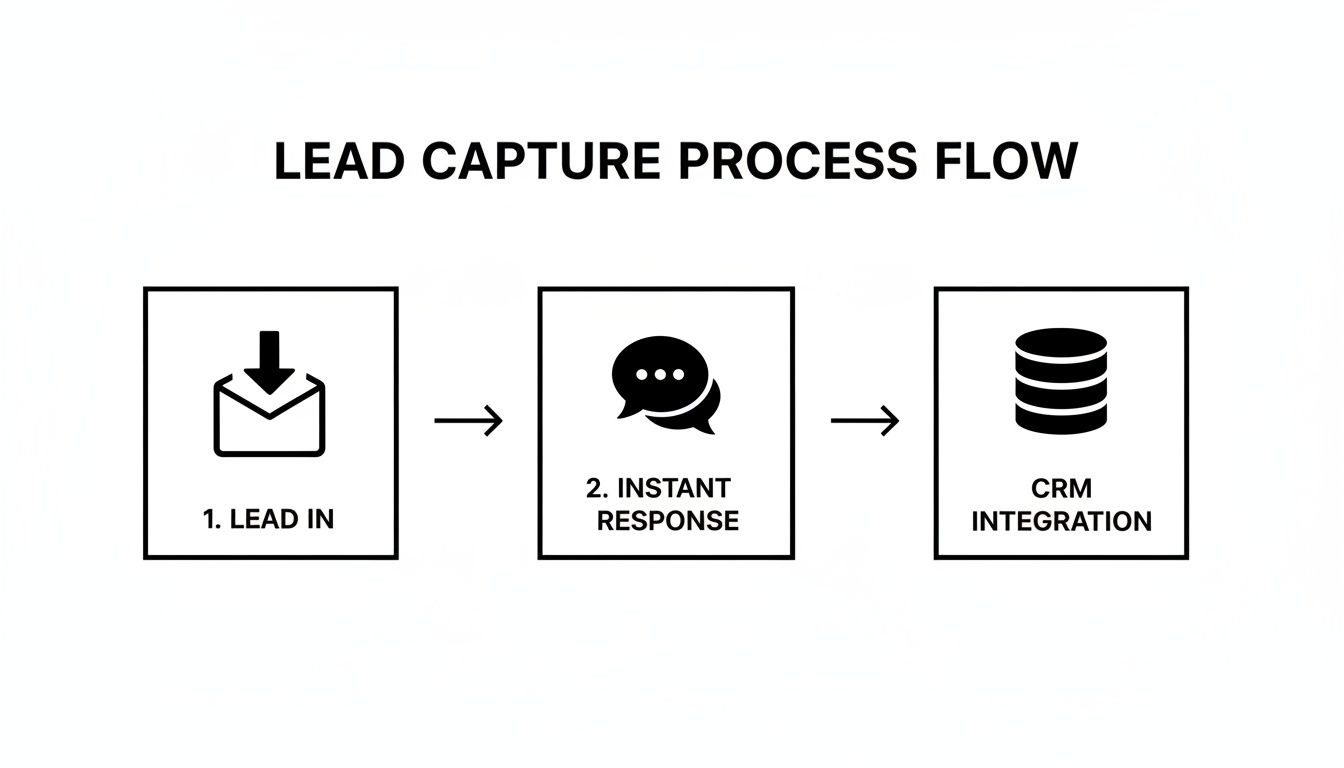
This simple, three-part process—Lead In, Instant Response, CRM Integration—is the backbone of a system that can actually grow with your business.
The final piece of the puzzle is organization. Every new lead needs to be automatically added to your CRM with specific tags (like "Facebook Buyer Lead" or "Zillow Seller Inquiry"). This keeps your pipeline clean and makes targeted follow-up a breeze. To really build out your tech stack, it’s worth checking out some of the best AI tools for real estate agents that can help automate and supercharge these efforts.
Want Predictable Business? Master Paid Ads
If you're serious about growing your real estate business, you can't just sit around waiting for referrals. To build a truly predictable pipeline of clients, you have to go out and find them. This is where paid advertising on platforms like Facebook and Instagram becomes your secret weapon.
And I'm not talking about just boosting posts. I mean building smart, strategic campaigns from the ground up designed to do one thing: capture qualified buyer and seller leads, day in and day out.
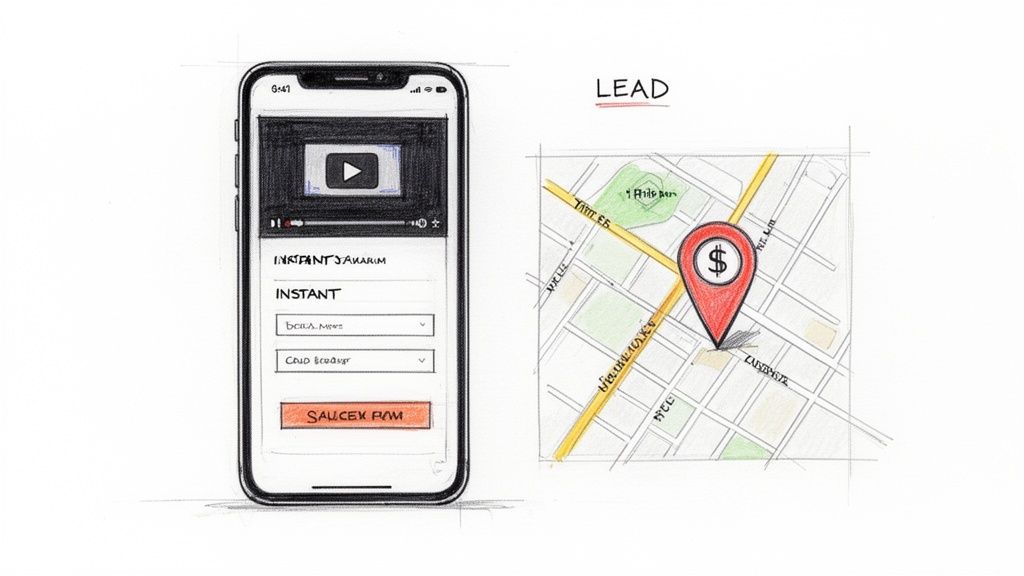
The name of the game today is reducing friction. That's why Instant Forms (or Lead Forms) are so powerful. They pre-populate with a user's contact info straight from their social media profile, making it dead simple for them to send you their details with just a couple of taps. No more sending people to a clunky website form on their phone—this is how you get leads now.
Crafting Ads That Actually Get Clicks
So, what’s the secret sauce for a killer real estate ad? It’s not just about pretty pictures. A high-performing campaign is a perfect mix of sharp targeting, compelling creative, and an irresistible call to action.
Let's break down what really works:
- Be a Hyper-Local Expert: Don't just target your entire city. Get specific. Focus on a tight 15-mile radius around your main service area. You can layer in interests like Zillow or first-time homebuyer programs, but geography is your best friend here.
- Video Crushes Everything: Seriously, video is king. A simple walk-through of a new listing you shot on your phone will almost always outperform a static image. And if you have client testimonials? That's pure gold. A 30-second clip of a happy client gushing about you is more persuasive than anything you could ever write.
- Write Copy That Solves a Problem: Stop using generic lines like, "Looking to buy a home?" Instead, speak directly to a local pain point. Try something like: "Tired of renting in Austin? See the top 3 homes for sale under $450k with a yard for your dog." See the difference? That resonates.
The secret to effective ad copy is to stop selling real estate and start solving problems. Are people in your area struggling with affordability? Are they looking for more space? Address that specific need, and you'll attract the right people.
This isn't just fluff; the numbers don't lie. Digital marketing is the engine for predictable lead flow, with 54% of agents now saying social media is their number one source for leads. And with agents dedicating 54.2% of their marketing budgets to digital, the ROI is undeniable—PPC ads average 36%, while social media marketing pulls in a massive 182%. You can dive deeper into these real estate marketing benchmarks to see how you stack up.
The High-Converting Facebook Ad Structure for Realtors
To pull all this together, here’s a simple but incredibly effective structure for your Facebook ad campaigns. This is the blueprint we see work time and time again.
| Campaign Level | Ad Set Level (Targeting) | Ad Level (Creative) |
|---|---|---|
| Objective: Lead Generation | Location: 15-mile radius of your city | Format: Video (preferred) or a high-quality image/carousel |
| Budget: CBO (Campaign Budget Optimization) is often best | Detailed Targeting: Layer interests like Zillow, Trulia, Realtor.com | Primary Text: Problem-focused copy (e.g., "Stop paying your landlord's mortgage…") |
| Special Ad Category: Housing (This is required) | Age & Gender: Keep this broad to start | Headline: Clear benefit (e.g., "See Homes Under $450k") |
| Placement: Automatic Placements (let Facebook optimize) | Call to Action: "Learn More" or "Get Offer" | |
| Destination: Instant Form (pre-populates user info) |
This framework gives you a solid foundation. From here, you can test different videos, headlines, and targeting options to see what resonates most with your local market.
That "First 5 Minutes" Follow-Up is Everything
Getting the lead is just the starting line. The race is won or lost in the moments immediately after they hit "submit." To capitalize on their interest, you need a two-pronged automated response that will skyrocket your connection rate.
- Get an Instant Alert: First, you need an immediate notification sent straight to your phone. Not an email you'll see in an hour, but a text that tells you a new lead just came in. Speed is everything.
- Send the "I'm Calling" Text: At the exact same time, an automated text message should go out to the new lead. This isn't your typical canned response. It's a game-changer: "Hey [First Name], this is [Your Name]. Just got your request for info on homes in [City]. I'm about to call you from this number to chat for a minute."
This one little text can easily double or triple your answer rate. Why? It eliminates the surprise of an unknown number, instantly establishes who you are, and sets the expectation that you're about to talk. It's simple, but it's incredibly effective.
How Much Should I Actually Spend on Ads?
This is the million-dollar question, right? While there's no single magic number, a great starting point for a solo agent is usually between $15-$25 per day. That's typically enough to generate a consistent flow of leads without breaking the bank while you test what works.
Once you dial in your ads and see a positive return, you can confidently scale your budget. The key is to obsessively track your cost per lead (CPL). If your CPL is low and you're turning those leads into appointments, increasing your ad spend isn't an expense—it's a predictable investment in your growth.
The Art of Follow-Up: Turning Leads Into Appointments
So you’ve got a new lead. That’s awesome. But here’s the hard truth many agents learn the hard way: getting the lead is the easy part. The real work—and the real money—is in the follow-up. A name and a phone number in your CRM are basically worthless until you turn that initial spark of interest into a real conversation and, eventually, an appointment in your calendar.
This is precisely where most agents drop the ball. They might make a call or two, maybe send a generic email, and when they don’t get an immediate bite, they mark the lead as "unresponsive" and move on. This is a massive mistake. The reality is, only a tiny fraction of leads are ready to talk the moment they inquire. Most people need to hear from you multiple times before they feel comfortable enough to engage.
The Multi-Channel Nurture Sequence
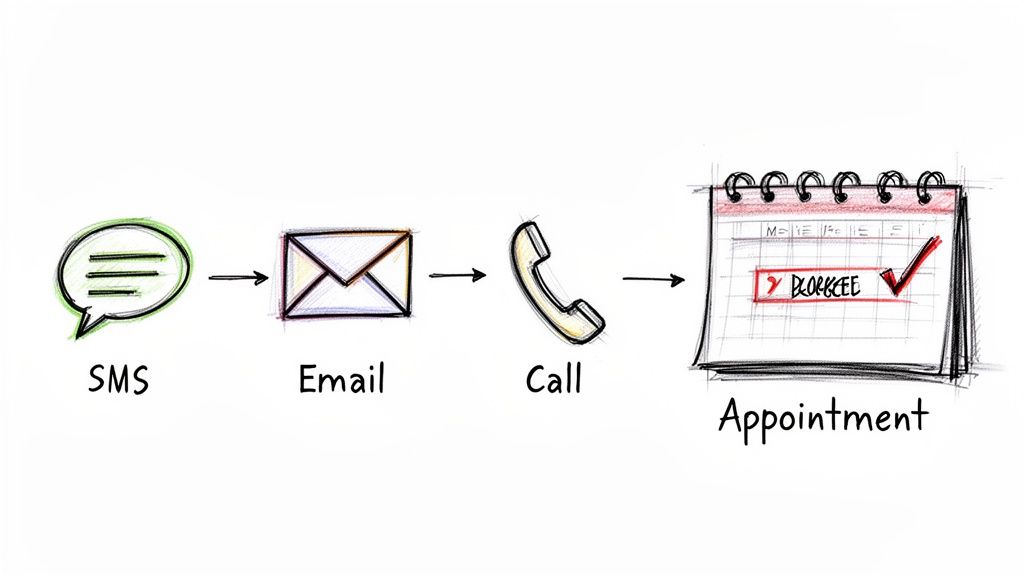
A killer follow-up strategy isn't just about being persistent; it's about using a mix of channels to stay top-of-mind without being a pest. A multi-touch sequence that blends SMS, email, and good old-fashioned phone calls is the gold standard. It meets people where they are and respects that everyone has their preferred way of communicating.
Your goal here is to build a relationship, not just hound someone for a sale. This means your follow-up has to provide actual value. Instead of just asking, "Are you ready to buy yet?" your messages should offer helpful information, build your credibility as the local pro, and gently guide them toward having a conversation with you.
Here’s a simple but incredibly effective 10-day sequence for a brand-new online lead:
- Day 1: Send an immediate "I'm calling" text, then pick up the phone. If they don't answer, leave a friendly, no-pressure voicemail. Later that evening, send a value-add email, like "Top 5 Things to Know Before Buying in [Your City]."
- Day 2: Fire off a morning SMS: "Hey [Name], just following up on my call yesterday. Any initial questions I can answer about the [Your City] market for you?"
- Day 4: Try another phone call. This time, don't leave a voicemail.
- Day 7: Send another email, but with a different piece of value. Maybe it's a link to a market report, a video tour of a popular neighborhood, or a quick guide to the home-buying process.
- Day 10: Make one final call and send a "break-up" text: "Hey [Name], tried to connect a few times. I'll assume now's not the right time, but I'm here if you need anything down the road!"
This kind of systematic approach ensures no lead ever falls through the cracks and dramatically increases your odds of actually starting a real conversation.
What Should I Say When I Call a New Lead?
This is probably the most common question I hear from agents, and it’s a great one. The fear of sounding like a pushy salesperson is real, but it’s easy to sidestep if you just reframe the goal of that first call. Your only objective is to build a little rapport and gather some information. That’s it.
Your first call is not about selling a house. It's about starting a conversation. Lead with curiosity, not a sales pitch. Ask open-ended questions and just listen.
Instead of launching into some canned script, try a more natural, low-pressure opener. After you introduce yourself, you could say something like:
Scenario-Based Opening Lines:
- For a Facebook Lead: "Hey, I saw you were checking out some homes in the [Neighborhood] area online. What was it about that area that caught your eye?"
- For a Website Inquiry: "Thanks for reaching out on my website! Just curious, what prompted your search today? Are you just browsing or starting to get serious about a move?"
- For a Zillow Lead: "Hi, I saw you were interested in the property on 123 Main Street. That's a great one! Are you looking for something similar, or was there something specific you liked about that home?"
Notice that none of these are aggressive. They are simple, open-ended questions designed to get the other person talking. Your job is to be the helpful expert, not a telemarketer. Listen to their answers, ask follow-up questions, and just focus on being a resource. This is how you land clients who actually want to work with you.
Nurturing Leads for the Long Haul
Look, not every lead is ready to move in the next 90 days. In fact, a huge chunk of them are 6, 12, or even 18 months out. These aren't dead leads; they're your future business. Moving them to a long-term nurture campaign is absolutely critical for building a sustainable pipeline.
This is where a simple, automated email newsletter is your best friend. A monthly or bi-weekly email packed with local market stats, a few featured listings, and helpful homeowner tips keeps you on their radar without you having to lift a finger. When they're finally ready to make a move months down the line, guess who they're going to remember? You.
Scaling Your Business With an ISA
As your lead generation starts cooking, you’re going to hit a wall. It’s a great problem to have, but it's a problem all the same. You're either so busy showing houses that you can't follow up with new leads, or you're glued to your CRM while your high-value clients are waiting.
This is the exact moment when bringing on an Inside Sales Agent (ISA) becomes the smartest move you can make to scale without burning yourself out.
An ISA is a specialist—either in-office or virtual—who has one job: lead conversion. They aren't running comps or negotiating offers. Their entire day is dedicated to the critical (and incredibly time-consuming) work of responding to, qualifying, and nurturing leads until they are genuinely ready for an appointment with you.
This frees you up to focus on what actually makes you money: meeting qualified buyers and sellers, building those key relationships, and closing deals.
What Does a Real Estate ISA Actually Do?
Think of a good ISA as the air traffic controller for your entire sales pipeline. They manage the chaos at the front end, making sure you only get a handoff when a lead is truly ready to talk business.
For a deeper look into the role, check out this excellent guide on what an ISA is in real estate.
But in a nutshell, their day-to-day includes:
- Instant Response: Making that first contact by text and phone within minutes—the single most important factor in conversion.
- Relentless Follow-Up: Running the multi-touch nurture plans we talked about earlier, so no lead ever slips through the cracks.
- Smart Qualification: Asking the right questions to uncover a lead's real motivation, their timeline, and their financial situation.
- Setting Appointments: Booking genuinely qualified, motivated prospects directly into your calendar.
A well-trained ISA becomes the engine of your business, systematically turning cold internet leads into warm, face-to-face appointments.
Getting Your ISA Set Up for Success
Just hiring an ISA and throwing them into the fire is a recipe for disaster. You need to plug them directly into your systems with crystal-clear rules of engagement.
Here's a pro tip: Set up a live transfer protocol. When your ISA gets a fired-up, ready-to-go lead on the phone, they shouldn't just book an appointment for tomorrow. They should transfer that call directly to you, right then and there. This one tactic can shave weeks off your sales cycle.
It’s also crucial to define exactly what a "qualified" lead looks like. Your ISA needs to know the specific criteria a lead must meet before they get passed to you. This protects your time from tire-kickers. Another great tool for their arsenal, especially when a call goes unanswered, is using voicemail drops for real estate agents to boost their outreach efficiency.
How Do You Know if Your ISA is Working?
You can't manage what you don't measure. To make sure your ISA is delivering a solid return on your investment, you need to track a few key performance indicators (KPIs). These numbers tell you the real story of how well they're turning clicks into clients.
Here are the essential KPIs you should be watching every week:
- Contact Rate: What percentage of new leads does the ISA actually have a two-way conversation with? A high contact rate means their speed and scripting are on point.
- Qualification Rate: Of the leads they talk to, what percentage meet your pre-defined criteria (like having a timeline or being pre-approved)? This shows you the quality of the conversations.
- Appointment Set Rate: What percentage of those qualified leads turn into a booked meeting on your calendar? This is the bottom-line metric for their effectiveness.
- Cost Per Appointment (CPA): This is where it all comes together. Just add up your total ad spend and the ISA's salary for the month, then divide it by the number of appointments they set. This gives you your exact cost to get a meeting with a qualified prospect.
Tracking these numbers pulls back the curtain on your client acquisition process. It removes the guesswork and lets you operate like a true CEO, making smart, data-driven decisions to fuel real, sustainable growth.
Tracking Your Success: The Key Metrics That Actually Grow Your Business
You can't improve what you don't measure. It’s that simple. Pouring money and time into marketing without tracking what comes back is like driving blindfolded—you’re moving, but you have no idea where you're going. To build a system that predictably brings you real estate clients, you have to stop guessing and start measuring.
This is where Key Performance Indicators (KPIs) come in. Don't let the corporate jargon scare you off. Think of KPIs as the vital signs of your business. By keeping a close eye on just a few essential numbers, you can instantly see what’s working, fix what’s broken, and make smart, data-backed decisions that put more money in your pocket.
Which Numbers Actually Matter?
The most important question to ask is, "What should I even be tracking?" It's easy to get lost in a sea of data. You don't need a monster spreadsheet with dozens of columns. The trick is to focus on a handful of metrics that tell the complete story of your client's journey, from their first click to the closing table.
I like to think of this as a simple funnel with three parts:
- Top of Funnel (Getting their attention): How well are you getting people to raise their hands?
- Middle of Funnel (Turning a "maybe" into a meeting): How good are you at starting real conversations and getting on their calendar?
- Bottom of Funnel (Getting the signature): How many of those conversations turn into signed clients?
Let's break down the must-track numbers for each stage.
Top of Funnel: Awareness and Interest Metrics
This part is all about the raw efficiency of your marketing dollars. You're trying to answer one core question: how much does it cost to get someone interested enough to give me their contact info?
- Cost Per Lead (CPL): This is your north star metric for ad spend. Just divide your total ad spend by the number of leads you generated. If you spent $500 on Facebook ads and got 25 leads, your CPL is $20. Knowing this number inside and out is the key to setting a realistic budget.
- Click-Through Rate (CTR): This tells you how compelling your ad is. It’s simply the percentage of people who see your ad and actually click on it. A low CTR (hovering under 1%) is a huge red flag that your ad copy, image, or offer isn't hitting the mark with your target audience.
A low CPL feels great, but it’s a vanity metric if those leads never go anywhere. That's why the middle of the funnel is where the real magic happens.
Middle of Funnel: Engagement and Qualification Metrics
Once someone's in your system, the game shifts entirely to your follow-up. These numbers show you how effective you (or your ISA) are at turning a name and email into a legitimate, qualified opportunity.
Honestly, tracking your middle-funnel metrics is where you find the hidden money in your business. A small improvement here—just getting one more appointment out of every 50 leads—can have a massive impact on your income without spending another dime on ads.
- Lead-to-Appointment Rate: Out of all the leads that come in, what percentage actually result in a booked meeting (like a buyer consultation or listing presentation)? If you generate 50 leads and set 5 appointments, your rate is 10%. This number is a direct reflection of your follow-up skills and speed.
- Cost Per Appointment (CPA): This is a much more powerful number than CPL. It tells you the true cost of getting a face-to-face (or Zoom-to-Zoom) meeting with a qualified prospect. To figure it out, divide your total marketing and sales costs (ad spend, CRM, ISA salary, etc.) by the number of appointments you actually set.
Bottom of Funnel: Closing the Deal
Finally, we get to the bottom line. These metrics are all about your ability to convert those hard-won appointments into paying clients.
- Appointment-to-Client Conversion Rate: Of the appointments you actually sit down for, how many end with a signed buyer or listing agreement? If you hold 10 meetings and sign 3 new clients, your conversion rate is 30%. This KPI tells you exactly how effective you are once you're in the room.
- Return on Ad Spend (ROAS): This is the ultimate scorecard. It answers the most important question: "For every dollar I put into ads, how many dollars in commission did I get back?" If you spent $1,000 on a campaign and it led to $8,000 in GCI, your ROAS is 8x. This is the number that lets you run your practice like a true business owner.
A Few Common Questions We Get All the Time
If you're trying to figure out how to get more real estate clients, you're not alone. It can feel like a moving target. Here are some of the questions I hear from agents every single day, along with some straight-up, no-fluff answers.
How Much Should I Really Budget for Leads?
This is the big one, isn't it? If you're a solo agent just diving into paid ads, a great place to start is somewhere in the $15 to $25 per day range. That’s usually enough to get a steady trickle of leads coming in from a platform like Facebook without breaking the bank.
Think of that initial spend as buying data, not just leads. You're learning what ads and what messages actually get people in your local market to click. Once you see what's working and have a positive return, you can pour more gas on the fire. The magic isn't the budget itself; it's being obsessed with your Cost Per Lead (CPL) and, even more importantly, your Cost Per Appointment (CPA).
What Do I Do When a Lead Just… Disappears?
First off, don't sweat it. Life gets in the way. They were probably serious when they first reached out, but then a kid got sick or a work project blew up. It's almost never about you. This is exactly why an automated, long-term nurture plan is your secret weapon for getting real estate clients.
When someone goes silent after your initial flurry of calls and texts, it's time to shift gears. Move them over to a low-pressure, high-value follow-up plan. This could look like:
- A simple monthly email newsletter with local market stats.
- A text every now and then about a big interest rate change or a new listing that matches their old search.
- Keeping your face in front of them with retargeting ads on social media.
You're essentially switching your message from "Are you ready to move NOW?" to "I'm here for you when the time is right." It’s incredible how many "dead" leads pop back up 6 to 12 months later simply because you were the one agent who didn't give up on them.
The agents who struggle are the ones who give up after a few tries. The agents with massive pipelines know the real money is in patiently playing the long game with people who aren't ready today.
What’s the One Piece of Tech I Absolutely Need?
If you have to pick just one thing to invest in, make it a solid Customer Relationship Management (CRM) system. I can't stress this enough. Your CRM is the brain of your entire business. It's the single place where every lead is stored, every conversation is tracked, and every follow-up plan is managed.
Trying to run a real estate business from a spreadsheet or a bunch of sticky notes is a recipe for disaster. Leads will fall through the cracks—it's not a matter of if, but when. A good CRM handles all the tedious organization for you, so you can spend your time on what actually matters: talking to people and closing deals.
Is It Better to Buy Leads or Generate My Own?
Honestly, both can work. But if you're building a business for the long haul, learning to generate your own leads through Facebook and Instagram ads is a game-changer. Think about it: when you buy a lead from a big portal, you're usually one of five agents getting that same contact info. The race is on.
When you generate your own lead, it's your lead. They responded to your ad. From that very first touchpoint, you're building a connection and establishing yourself as the expert. While buying leads can give you a quick shot in the arm, generating your own is a skill that creates a predictable, profitable, and sustainable business you actually control.
Ready to stop guessing and start building a real system for getting clients? At DB Marketing Co., we build the exact playbooks you need to attract leads and turn them into appointments. Whether you just need a rock-solid instant response system or a fully managed ISA service to do it all for you, we've got you covered.