

Picture this: you have a digital sidekick working around the clock. It greets every single new lead the second they come in and sends the perfect follow-up message, every time, without fail. That’s the magic of real estate marketing automation. It’s not about replacing you; it’s about freeing you up from the repetitive grunt work so you can do more of what you do best.
What Is Real Estate Marketing Automation Anyway?
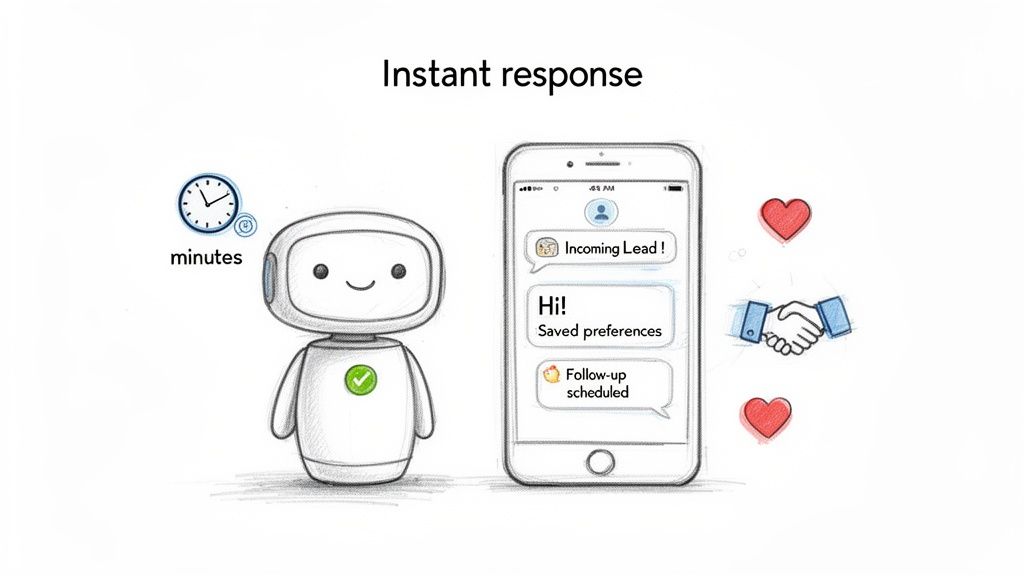
Let's cut through the jargon. Real estate marketing automation is simply using software to handle your repetitive, time-sucking marketing tasks for you. Think of it as your ultimate business assistant—the one who makes sure no lead ever gets forgotten, even when you're busy at a showing or deep in paperwork.
Instead of manually texting every new lead from your Facebook ad or trying to remember who you met at that open house three weeks ago, an automated system jumps on it instantly. This clears your plate, letting you focus on the high-value, human-to-human stuff like building relationships and closing deals.
Why Is This Such a Big Deal Right Now?
Today's real estate market moves at lightning speed, and clients expect the same from you. Being the first to respond isn't just a nice touch; it's often the difference between getting the client and losing them to a competitor.
The numbers don't lie. Research shows that 90% of customers say an 'immediate' response is a top priority, and a whopping 60% consider 'immediate' to mean 10 minutes or less. When you automate that first touchpoint, you're not just being fast—you're meeting the modern client's core expectation and gaining a massive head start.
This kind of tech has gone from a "nice-to-have" luxury to a must-have tool for any serious real estate business. It helps you deliver a consistent, professional experience to every single person you interact with, building trust from the very first click.
So, What Does Automation Actually Do?
Let's get practical. What kind of tasks can you actually hand off to your new digital assistant? You'd be surprised how much it can handle to directly boost your bottom line.
Automation helps you:
- Respond to New Leads in Seconds: Automatically send a welcome text or email the moment someone fills out a form on your website or ad. No more "I'll get to it later."
- Nurture Your Long-Term Pipeline: Drip valuable market updates or relevant listings to those "just looking" leads for weeks or months, keeping you top-of-mind so they call you when they're ready.
- Never Miss a Follow-Up Again: Set up timed message sequences to automatically check in after an open house, a phone call, or a showing. It’s systematic and foolproof.
- Keep Your Database Organized: Automatically tag and sort leads in your CRM based on their source (e.g., "Zillow lead," "Website contact") or their interests ("Looking to buy," "Wants a 3-bedroom").
To make this crystal clear, let's look at a side-by-side comparison of how a few common tasks get done.
The Manual Way vs The Automated Way
| Task | Manual Process (Without Automation) | Automated Process (With Automation) |
|---|---|---|
| New Lead Response | Check notifications, stop what you're doing, copy/paste a message, and send. (Avg. time: 5-30+ mins) | System instantly sends a pre-written, personalized text/email. (Avg. time: Under 60 seconds) |
| Post-Open House | Manually enter all names into CRM, then individually email or text each person the next day (if you remember). | Scan a QR code at the event. System automatically adds them to the CRM and starts a follow-up sequence. (Avg. time: Zero) |
| Long-Term Nurture | Set calendar reminders to "check in" every few months. Look up old notes and try to send something relevant. | System automatically sends monthly market reports or new listings that match their old search criteria. (Avg. time: Zero) |
See the difference? It's not just about saving a few minutes here and there; it's about building a reliable, scalable system that works for you even when you're not working.
The real goal here is to scale your human touch without burning out. Automation ensures every single lead gets the attention they deserve, which lets you run a much more efficient and profitable business.
If you're just dipping your toes into this world, it helps to see these tools in action. A great place to start is by looking into the best real estate chatbots. They are a perfect example of how technology can handle those crucial first conversations, setting you up for success.
The Building Blocks of a Powerful Automation System
Think of your real estate marketing automation like building a custom race car. It's not one single part that makes it fast; it's a bunch of high-performance components working together in perfect sync. When you bolt them all together the right way, you get a machine that pretty much drives itself, fueling your business growth without you having to be behind the wheel 24/7.
So, what are these essential parts? Let's pop the hood and take a look at the four pillars that every successful automation setup is built on. Figuring out how they connect is the key to building a business that works for you, not the other way around.
The Foundation: Lead Capture Mechanisms
Before you can automate a single follow-up, you obviously need leads. Lead capture is your starting line—it's how potential clients signal they're interested. A smart system doesn't just have one way in; it has multiple doors.
This usually includes things like:
- Website Forms: Your classic "Get a Free Home Valuation" or "Contact Us" forms. Simple, but they work.
- Social Media Integrations: These are clutch. They pull lead info directly from your Facebook or Instagram ads the second someone clicks.
- Missed Call Text-Back: This one is a game-changer. Someone calls your number and hangs up? It automatically shoots them a text so you never miss a beat.
Each of these entry points acts like a funnel, pouring fresh opportunities right into your system so you can get to work on them instantly. If you can't capture leads effectively, the fanciest follow-up in the world won't do you any good.
The First Responder: Instant Engagement Tools
The moment a lead hits your system, the clock is ticking. This is where instant response tools become your MVP. Their whole job is to engage a new lead within seconds of them reaching out.
Responding immediately isn't just a nice-to-have anymore; it's what people expect. It's probably the single most impactful part of any automation because it dramatically increases your odds of actually having a conversation.
This isn't just about being fast, either. It’s about making a professional first impression, even if it's 2 AM on a Sunday. Whether it's a quick text confirming you got their info or an email with some helpful next steps, this piece of the puzzle makes every single lead feel like a priority from the get-go.
The Central Hub: CRM Integration
Okay, so lead capture is the front door and instant response is the friendly greeting. Your Customer Relationship Management (CRM) system is the brain of the whole operation. A good automation platform doesn't just create a flurry of activity; it keeps everything perfectly organized.
What does a CRM actually do in all this?
Think of it as your digital command center. It stores every little detail about your leads and clients. When you hook it up to your automation, it automatically logs every single interaction—every text, every email, every call. No more frantic manual data entry. You get a complete, organized history for every contact.
This is absolutely critical for long-term nurturing. It’s what allows your system to be smart—to send the right message to the right person at the right time, because it knows exactly who they are and where they are in their journey. For a closer look at the tools that power this, you can learn more about the different types of real estate marketing automation software out there.
The Fuel Source: Paid Advertising
Last but not least, every high-performance engine needs fuel. In this world, paid advertising is the premium, high-octane stuff that keeps your machine running at full throttle. Organic and referral leads are fantastic, but if you want predictable growth, you need a predictable source of new business.
Paid ads on platforms like Facebook and Instagram let you get incredibly specific. You can target first-time homebuyers in a particular zip code or homeowners who might be thinking about selling, and then feed a steady stream of these qualified leads right into your capture funnels. This is what turns your automation from a simple tool that reacts to a proactive engine for growth, putting you in control of your pipeline.
Your Automation Roadmap From New Agent to Top Producer
Jumping into real estate marketing automation can feel like trying to drink from a firehose. So much to learn, so many tools. But here’s the good news: you don't need every bell and whistle right out of the gate. The real secret is to layer in automation that actually matches where you are in your career, building a powerful system piece by piece.
Think of it like leveling up in a game. You start with the basic gear, get really good with it, and then add more advanced tools as you take on bigger challenges. This roadmap breaks that journey down into three clear stages, so you always know what to focus on next.
Phase 1: The New Agent (Focus on Foundation)
When you're just starting out, your number one priority is simple: don't waste a single lead. You're hustling for every single opportunity, so letting one slip through the cracks because you were in a meeting is a painful, costly mistake. This is where you lay the foundation for everything to come.
Your non-negotiable first step is an instant-response system. Think of it as your safety net. It makes sure every single person who reaches out—whether from your website, a Facebook message, or a missed call—gets an immediate, professional reply.
Your only goal here is to capture and connect.
- What to Automate First: Set up a simple system that automatically shoots out a text or email the second a new lead comes in. This buys you precious time and makes an incredible first impression.
- Why It Works: It instantly tells the lead, "I got your message, and you're important to me," which is exactly what today's clients expect.
- Keep It Simple: You don't need a 20-step email campaign at this point. A single, well-worded message like, "Hey [Name], thanks for reaching out about [Property/Topic]. I'm with a client right now but will call you in a few minutes," works wonders.
This foundational layer makes sure you capitalize on every hard-earned opportunity, giving you the momentum you need to really get your business off the ground.
Phase 2: The Growing Agent (Focus on Predictability)
Okay, so your instant-response system is humming along, catching every lead without fail. Awesome. Now it’s time to really open up the pipeline. As a growing agent, your focus shifts from just surviving to creating a predictable flow of new business. You're ready to move beyond relying on your sphere and start generating leads on your own terms.
This is where you plug a predictable lead generation engine—usually targeted digital ads—into your automation stack.
What exactly is "predictable lead generation?" It means you can confidently put a certain amount of money into your advertising and know, with a pretty high degree of certainty, how many leads you'll get back. This turns your marketing from a random expense into a measurable investment.
The key at this stage is to wire your new lead sources directly into the instant-response system you already built. This creates a seamless, hands-free journey from ad to conversation.
This diagram shows how that simple, powerful funnel works.
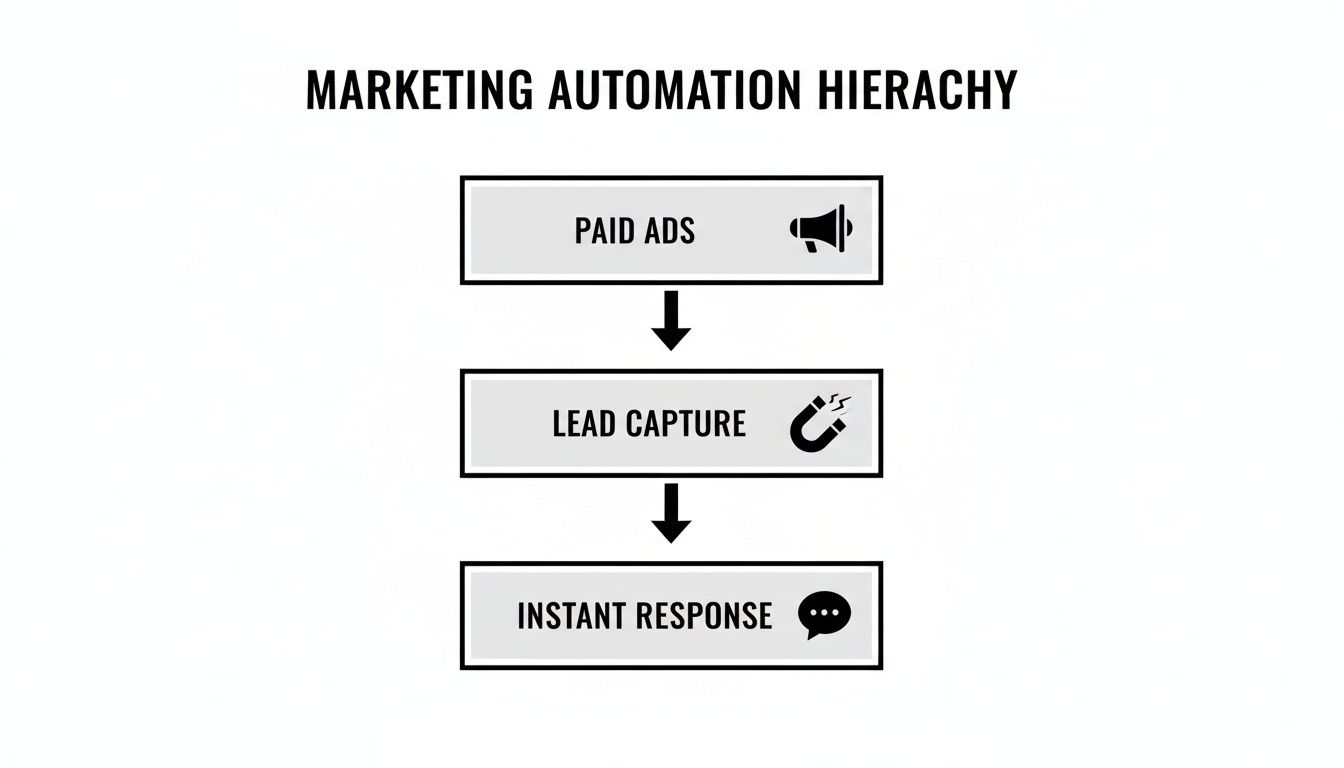
It’s a straight shot from grabbing someone's attention online to starting a real conversation, all powered by your automation.
Phase 3: The High-Volume Agent or Team (Focus on Leverage)
You've hit the big leagues. You have a steady stream of leads pouring in, but you've run out of hours in the day to personally follow up with all of them. This is a great problem to have! Your challenge is no longer about getting leads; it's about managing and qualifying them. Your new goal is leverage—multiplying your results without cloning yourself.
This is the perfect time to plug an Inside Sales Agent (ISA) service into your real estate marketing automation. An ISA service takes the entire time-sucking qualification process off your plate.
Here’s a look at how this high-level setup runs:
- Lead Comes In: Your ads generate a new lead that drops right into your system.
- Automation Engages: Your system instantly sends that first text/email you set up way back in Phase 1.
- ISA Takes Over: A professionally trained ISA immediately follows up with calls and texts, asking all the key qualifying questions (Are they working with an agent? What's their timeline? Are they pre-approved?).
- Appointments Are Booked: Once the ISA confirms the lead is a serious, ready-to-talk prospect, they book an appointment directly on your calendar.
You only show up for meetings with pre-vetted, motivated buyers and sellers. This is the ultimate form of leverage, freeing you up to focus only on high-value, dollar-producing activities. This is how top producers and teams scale their business to incredible heights.
Real-World Automation Plays You Can Run Today
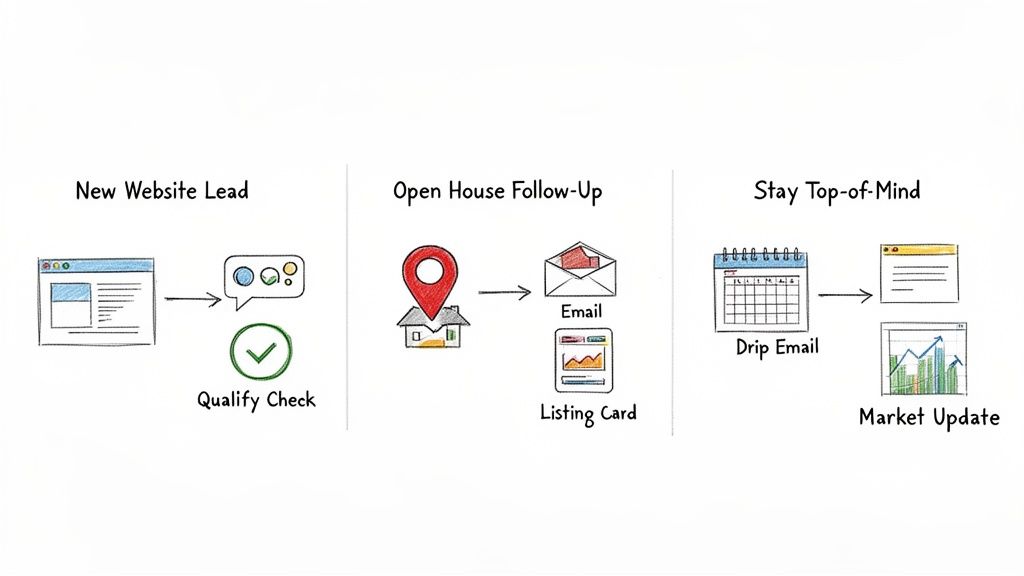
Knowing the theory behind real estate marketing automation is great, but putting it into practice is where the magic really happens—and where you’ll see a real impact on your bottom line. So, let’s get out of the clouds and onto the ground with some practical, proven workflows you can start using in your business today.
Don't worry, these aren't some ridiculously complicated, tech-heavy strategies. They're just simple, logical sequences designed to engage leads, build relationships, and, most importantly, give you back a massive amount of your time.
Play 1: The New Website Lead
This is the bread and butter, the foundational play every single agent needs. The goal is simple: make instant contact and start qualifying a lead the second they fill out a form on your site.
How does it work?
The whole sequence kicks off the moment someone hits "submit," starting a multi-channel follow-up designed to get a conversation going while they're still hot.
Here’s how it breaks down, step-by-step:
- The Trigger: A new lead fills out a "Contact Us" or "Get More Info" form on your website.
- Instantly (Within 60 seconds): An automated text goes out. "Hi [Lead Name], thanks for reaching out on my site! I'm just wrapping up with a client but will call you in about 15 minutes. – [Your Name]"
- 15 Minutes Later: You get a slick, automated reminder on your phone to make that call. No more forgetting.
- 1 Hour Later (If they don't reply): An automated email lands in their inbox with something genuinely useful, like a first-time homebuyer guide or a local market report.
- Day 2: Another text fires off. "Hey [Lead Name], just wanted to follow up. Are you looking to buy in the next 3-6 months, or are you just browsing for now?"
This simple sequence makes sure every single lead gets immediate attention, which massively boosts your odds of actually connecting with them while your website is still fresh in their mind.
Play 2: The Open House Follow-Up
Let's be honest, open houses can be a goldmine for leads, but following up with everyone manually is a soul-crushing task that often gets pushed to the side. This play automates that entire process, turning those casual Sunday visitors into genuinely warm prospects.
How does it work?
Ditch the old-school paper sign-in sheet and use a QR code that links to a simple digital form. The moment a visitor fills it out, they’re dropped right into this workflow.
- The Trigger: An attendee submits their info through your digital sign-in form.
- 1 Hour After the Open House: An email automatically goes out. "Thanks for stopping by 123 Main St! Here are the details on the property again. Let me know if you have any questions."
- Day 3: A text hits their phone with a link to similar properties. "Hi [Lead Name], a few other homes came on the market nearby that you might like. You can view them here: [Link to your website]."
- Day 7: Another email arrives asking for their thoughts. "Now that you've had some time to think, what did you like or dislike about the home? Your feedback helps me find the perfect fit for you."
This approach keeps you top-of-mind without you having to lift a finger. It provides real value and positions you as a helpful resource, not just another agent begging for business.
Play 3: The Long-Term Nurture
So, what about all those leads who say they’re "just looking" or "maybe in 6-12 months"? This is where most agents completely drop the ball. This play is a low-touch, high-value sequence that keeps you connected without being annoying.
How does it work?
Think of this as your slow-drip campaign for all the colder leads sitting in your CRM.
- The Trigger: You manually tag a lead as "Long-Term Nurture" in your CRM.
- Monthly: An automated email is sent with a hyper-local market update or a link to a blog post you wrote. The key is to be educational and valuable, not salesy.
- Quarterly: A quick text message checks in. "Hi [Lead Name], hope you're doing well! The market is still moving. Have your real estate plans changed at all?"
A quick but important note on compliance: Using an automated system isn’t just about being efficient; it’s also about protecting yourself. Professional real estate marketing automation platforms help you stay compliant with regulations like the Telephone Consumer Protection Act (TCPA) by logging consent the moment a lead opts in. This creates a digital paper trail, which is absolutely crucial for minimizing your risk.
The global marketing automation market is absolutely exploding, projected to jump from $6.65 billion in 2024 to $15.58 billion by 2030. For us in real estate, this growth is all about meeting the demand for personalized, multi-channel experiences. Professional systems are built to handle these complex nurture sequences while also logging the necessary consents to align with FTC and TCPA rules—a must-have now that 75% of agents use social media for lead generation. If you want to go deeper, you can explore more marketing automation statistics and trends.
How to Know If Your Automation Is Actually Working
So you’ve got your real estate marketing automation up and running. That's a huge win, but it's really just the starting line. Now comes the real question: is it actually doing anything for your business?
An automation system without a way to measure it is just a bunch of fancy software running in the background. To know if it's a smart investment or just an expensive hobby, you have to track the numbers that matter—your Key Performance Indicators (KPIs).
Think of KPIs as the dashboard of your business. They're the gauges that tell you if you're speeding toward your goals or just burning fuel. Without them, you're flying blind.
What Are the Most Important Automation KPIs to Track?
Let’s be honest, vanity metrics like email open rates are nice to look at, but they don't cash commission checks. You need to focus on the KPIs that trace the real journey from a curious click to a closed deal.
These are the numbers that actually move the needle:
- Lead Response Time: How fast does your system jump on a new lead? We're talking about the time from the second they hit "submit" to the moment your first text goes out. The goal here is under 60 seconds. In this game, speed is everything.
- Connection Rate: This is the percentage of new leads you (or your ISA) actually manage to have a real, two-way conversation with. If this number is low, your initial scripts might be falling flat, or you're not following up aggressively enough.
- Lead-to-Appointment Ratio: Of all the leads you actually talk to, how many agree to meet with you? This KPI is a direct reflection of how well you’re qualifying leads and building value during those initial chats.
- Appointment-to-Client Ratio: You're holding appointments, but are they turning into signed agreements? This number tells you how effective you are once you get face-to-face (or screen-to-screen) with a potential client.
When you track these metrics, you get a crystal-clear, step-by-step breakdown of your entire sales pipeline. You'll see exactly what's working and, more importantly, where the leaks are.
Here's a quick guide to the most crucial KPIs and how you can actually use them to get better results.
Key Automation KPIs and How to Track Them
A practical guide to the most important metrics for measuring the success of your real estate automation strategy.
| KPI (Key Performance Indicator) | What It Measures | Why It Matters | How to Improve It |
|---|---|---|---|
| Lead Response Time | Time between lead submission and first contact. | A response within 5 minutes makes you 21x more likely to qualify a lead. | Set up instant SMS/email triggers in your CRM. Use chatbots on your site for immediate engagement. |
| Connection Rate | Percentage of leads you have a live conversation with. | This is the first real gate in your funnel. A low rate means wasted ad spend. | A/B test your opening text messages. Implement a multi-touch sequence (text, email, call). |
| Lead-to-Appointment Ratio | Percentage of connected leads that book a meeting. | Shows the effectiveness of your scripts and qualification process. | Refine your scripts, practice objection handling, and ensure you're clearly communicating your value proposition. |
| Appointment-to-Client Ratio | Percentage of held appointments that become signed clients. | The ultimate test of your in-person sales skills and presentation. | Improve your listing presentation, create a buyer consultation package, and master your closing techniques. |
Tracking these isn't just about crunching numbers; it's about giving yourself a roadmap for improvement at every single stage of the game.
Connecting the Dots to Your Return on Investment
So, how does all this tracking prove your automation is worth the money? It all boils down to your Return on Investment (ROI). It sounds like a stuffy business term, but it’s actually pretty simple: for every dollar you put into your system (think software, ads, etc.), how many dollars in commission are you getting back?
The ultimate goal of real estate marketing automation isn't just to be busy; it's to be profitable. Tracking your KPIs is the only way to know for sure if your marketing dollars are working as hard as you are.
Let’s run the numbers. If your average commission is $9,000 and it takes you 100 leads to land one closing, then every single lead is worth $90 to your business. Boom. Just like that, you have a hard number that empowers you to make smart, data-driven decisions. You know exactly what you can afford to spend on a new lead and still come out ahead.
To really see if your automation is firing on all cylinders, you have to look at how each piece is performing. For instance, you can boost your entire funnel by applying a few smart conversion rate optimization tips for forms. When you get more leads to fill out your forms in the first place, every other KPI down the line gets a lift, paving a much smoother road to a solid ROI.
Common Mistakes to Avoid When Automating

Knowing what to do is half the battle. Knowing what not to do? That’s the other half. Even the most powerful real estate marketing automation can fall flat if you stumble into a few common traps. Let's walk through the big ones so you can dodge them from the get-go.
One of the easiest ways to kill a lead's interest is to sound like a machine. Just because a system is sending the message doesn't mean it should be writing it. Generic, canned responses are an immediate red flag for clients and a surefire way to get ignored.
Sounding Too Robotic
Your personality is your biggest advantage in this business, so don't let your automation strip it away. Ditch the stiff, formal language and write messages that actually sound like you.
What is the best way to keep automated messages human?
Simple: write like you talk. Use the lead's name, mention the specific property they inquired about, and let your voice shine through. A friendly, genuine tone makes a world of difference and shows there's a real person on the other end.
The goal of automation is to scale your personal touch, not eliminate it. A well-crafted message should feel like you personally took the time to send it, even when you didn’t.
Having No Handoff Plan
This is a classic blunder. You've got this amazing automated sequence running, but there's no clear point where you, the human, are supposed to jump in. A lead might reply with a direct question or signal they're ready for a call, but if your system just keeps plowing ahead with its script, you've already lost them.
You need a solid plan for that "handoff." Set up alerts and triggers that tell you it's your turn to take the wheel. This is the moment where the tech steps back and you step forward to build a real relationship.
Adopting a Set-It-and-Forget-It Mindset
Lastly, you can't treat your automation like a crockpot. It’s not something you can just set up once and walk away from. Your system needs regular tune-ups to keep it running smoothly and effectively.
Think of it like tending a garden, not flipping a switch. To keep your automation from getting stale and out of touch, make a habit of these things:
- Check your message performance: Are some texts getting way more replies than others? See what's working and do more of it.
- Keep your content fresh: Is that market update you loaded in six months ago still relevant? Probably not. Swap out old info for new insights.
- Listen to your leads: If you notice people are always asking the same follow-up question, build the answer right into your sequence.
By sidestepping these common pitfalls, your automation will work for you, not against you. It'll become a true extension of your business, helping you connect with more people without losing that personal touch that makes a great agent.
Your Real Estate Automation Questions, Answered
Jumping into real estate marketing automation can feel like a huge step, and you probably have a lot of questions. That’s a good thing. It means you're being smart about a major business decision. Let's walk through some of the most common concerns agents have before they take the leap.
Will Automation Make My Business Feel Impersonal?
This is probably the number one fear I hear from agents, and it's a completely valid one. Real estate is a relationships business, after all. But here’s the thing: great automation doesn't make you less personal. It makes you more personal, more often.
Good automation isn’t about replacing conversations; it’s about starting them. You design messages that sound exactly like you, and you set up alerts that tell you the second a real person needs to step in. Think of it as your virtual assistant handling the initial "hello," which frees you up to have the meaningful, high-value conversations that actually close deals. It lets you connect with more people without sacrificing that personal touch.
How Much Technical Skill Do I Need to Start?
Honestly, way less than you'd think. The days of needing a computer science degree to automate your marketing are long gone. Today’s platforms are built for busy professionals like you, not developers. Most have simple, drag-and-drop interfaces that are pretty intuitive.
Better yet, a lot of what we do is a "done-for-you" service. That means we handle all the setup, management, and tweaking behind the scenes. Your only job is to show up for the qualified appointments that pop up on your calendar.
The best systems are designed to simplify your life, not complicate it. The whole point is to spend less time clicking buttons and more time talking to people who are ready to make a move.
Is This Affordable for a New Real Estate Agent?
Absolutely. The trick is to start smart and scale up. You don't need to buy a massive, do-everything software suite on day one.
Start with the one thing that will give you the biggest bang for your buck: a system that captures and instantly responds to every single lead. This core function is surprisingly affordable and delivers an immediate return on your investment. Then, as your commission checks get bigger, you can reinvest in more advanced features like paid ads or ISA services.
What Is the Difference Between a CRM and Marketing Automation?
Great question, because they're often talked about together and work hand-in-hand.
Think of it this way: your CRM is your digital rolodex. It’s the database that neatly stores and organizes everything you know about your clients and leads.
Marketing automation, on the other hand, is the engine that does things with that information. When a new lead fills out a form on your website, the automation is what instantly sends them a welcome text. At the same time, your CRM is what creates and files away their contact card for you. They’re two distinct tools that work together as a powerful team.
Ready to see how a simple, scalable automation system can transform your business? At DB Marketing Co., we build the exact system you need for your career stage, from foundational lead response to full-service appointment setting. Explore our services and get started today.