
A single property website is pretty much what it sounds like: a dedicated website built for one specific real estate listing. Think of it less like a classified ad and more like a premium, standalone digital brochure that showcases a single home without any other listings trying to steal the spotlight.
Your Secret Weapon in a Crowded Market
Ever pour your heart and marketing budget into a stunning new listing, only to watch it get lost in the endless scroll on Zillow or the local MLS? You’re not alone. The single biggest challenge for agents today is cutting through all that noise. This is exactly where a single property website becomes your secret weapon.
Imagine a potential buyer landing on a page that is 100% dedicated to your listing. There are no ads for other agents, no distracting sidebars featuring competing homes, and no cluttered navigation pulling their attention away. It’s just them and the property. This creates an immersive, focused experience that standard listing platforms simply can't replicate.
Before we dig deeper, let's look at a quick comparison to see why this approach is so effective.
Single Property Website vs Standard MLS Listing
| Feature | Single Property Website | Standard MLS Listing |
|---|---|---|
| Branding | Fully branded to you, the agent. | Co-branded with the MLS/portal; agent branding is minimal. |
| Visitor Focus | Captures 100% of visitor attention on one property. | Displays competing listings and other agents' ads. |
| Content Control | Unlimited space for photos, videos, 3D tours, and storytelling. | Limited by MLS field constraints and templates. |
| Lead Capture | Multiple, strategic lead capture forms and CTAs. | Generic contact form, often shared with other agents. |
| Analytics | Detailed tracking of visitor behavior, traffic sources, etc. | Basic, high-level view counts; no granular data. |
| Seller Impression | Positions you as a premium, marketing-savvy agent. | Meets the basic expectation of what every agent does. |
This table really just scratches the surface. A dedicated site gives you a level of control and marketing power that's impossible to achieve when your listing is just one among thousands.
Win More Listings and Justify Your Value
Think about your next listing presentation. What really sets you apart? Every agent promises professional photos and an MLS entry. But when you pull up an example of a sleek, dedicated website for a past client, you're showing sellers a whole different level of marketing commitment.
This strategy isn’t just about selling their house; it’s about selling yourself as a top-tier agent who invests in premium marketing tools. It's a tangible asset that proves you go the extra mile.
By offering a dedicated website, you’re not just listing a home—you’re launching a full-blown marketing campaign for it. This instantly elevates the perceived value of the property and, just as importantly, the value of your services.
This approach has been a game-changer, especially for unique or luxury properties. In hyper-competitive markets, as detailed in reports from places like HousingWire, every small advantage counts. These sites completely remove the distractions that bombard users on the big portals.
Creating an Exclusive, High-End Feel
The psychology here is pretty powerful. A single property website frames the home not as just another house for sale, but as a standout property that truly deserves its own spotlight. That feeling of exclusivity can directly influence how a buyer perceives its value and how much they might be willing to pay.
This focused environment lets you tell a compelling story. You're no longer stuck within the rigid templates of the MLS. You control the entire narrative from start to finish.
- Sell the Lifestyle: You have the space to showcase the neighborhood, talk about the local coffee shop, and paint a picture of the unique lifestyle the home offers.
- Curate the Tour: You can guide visitors on a carefully planned journey, from a breathtaking hero image to an immersive video tour, interactive floor plans, and a detailed feature list.
- Build an Emotional Connection: Use compelling language and incredible media to help potential buyers actually see themselves living in that space.
At the end of the day, a single property website is much more than just another marketing tool. It's a strategic asset that helps you capture undivided attention, seriously impress sellers, and build a brand that stands out. It’s how you stop competing on volume and start winning on value.
Laying the Groundwork for Your Website
Before you ever touch a website builder or think about colors and fonts, you've got to have a solid plan. A truly effective single property website isn't just a digital brochure; it's a strategic marketing tool. It all boils down to one simple, yet crucial, question.
Who, exactly, are you trying to sell this home to?
Everything hinges on that answer. Seriously. Is this a starter home for a young family that cares about school districts and a fenced-in yard? Or is it a sleek downtown condo perfect for a professional couple who values walkability and low maintenance? Maybe it's a luxury retreat for an empty-nester looking to downsize without downgrading.
Once you nail down your ideal buyer persona, every other decision falls into place. The language you use, the features you highlight, the story you tell—it all needs to speak directly to them.
Go Beyond MLS Photos: Craft Content That Sells a Lifestyle
Let's be real: standard MLS photos are the bare minimum. If you want to create a website that actually gets people excited, you have to offer an experience. You need to help potential buyers emotionally connect with the home before they even book a showing.
Your job here is to sell the lifestyle, not just the four walls and a roof. This is where you can flex your marketing muscles and really stand out.
Here’s the kind of content that makes a real difference:
- A Cinematic Video Tour: A well-shot video tells a story that photos just can't. It shows the flow of the home, captures the light, and creates a feeling. It makes the space feel real and alive.
- Immersive 3D Walkthroughs: Tools like Matterport are game-changers. They let buyers virtually "walk" through the entire property from their couch. This isn't just cool tech; it's a powerful lead qualifier. Anyone who spends 10 minutes exploring a 3D tour is a serious prospect.
- Clean, Detailed Floor Plans: Buyers are practical. They need to know if their king-size bed will fit or if the kitchen layout works for them. Crisp, easy-to-read floor plans with dimensions are non-negotiable.
- Descriptions That Tell a Story: Ditch the boring, feature-list descriptions. Instead, paint a picture with your words. Talk about enjoying a morning coffee in the sun-drenched breakfast nook or hosting summer barbecues on the sprawling back patio.
The stats don't lie. Listings with video tours can pull in up to 403% more inquiries. And when you consider that 28% of buyers are first-timers doing tons of online research, it's clear why rich media matters. In fact, 41% of buyers are more likely to visit a home in person after seeing a virtual tour or professional photos. If you want to dig deeper, these real estate photography statistics really drive the point home.
Don't Forget the Neighborhood
A house is more than just a structure; it's part of a community. The neighborhood is a massive piece of the puzzle, and a great single property website weaves that story right into the property details.
Don't just list facts—bring the area to life.
Don't just say it's in a 'great school district.' Name the specific schools, link to their GreatSchools rating, and mention something unique, like the beloved annual science fair. That kind of detail shows you're a true local expert and builds immediate trust.
This is how a single property site becomes the powerful hub of all your marketing. It takes the basic info from the MLS and elevates it into a compelling story that captures buyer interest.
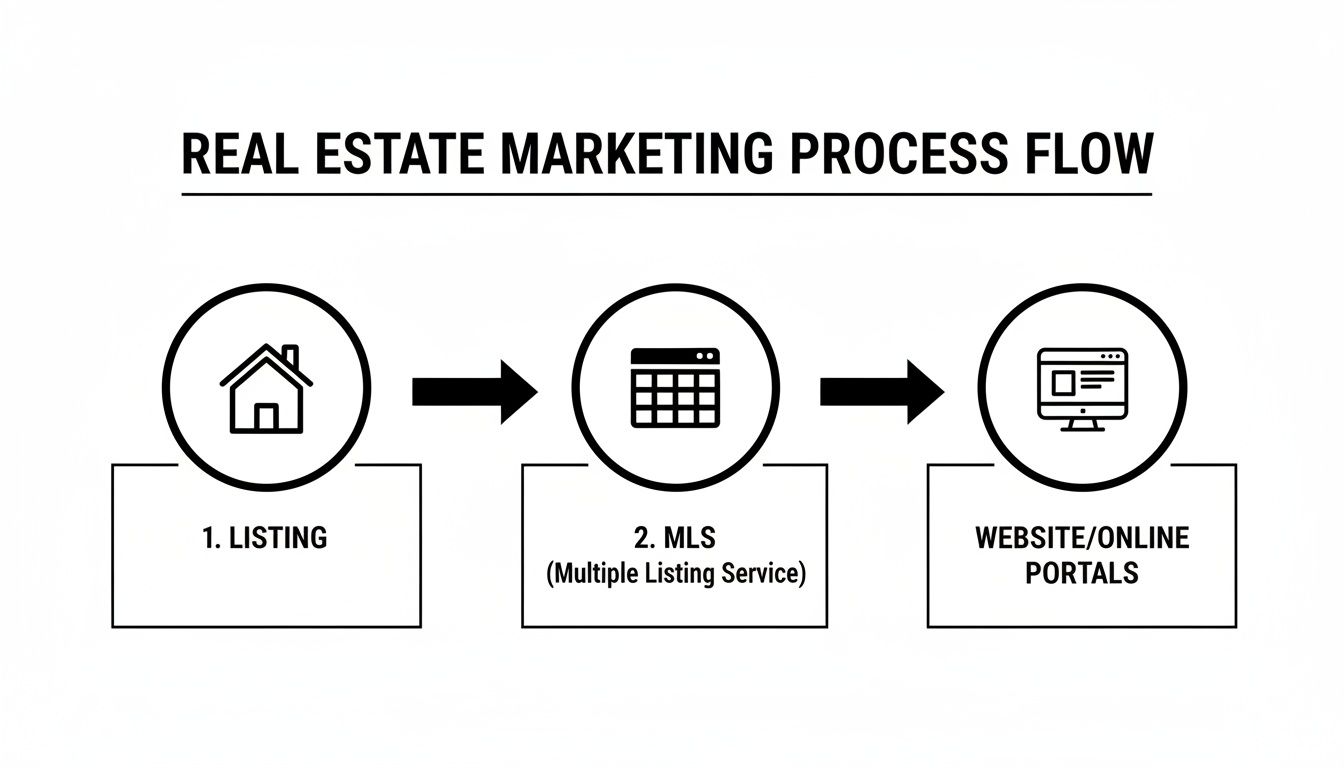
As you can see, the dedicated website isn't just another step; it's the destination where you turn casual lookers into genuinely interested buyers.
Helping Google Find You: SEO 101
Okay, so you've built a beautiful, compelling website. Now what? People need to be able to find it. While you'll likely run paid ads, you can't afford to ignore free, organic traffic from search engines. That means you need some basic Search Engine Optimization (SEO).
Let's start with the very first thing people will see: the domain name.
What’s the best domain for a single property site?
My advice? Keep it simple and memorable. The absolute best practice is to just use the street address.
- Good Example:
123ElmStreet.com - Okay Example:
TheOaksAtRiverCreek.com(This works for a new development but is too vague for a single home.) - Bad Example:
BestHomeForSaleInAustinTX.com(This just screams spam and is impossible to remember.)
An address-based domain like 123ElmStreet.com is professional, clean, and super easy for a buyer to type in after seeing it on your yard sign or a flyer.
Next up is a simple trick for your images. Before you upload a single photo, rename the files. A camera spits out names like IMG_9876.jpg. That means nothing to Google. Change it to something descriptive, like 123-elm-street-kitchen-remodel.jpg. This is a tiny step that helps search engines understand what your photos are about, giving you a better shot at showing up in image searches and driving more organic traffic to your site.
Designing for Dollars: How to Turn Website Visitors Into Leads
A gorgeous website is great, but let's be honest—if it isn't bringing in leads, it's just a pretty digital brochure. A single property website needs to be a business asset. If yours isn't turning curious lookers into actual buyers, it's time to focus on conversion. This is all about turning those clicks into real conversations and tour requests.
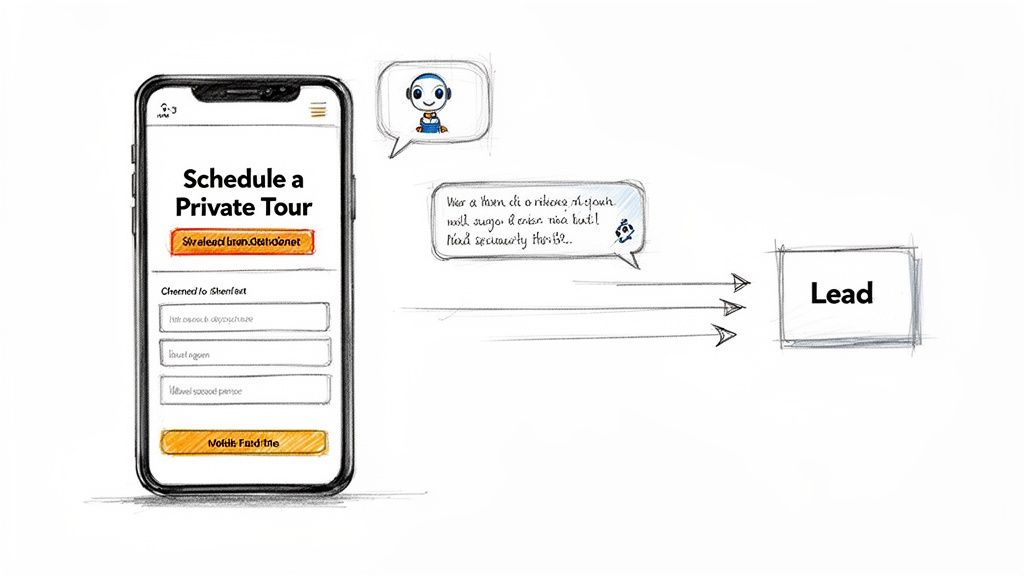
Think of it this way: you're building an automated lead machine that works for you 24/7. Every single element on the page should be strategically placed to nudge visitors toward one specific action: getting in touch with you. The whole point is to make it incredibly easy and compelling for them to take that next step.
Make Your Calls to Action Impossible to Miss
Your call-to-action (CTA) is hands-down the most important piece of the conversion puzzle. It's the button or link that tells people exactly what to do next. Weak, generic CTAs like "Contact Us" just don't cut it anymore. They're boring and don't inspire anyone to act.
You need to use clear, benefit-focused language that taps right into what a buyer is thinking. Your CTAs should be big, bold, and placed where no one can miss them.
Here are a few examples that actually work:
- Schedule a Private Tour: This feels direct and exclusive. It’s a clear next step.
- Download the Floor Plans: You're offering something of value in exchange for their email.
- Ask a Question: A perfect low-commitment option that opens the door for a chat.
- See the 3D Walkthrough: This is a great way to "gate" your best content and capture a lead.
I always recommend placing these buttons "above the fold" (what people see without scrolling), right after the photo gallery, and again near the bottom. A little repetition goes a long way in making sure a visitor never has to search for how to reach you.
What Should I Ask on a Real Estate Contact Form?
I get this question all the time, and my answer is always the same: ask for as little as humanly possible. Seriously. Every extra field you add is another reason for someone to give up and leave. The goal here is just to start a conversation, not to pre-qualify them on the spot.
For a single property site, a high-converting form only needs three things:
- Name: So you know who you're talking to.
- Email: The main way you'll follow up.
- Phone Number: For when you need to get in touch quickly.
That’s it. Fight the urge to ask about their budget, their buying timeline, or if they’re already working with an agent. Those are all great questions for your follow-up call, not roadblocks on your website.
Keep the form dead simple, label everything clearly, and make that "submit" button pop. This simple approach removes all the friction and will absolutely maximize the number of leads you get. If you want to go deeper, we cover this in our guide on creating high-converting landing pages for real estate.
Engage Buyers Instantly with Chat
What if you could answer a potential buyer's question the exact moment it pops into their head? That’s what a good chat tool does. Adding a chat widget—whether it's run by you or a smart chatbot—can be a game-changer for engagement.
Imagine a visitor lands on your site, and a friendly little window pops up saying, "Have a quick question about 123 Elm Street? I'm here to help!" It feels personal and provides an instant way for them to connect, grabbing those leads who might have otherwise just clicked away.
Why Mobile-First Design Is Not Optional
Let's face it: the overwhelming majority of buyers will see your website for the first time on their phone. If that experience is clunky, slow, or hard to use, you've already lost them. Mobile-first design isn't just a trendy phrase; it’s a must-do.
This means you design the website for a phone screen first, then adapt it for desktops and tablets.
- Images have to load fast. No one is waiting.
- Text needs to be big enough to read. No pinching and zooming.
- Buttons must be easy to tap with a thumb.
- Forms should be a breeze to fill out on a touchscreen.
A bad mobile experience is the quickest way to kill a lead. Always, always test the site on your own phone. Make sure it delivers a smooth, professional experience that reflects the quality of the home you're selling.
Your Tech Toolkit for a Smooth Launch
Let's be clear: you don't need to be a tech guru to get a killer single property website off the ground. The tools we have today are incredibly intuitive, but understanding your options is what separates a smooth launch from a week of headaches. This is all about getting your site live efficiently while making sure you’re playing by the rules.
Nailing the Domain and Hosting
First things first, you need a digital address for your listing—the domain name. This is what people will type into their browser, so keep it simple, professional, and memorable.
I always recommend using the property’s street address, like 455MapleLane.com. It's clean, looks fantastic on a sign rider or mailer, and instantly connects the site to the physical home. Steer clear of long, clunky domains stuffed with keywords; they just look spammy.
Once you have a domain, you need a place for your website to live (hosting) and a way to build it. For agents who want a dedicated online space for their listings, picking the right platform is key. You can find some great in-depth reviews of the best website builders specifically designed for real estate agents that break down all the features and costs.
You’ve basically got a few paths you can take:
- All-in-One Builders: Think Squarespace, Wix, or other real estate-specific platforms. They usually bundle everything you need—hosting, templates, and drag-and-drop editors. This is the fastest, most direct route for most agents.
- WordPress: This is the power user's choice. It gives you incredible flexibility and customization, but it definitely has a steeper learning curve. You’ll have to set up your own hosting and get a bit more hands-on, but the trade-off is total control.
For a single property site? An all-in-one builder is almost always the most efficient and budget-friendly option. Your goal is to get a beautiful, functional site live fast, not to moonlight as a web developer.
Staying on the Right Side of MLS and IDX Rules
This is the part that makes a lot of agents nervous, but it’s simpler than you think. IDX (Internet Data Exchange) is the policy that lets us display MLS listing data on our websites. Now, since you’re marketing your own listing on a standalone site, many of the strictest IDX display rules don't apply in the same way they do for a big search portal.
However—and this is a big however—you are still bound by your local MLS and brokerage guidelines. This means you have a tiny bit of homework to do.
Pro Tip: The single most important thing you can do is check your local board's rules. Just call or email your MLS provider and ask, "What are the display requirements for marketing my own listing on a standalone website?" That one question will save you a world of trouble.
A few questions pop up constantly when I talk about this with other agents.
Do I have to link back to the MLS?
Usually, yes. Many boards require any advertising for a listed property to include a link back to the official MLS listing or to display the MLS number prominently. This is easy—just a simple link you can pop into the website's footer.
How do I know for sure I’m compliant?
When in doubt, ask! After checking the official rules, have a quick chat with your broker. They’re ultimately responsible for your compliance and will know the specific nuances for your area.
The most common rules you'll run into involve:
- Clearly displaying your brokerage name.
- Including the fair housing and equal opportunity logos.
- Making sure the property’s official MLS number is visible.
Getting these little details right from the beginning ensures your awesome new site is fully compliant. That way, you can focus on what really matters: finding the perfect buyer for your listing.
Getting Your Site in Front of the Right Buyers
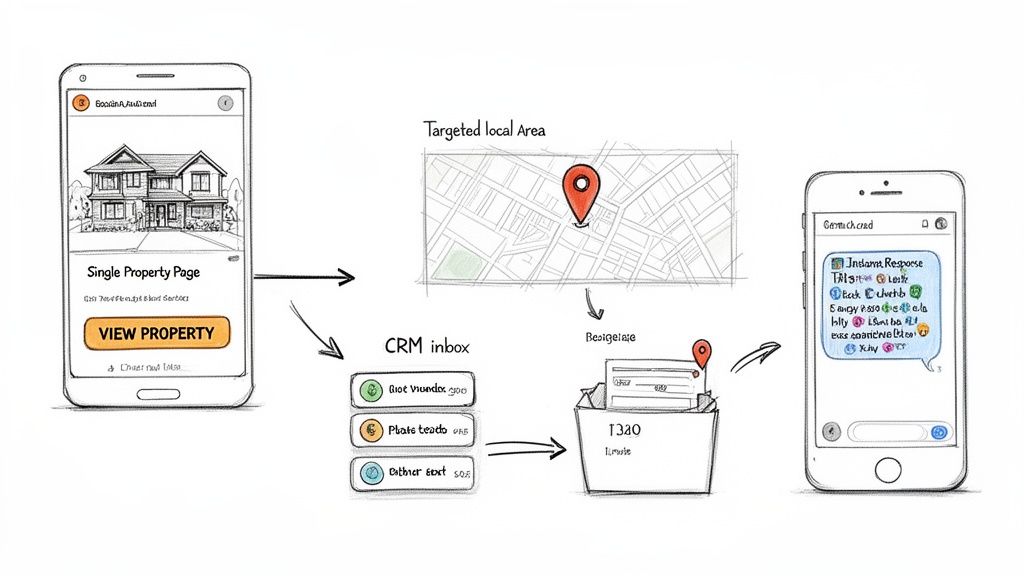
Alright, your single property website is live, looking sharp, and ready to go. But let's be real—hitting "publish" is just step one. A beautiful website with no visitors is like hosting an open house and forgetting to put out any signs. It won't do you much good.
Now comes the fun part: actively driving the right kind of traffic to your site and turning those clicks into actual, tangible leads. This is where your website stops being a simple brochure and becomes the engine of your entire lead-gen strategy. You're not just waiting for buyers to stumble upon your listing; you're going out and finding them.
Running Targeted Social Media Ad Campaigns
Forget about casting a wide, expensive net with newspaper ads. The real magic of digital advertising is how incredibly precise you can be. Platforms like Facebook and Instagram are goldmines for getting your property in front of local buyers who are genuinely in the market for a home just like yours. A small, focused ad budget here can deliver a much higher return than traditional marketing ever could.
So, what does a winning ad campaign look like?
- Dial in Your Audience: You can target users based on location (think a 15-mile radius of the property), demographics (age, income), and even their online behavior (like people who recently interacted with Zillow or Realtor.com).
- Show Off the Goods: Your ad creative needs to be a showstopper. Lead with that stunning twilight photo or, even better, a short, punchy video clip from your property tour. Grab their attention immediately.
- Give a Clear Call to Action: Don't be vague. Tell people exactly what you want them to do. Use phrases like, "Click to see the full photo gallery and 3D tour" or "Get instant access to the floor plans."
- Send Them to the Right Place: This is critical. The ad should link directly to your single property website. Never send them to your brokerage homepage or a generic profile. The goal is to land them in that focused, distraction-free environment you worked so hard to build.
How Do I Make Sure Every Lead Gets Tracked?
A scattered approach to lead management is a surefire way to lose business. When someone fills out the contact form on your website, where does that lead go? If your answer is "my email inbox," you're setting yourself up for missed opportunities. This is exactly why a Customer Relationship Management (CRM) system is non-negotiable.
By connecting your website forms directly to your CRM, every single inquiry gets automatically captured, organized, and tracked. This creates a seamless flow of information, logging the lead's contact details, the specific property they're interested in, and the exact moment they reached out. It’s the foundation of a reliable sales pipeline.
A CRM integration turns a flood of random inquiries into an organized, actionable database. You can see every interaction, set follow-up reminders, and nurture leads methodically instead of letting hot prospects get lost in a cluttered inbox.
Why Is Speed to Lead So Damn Important?
In real estate, the agent who responds first usually wins. It's that simple. Study after study has shown that your chances of actually connecting with a new lead plummet after just five minutes. An instant-response system isn't just a nice-to-have; it's your secret weapon for engaging prospects the moment their interest is at its peak.
This can be a simple automated text or email that fires off the second a lead hits "submit" on your website. It doesn't have to be fancy. Something as straightforward as, "Hi [Name], thanks for your interest in 123 Maple Street! I'm looking over your message now and will call you in just a few minutes," can make all the difference.
This immediate touchpoint accomplishes two crucial things:
- It confirms their submission went through, which looks professional and reassuring.
- It keeps you top-of-mind and buys you precious time to follow up personally.
Scaling Your Lead Flow for a Growing Team
As your business expands, this kind of automated system becomes even more valuable. For teams, a single property website can act as a central lead-gen machine that funnels prospects directly to an Inside Sales Agent (ISA).
An ISA is a specialist whose sole job is to respond to, qualify, and nurture new leads. With an ISA in the mix, the workflow is incredibly efficient:
- A buyer submits their info on your website.
- The lead is instantly routed to the CRM, and the ISA gets a notification.
- The ISA responds within seconds—literally—via text and phone to qualify the lead.
- Once qualified, the ISA books a showing or appointment directly on a buyer's agent's calendar.
This process ensures your agents are spending their time only with serious, pre-qualified buyers. It streamlines everything, boosts conversion rates, and allows your team to handle a much higher volume of leads without ever sacrificing quality or speed.
Burning Questions I Hear from Top Agents
It's smart to ask questions before jumping into a new marketing strategy. Honestly, I'd be worried if you didn't. Let's walk through the questions that come up most often when I talk to agents about building these sites.
"What’s This Going to Cost Me?"
This is always the first question, and it's a fair one. The real answer is: it’s not a one-size-fits-all price tag, but it's way more accessible than most agents assume.
You could use a template from a website builder and be all-in for a couple hundred bucks. On the flip side, a completely custom-built site with every possible feature could run you a few thousand.
Here's a mind-shift I encourage every agent to make: stop viewing this as a cost. It’s an investment. A single property website often pays for itself by helping you sell faster, snagging a higher offer, or landing that next big listing because you blew the seller away with your marketing.
This isn't just another expense; it’s a powerful tool with a direct, measurable return.
"I'm Already Swamped. How Much Time Will This Take?"
Your time is your most valuable asset, so I get it. The great news is that once one of these sites is up and running, it's pretty much on autopilot.
The real work is all upfront. You’ll need to pull together your best marketing materials—the professional photos, the video tour, that killer property description, and all the local highlights. That's the heavy lifting.
- The Setup: Block out a few hours of focused time to get the content loaded and tweak the settings.
- The Upkeep: Almost none. The site does the work for you. Your only job is to follow up with the high-quality leads it sends your way.
Think about the time you'll get back by not having to chase down cold leads or answer the same basic questions over and over. For agents who want to streamline this even further, there are some great dedicated resources for real estate agents out there.
"So, I Can Ditch My MLS Listing Then?"
Whoa, not so fast! That's a common misunderstanding. A single property website is a supplement to your MLS listing, not a replacement for it. They're two different tools in your marketing toolkit, and they work brilliantly together.
Think of it like this:
| Tool | The Job It Does | Who It's For |
|---|---|---|
| MLS Listing | Maximum exposure, agent networking | Every agent in your market, data feeds to portals |
| Single Property Website | Direct-to-buyer marketing, an immersive story | Potential buyers, your seller (as a marketing showcase) |
The MLS is your industry backbone. It gets the property in front of every other agent. Your dedicated website, on the other hand, is your premium, direct-to-consumer marketing piece. It’s designed to emotionally connect with buyers and seriously impress your sellers in a way the MLS just can't.
"Can't I Just Reuse the Same Site for My Next Listing?"
Technically, you could recycle a template, but I strongly advise against it. The whole point of a single property website is its laser focus. A URL like 123MapleStreet.com is all about one thing: selling that specific home.
A much better approach is to create a unique site for each high-value listing. Modern platforms make this a breeze; you can often clone the layout of a previous site and just drop in the new content. This keeps that exclusive, high-end vibe for every property and gives you a powerful, repeatable marketing system you can show off in every listing presentation.
Ready to turn your listings into lead-generating machines? DB Marketing Co. sets up the automated systems you need to capture, nurture, and convert every single lead, ensuring you never miss an opportunity. See how our lead management systems can help you grow.