
Ever wonder what a real estate landing page really is? It's a simple, standalone web page built for one single purpose: to turn a casual visitor into a genuine lead. It's not your homepage, which is full of distractions and different paths to take. Instead, a landing page is designed with a laser focus on a specific offer, like a free home valuation or a list of new properties. This focus is what makes it an absolute must-have in your marketing toolkit.
Why Your Website Is Leaking Real Estate Leads
Let’s get real for a second. Your main real estate website, as beautiful as it may be, is probably not the lead-generating machine you hoped for. If you're pumping money into Facebook or Google ads and sending all that hard-earned traffic straight to your homepage, you're almost certainly losing leads.
A homepage is built for browsing. It’s packed with navigation links, agent bios, blog posts, and information about every single thing you do. It's the digital equivalent of a cluttered open house. A landing page, on the other hand, is a specialist. It’s a private showing, designed for one person with one goal in mind.
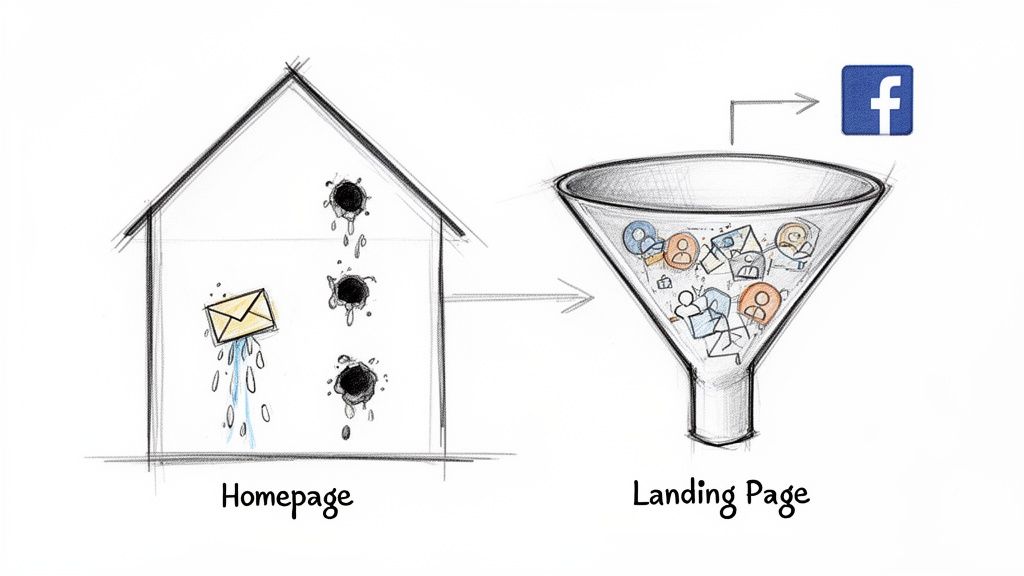
To make this crystal clear, let's break down the key differences between a homepage and a dedicated landing page.
Website Homepage vs. Real Estate Landing Page
| Feature | Typical Website Homepage | Real Estate Landing Page |
|---|---|---|
| Primary Goal | General browsing, brand info, exploration. | Capture a lead for a single, specific offer. |
| Navigation | Full menu with many links (About, Listings, Blog, etc.). | No navigation. The only way out is back or through the form. |
| Call to Action (CTA) | Multiple CTAs (Search Homes, Contact Us, Read More). | One clear, unmissable CTA (e.g., "Get My Free Home Valuation"). |
| Content | Broad overview of your services and value prop. | Hyper-focused on the benefits of one specific offer. |
| Audience | Anyone and everyone. | A targeted visitor from a specific ad campaign. |
| Success Metric | Time on site, bounce rate, pages per visit. | Conversion rate (the % of visitors who become leads). |
As you can see, they serve completely different, yet equally important, functions in your marketing.
The Power of a Focused Offer
Think about it like this. Your standard "For Sale" sign on a lawn is your homepage. It tells people who you are, but it doesn't really ask them to do anything specific.
Now, what if you added a sign rider that said, "Get an Instant Valuation for This Home—Text 'VALUE' to 555-1234"? That rider is your landing page. It’s a direct, irresistible offer with a crystal-clear call to action.
This focused approach is what makes landing pages for real estate so incredibly effective. They become your best digital salesperson, working 24/7 to turn clicks from your ads into actual conversations with potential clients. When someone clicks your Facebook ad for a "First-Time Homebuyer's Guide," they expect to see a page about that guide—and nothing else.
This singular focus gets rid of all the noise and speaks directly to what that visitor wants, which dramatically increases the odds they'll hand over their contact info.
And the numbers back this up. The median conversion rate for landing pages across all industries hovers around 2.35%, but real estate agents often see much better results, typically between 2.8% and 4.36%. For those who really dial in their pages and offers, conversion rates of 5-15% are totally achievable. You can dig into more of the data by checking out these landing page conversion rate insights.
Where Landing Pages Fit in Your Funnel
So, where does this powerful tool fit into your overall marketing plan? It comes in right at that crucial moment when a prospect raises their hand and shows interest.
Here's what that journey looks like in the real world:
- The Ad: A potential seller is scrolling through Facebook and sees your ad offering a free, instant home valuation for their neighborhood.
- The Click: Intrigued, they click the ad.
- The Landing Page: Instead of getting dumped on your busy homepage, they arrive on a clean, simple page that's all about the home valuation offer.
- The Conversion: They quickly enter their address and email into a simple form to get their valuation.
- The CRM: Boom. That new lead is automatically sent straight into your CRM, which kicks off an immediate follow-up sequence.
This seamless process plugs the leaks that are costing you money. By using just a few targeted landing pages, you stop wasting ad spend and start building a predictable pipeline of qualified leads you can actually convert.
The Blueprint for a Landing Page That Converts
Let's ditch the marketing fluff and get straight to what works. I’m going to walk you through how to build a real estate landing page that actually pulls in leads, piece by piece. This isn't theory; it's a practical blueprint based on what I've seen succeed time and time again.
Think of your landing page as a finely-tuned machine. Each element we're about to cover is a critical gear. When they all click into place, the results are almost automatic.
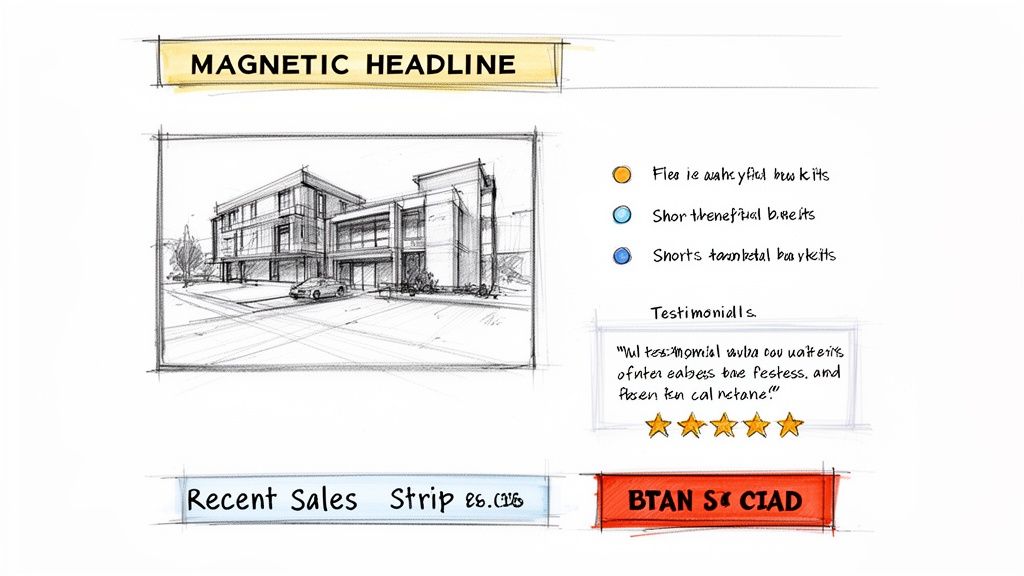
What Are the Key Elements of a Real Estate Landing Page?
Every killer landing page for real estate has the same basic DNA. The photos and the sales pitch might change, but the underlying structure is always there because it’s built on what we know about human psychology and what makes people take action.
These are the non-negotiables. You need every single one.
- A Magnetic Headline: The first thing they see. You have about three seconds to make them care.
- Benefit-Driven Body Copy: The text that shows them why they should give you their info.
- Compelling Visuals: High-quality images or video that do the heavy lifting for you.
- Irrefutable Social Proof: Proof that you’re the real deal, from people just like them.
- A Clear Call-to-Action (CTA): The big, obvious button that tells them exactly what to do next.
Let's break down how to nail each one.
Crafting a Headline That Hooks
Your headline is more than just a title; it’s a promise. It has one job: connect instantly with what your visitor wants or what’s keeping them up at night. A generic headline like "Austin Real Estate Agent" is a complete waste of digital real estate.
For a page targeting sellers, you need to hit them right in their curiosity about their home's value. A headline that works is:
"Finally Know What Your Austin Home Is Really Worth"
See why that works? It's specific (Austin), it uses emotional words ("Finally," "Really"), and it speaks directly to that big question every homeowner has. It creates an itch they have to scratch.
If you're going after buyers, your headline should promise them exclusive access or a shortcut to their dream lifestyle. Think along these lines:
- "Get a Curated List of Off-Market Homes in Scottsdale"
- "See Every Miami Condo with an Ocean View Under $1M"
These headlines offer a specific solution to a specific problem, making your offer feel exclusive and way more valuable than a generic Zillow search.
Writing Copy That Sells the Outcome
Okay, your headline got their attention. Now the rest of the text needs to close the deal. The single biggest mistake I see agents make is talking about their process instead of the outcome. Nobody cares about your "advanced CMA report." They care about knowing if they have enough equity to finally buy that lake house.
Keep your copy short, easy to scan, and focused entirely on what's in it for them.
- Bad Copy (Process-Focused): "We use a proprietary algorithm to analyze market data and generate a comprehensive comparative market analysis."
- Good Copy (Benefit-Focused): "Get a clear, accurate home value report in minutes so you can make confident decisions about your future."
Use short sentences and bullet points. They’re your best friend. For that home valuation page, your bullet points could be something like:
- Discover your home's current market value—for free.
- See what similar homes in your neighborhood actually sold for.
- Get the data you need to plan your next move with confidence.
Using Visuals That Stop the Scroll
Real estate is a visual game. Your landing page is no different. A great photo or video can communicate value and emotion way faster than words ever could. If you're promoting a specific listing, this is a no-brainer—use knockout professional photos.
But what about a home valuation or a buyer's guide page? Visuals are still crucial.
- Use a high-quality, aspirational photo of a stunning home from the neighborhood you're targeting.
- Put a professional headshot of yourself on the page. It builds a human connection and starts creating trust.
- Even better, record a quick 30-second video of you personally explaining what they'll get. That personal touch is incredibly powerful.
Building Trust with Social Proof
Why should a complete stranger on the internet trust you with their biggest financial asset? Because other people already have. Social proof is the secret sauce that melts away skepticism. Without it, you’re just some agent making promises. With it, you're a proven expert.
Weave social proof right into the fabric of your page. Here’s how:
- Client Testimonials: A direct quote from a happy client, ideally with their name and a photo. It’s gold.
- Recent Sales: Show, don't just tell. Phrases like "Over 50 Homes Sold in Your Area" combined with a few photos of sold properties are incredibly persuasive.
- Credentials & Awards: Slap those logos on there—your brokerage, the National Association of Realtors (NAR), any "Top Producer" awards. It all adds up.
This mix of trust signals tells visitors you’re a legitimate, successful pro they can count on. If you really want to go deep and learn how to optimize landing pages for conversions, it's worth the read. By putting these proven elements together, you create a smooth path that guides visitors from a simple click to becoming a quality lead, turning your ad budget into a predictable business pipeline.
Designing Lead Forms That People Actually Fill Out
Alright, let's talk about the moment of truth for your entire landing page: the lead form and the call-to-action (CTA). Everything else you've done—the killer headline, the convincing copy, the gorgeous photos—has all been leading up to this one critical point.
This is where a curious visitor either becomes a real, tangible lead or bounces forever. If your form is a pain to fill out, asks for too much, or just feels sketchy, you’ve lost them. The goal is to make giving you their info feel easy, safe, and worthwhile.
Embrace the 'Less Is More' Philosophy
Want to know the fastest way to absolutely tank your conversion rate? Ask for way too much information. Put yourself in their shoes for a second. They just landed on your page, they don't know you from Adam, and suddenly you're asking for their entire life story.
Every single field you add creates more friction and gives them another reason to bail. It’s no surprise that minimalist forms consistently crush lengthy ones. The sweet spot for most landing pages for real estate is just 3-4 essential fields. Any more than that, and you'll see your abandonment rate start to climb. If you want to see what works, check out how top agents design their landing page forms.
Remember, your job right now isn't to get them pre-qualified for a mortgage. It's just to start a conversation.
What Are the Essential Form Fields?
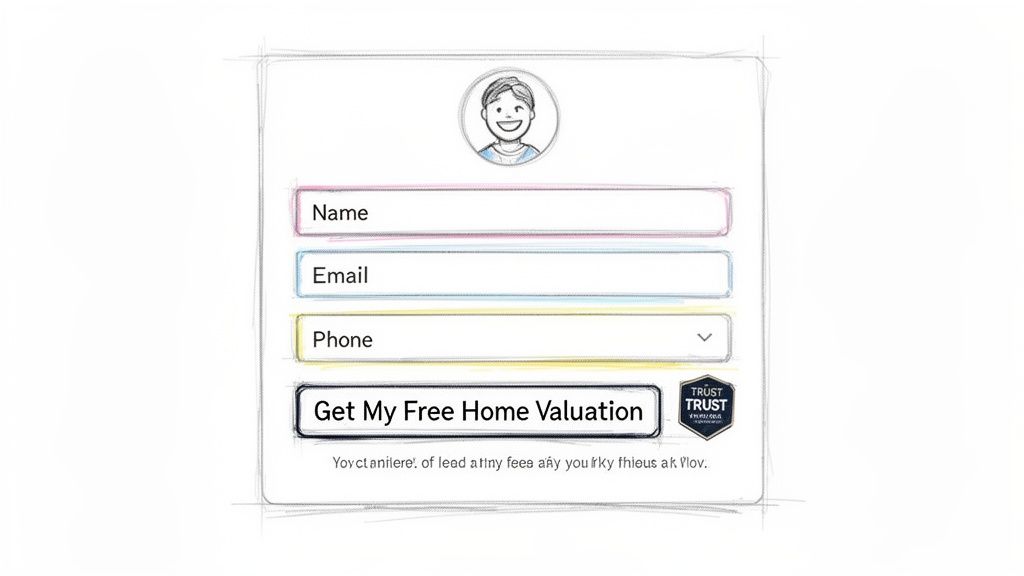
For nearly any offer you can dream up, you only need three key pieces of information to get the ball rolling:
- First Name: This is non-negotiable. It lets you personalize every follow-up email and text, making your communication feel like it's coming from a real person, not a robot.
- Email Address: This is your primary channel for follow-up. It’s how you’ll deliver the promised home valuation, buyer's guide, or list of properties.
- Phone Number: Absolutely critical for "speed to lead." The second they hit submit, an automated text can go out, engaging them while your offer is still fresh in their mind.
That's really it. For something like a home valuation page, you’ll obviously need a fourth field for "Property Address," but fight the temptation to ask for more. Questions about their timeline or budget can wait.
Pro Tip: Let your CRM do the heavy lifting. The form is just there to open the door. Once they're in your system, your automated follow-up sequences can conversationally ask those deeper qualifying questions over the next few days.
Crafting a CTA That's Impossible to Ignore
Your call-to-action button is no place to be subtle or boring. Forget generic words like "Submit" or "Download." Nobody gets excited to click "Submit."
Those words are all about what the user has to do for you, not what they’re about to get.
A powerful CTA should complete the sentence, "I want to…"
- Instead of "Submit," try "Get My Free Home Valuation."
- Instead of "Download," try "Send My First-Time Buyer Guide."
- Instead of "Click Here," try "See the New Listings Now."
You feel the difference, right? The language is personal ("My"), it highlights the value ("Free," "New"), and it creates a sense of getting something right now.
The Simple Psychology of Button Design and Placement
Okay, now for the button itself. You might be surprised how much its look and location can impact whether people actually click it.
Button Color and Contrast
There's no magic color that converts best. The only rule that matters is contrast. Your button needs to leap off the page and grab the visitor's attention. If your page has a blue and white theme, a bright orange or green button will stand out way more than another shade of blue. It should be the most eye-catching thing on the screen.
Placement and Size
Make your CTA button big, bold, and place it "above the fold"—meaning, visible without any scrolling. You want it to be impossible to miss. For longer landing pages, it’s a smart move to repeat the CTA button further down the page. That way, once they're convinced, they don't have to scroll all the way back up to take action.
By pairing a dead-simple form with a commanding, high-contrast CTA, you eliminate all the roadblocks. You make it incredibly easy for a visitor to say "yes," turning a simple click into a new client relationship.
Driving the Right Traffic to Your Real Estate Landing Pages
A perfect landing page is a lot like a beautifully staged open house—it’s completely useless if nobody shows up. Now that you've got the blueprint for a high-converting page, it's time to open the floodgates and get the right kind of people to visit. This is how you turn a simple webpage into a predictable lead-generation machine.
The goal isn't just to get clicks. It's about getting clicks from people who are genuinely in the market. This is a game of precision, not just volume. We'll zero in on the ad channels that consistently deliver the best results for real estate agents.
Facebook and Instagram Ads: Your Targeting Superpower
So, what makes Facebook and Instagram ads so effective for real estate? The data. It’s almost scary how much these platforms know about their users, and you can put that information to work, putting your ads directly in front of your ideal audience.
Go way beyond just targeting a city. You can get incredibly specific.
- Location: Target a 15-mile radius around a specific zip code you dominate.
- Demographics: Reach people in a certain age range or income bracket.
- Life Events: This is the goldmine. You can target users with behaviors indicating they are "likely to move."
Imagine you have a landing page with a "First-Time Homebuyer's Guide." You can run a Facebook ad campaign targeting renters, aged 28-35, living in a high-rent neighborhood, who have also shown interest in things like mortgage calculators. You’re not just casting a wide net; you're fishing with a laser-guided spear.
Winning with Google Ads and High-Intent Keywords
While social media ads are great for finding people who might be thinking about moving, Google Ads are for capturing people who are actively searching for a solution right now. These are bottom-of-the-funnel prospects, and they are incredibly valuable.
The real secret here is bidding on long-tail keywords that signal serious intent. Forget generic terms like "real estate agent." Get inside the head of a serious buyer or seller and focus on the hyper-specific phrases they’d actually type into the search bar.
Examples of High-Intent Keywords:
- "Phoenix homes for sale with a pool under $700k"
- "Best real estate agents in Jupiter Florida for sellers"
- "How much is my home worth in Austin TX 78704"
When someone searches for one of these phrases and clicks your ad, they are a red-hot prospect. The magic happens when you send them to a landing page that directly answers that exact question, creating a seamless and powerful experience.
The Golden Rule: Ad Scent and Message Match
Here’s a critical piece of the puzzle that so many agents miss: your ad and your landing page have to be a perfect match. In the marketing world, we call this "ad scent" or "message match."
If your Facebook ad headline says, "Discover the True Value of Your Miami Beach Condo," your landing page headline needs to echo that promise almost word-for-word. Don't just dump them on a generic page about your services. That consistency builds instant trust and reassures the visitor they've made a good click.
When the headline, imagery, and core promise of your ad are mirrored on your landing page, conversion rates soar. It removes cognitive friction and guides the user smoothly toward the call-to-action.
This alignment basically tells the visitor, "Yes, you're in the right spot. What I promised you is right here." Breaking this continuity is the fastest way to get someone to hit the back button.
Real Estate Ad Channel Performance Snapshot
Not all traffic is created equal. The source of your visitors has a huge impact on how likely they are to convert. To help you prioritize your ad budget, here’s a look at how different channels typically perform for real estate landing pages.
| Traffic Channel | Average Conversion Rate | Best For |
|---|---|---|
| Email Marketing | 19.3% | Nurturing past clients & your sphere of influence. Highest trust factor. |
| Paid Social Media | 12.0% | Generating top-of-funnel leads & building brand awareness in specific geos. |
| PPC/Search Ads | 10.9% | Capturing high-intent buyers and sellers actively searching for services. |
As you can see, traffic from your existing email list will almost always outperform cold traffic because those people already know, like, and trust you. Based on broad landing page conversion statistics, email traffic converts at an impressive 19.3% on average.
This doesn't mean you should ignore social (12.0%) or search ads (10.9%)—they are absolutely essential for growing your business. It just proves that a multi-channel approach is the smartest way to fill your pipeline with high-quality leads.
Automating Your Follow-Up So No Lead Gets Lost
Getting a lead to fill out your landing page form is a great first step, but let's be honest—that's where the real work begins. The follow-up is where you actually turn that click into a commission check. This is the final, make-or-break piece of the puzzle that truly separates the top producers from everyone else.
The game is won or lost in the first five minutes. I'm not exaggerating. Study after study has shown that your odds of actually making contact with a new lead are a staggering 100 times greater if you respond within that tiny window. Wait just 30 minutes, and those odds plummet.
This is why you hear agents talk so much about "speed-to-lead." It isn’t just some trendy marketing buzzword; it's the single most important metric for converting online leads.
Why Is Immediate Follow-Up a Non-Negotiable?
Think about it from the client's perspective. When someone fills out your "Get My Home Value" form, their interest and motivation are at an all-time high. They are actively thinking about selling their home right now.
If you make them wait hours, or even until the next morning for your call, that fire starts to fade. They've already clicked away, probably onto another agent's website, and moved on with their day.
An immediate, automated follow-up ensures you’re the very first agent to engage them. It lets you strike while the iron is hot and secure your spot as their go-to expert before anyone else gets a chance.
Connecting Your Landing Page to Your CRM
So, how do you make this happen without being glued to your phone 24/7? Simple: you create a seamless, instant connection between your landing page form and your Customer Relationship Management (CRM) software. Manually exporting leads from a spreadsheet just won't cut it—you'll never be fast enough.
This connection is the technical backbone of your whole follow-up system. The second a lead clicks "submit," their information should automatically pop up as a new contact in your CRM, already tagged and ready to go. Most modern landing page builders and CRMs have direct integrations or can be linked up using a tool like Zapier.
This is the kind of flow we're talking about—straight from an ad, to your page, and right into your system. No delays.
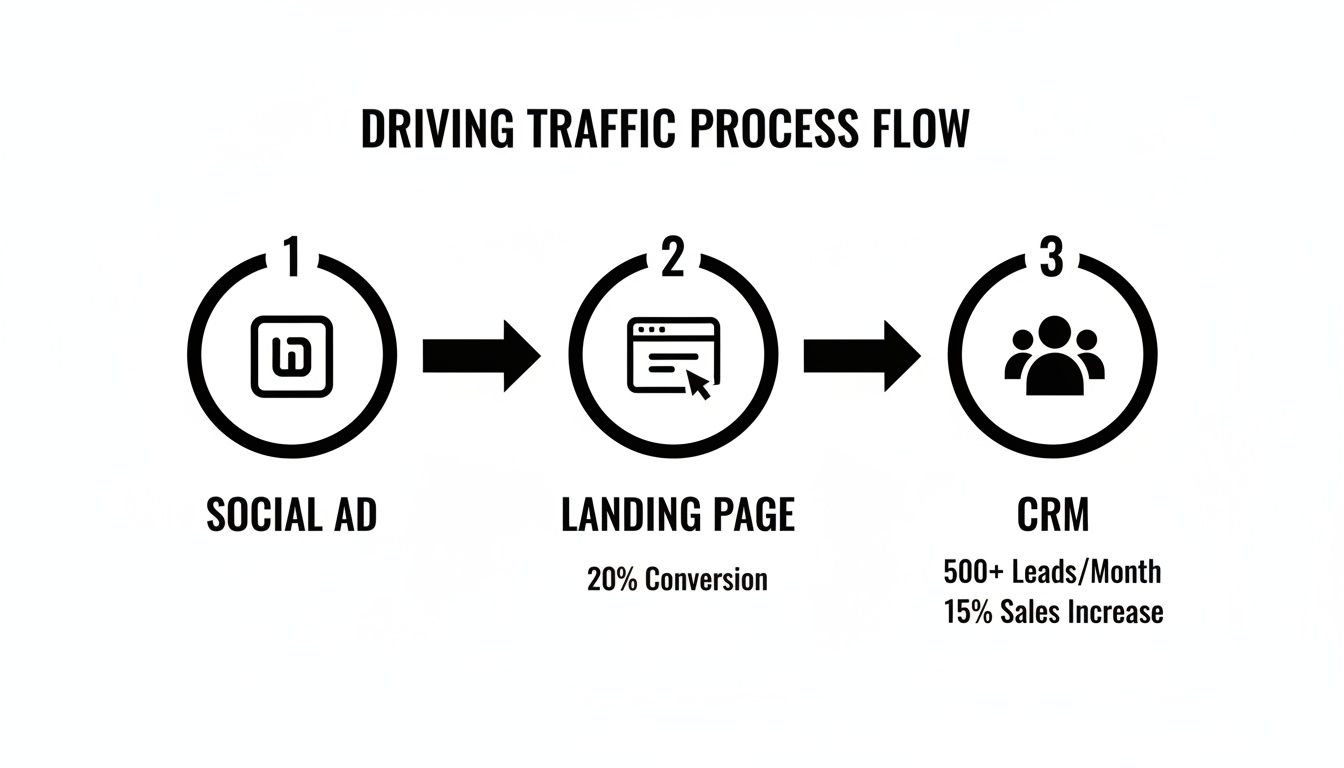
This automated pathway is your key to capitalizing on a lead's peak interest without any manual friction.
Setting Up Instant, Personal Autoresponders
Once a lead is safely in your CRM, the real magic kicks in. You need to have instant autoresponders firing off via both email and SMS text message. The crucial part? They absolutely cannot sound like they came from a robot.
Let's walk through a real-world scenario: A lead comes in at 10 PM on a Saturday.
Without automation, that lead sits cold until Monday morning. With automation, this is what happens instead:
- Instantly: Their phone buzzes with a text message. It says something like, "Hey [First Name], just got your request for the home value report. John here. I'm pulling the comps now and will have it over to you shortly. Is this the best number to reach you at?"
- Simultaneously: An email lands in their inbox with a subject like, "Your Home Value Report for [Property Address]." The email simply confirms you received their request and tells them what to expect next.
This one-two punch is incredibly powerful. The lead feels heard and taken care of, which immediately builds trust and positions you as a responsive professional who is on top of their game.
For a deeper dive into writing messages that get opened and replied to, our guide on email marketing for real estate has some great strategies you can use right away: https://dbmarketingco.com/email-marketing-for-real-estate/
To take it a step further, the best way to make sure no lead ever slips through the cracks is by implementing a dedicated real estate marketing automation software that can handle all of this for you.
What About Routing Leads to a Team?
If you're running a team, this kind of automation isn't just a nice-to-have; it's essential. A good CRM will let you set up "round-robin" lead routing.
This means when a new lead comes in, it's automatically and fairly assigned to the next agent in line. This simple rule ensures that every single inquiry gets that same lightning-fast response, no matter who is on duty. It eliminates the chaos of figuring out who should grab what and guarantees every lead your landing pages for real estate generate gets the immediate attention it deserves.
Common Questions About Real Estate Landing Pages
As you start building out your landing pages, a few key questions are likely to come up. Addressing them head-on will help you build pages that are more effective from day one. Here are the answers to some of the most frequent questions agents ask.
How many landing pages do I really need?
You need more than one. The best practice is to have a unique landing page for every specific ad campaign or offer. If you're running an ad for first-time homebuyers, it should lead to a page about a first-time homebuyer's guide. An ad for a specific luxury listing should go to a page dedicated solely to that property. This ensures perfect "message match," which dramatically boosts conversion rates. A good starting point is to have at least three core pages: one for sellers (e.g., a "Home Valuation" page), one for general buyers (e.g., a "New Listings Alert" page), and one that you can duplicate for individual property listings.
Should I put my website's navigation links on my landing page?
No. This is a common mistake that can kill your conversion rate. The goal of a landing page is to get a visitor to take one single action—fill out your form. Adding your main website navigation (links to "Home," "About," "Blog," etc.) creates distractions and gives visitors an easy way to click away from the offer. By removing the navigation, you create a focused, high-intent environment that guides the user directly to the goal.
What's a good conversion rate for a real estate landing page?
While conversion rates can vary widely based on your traffic source and offer, a solid benchmark for real estate landing pages is anywhere from 3% to 5%. However, a well-optimized page with a compelling offer and targeted traffic can easily achieve rates of 5% to 10% or even higher. The key is to constantly track your performance using tools like Google Analytics and test different elements—like your headline or call-to-action button—to see what improves your results over time.
What's the difference between a landing page and a squeeze page?
You'll often hear these terms used interchangeably, and for good reason. A squeeze page is simply a specific, hyper-focused type of landing page. Its sole purpose is to "squeeze" contact information (usually just an email address) from a visitor in exchange for a high-value piece of content, like a PDF guide or a webinar registration. A landing page is the broader category for any standalone page a visitor "lands" on from a specific traffic source. In real estate, almost all of our effective landing pages function like squeeze pages because their primary goal is lead capture.
Ready to stop leaking leads and start building a predictable pipeline? The team at DB Marketing Co. can help you set up an automated system that captures, qualifies, and follows up with every lead, so you can focus on closing deals. Learn more about our services.