
So, what exactly is email marketing for real estate? It's not about spamming your contact list with every new listing. Think of it as your direct line to potential buyers, sellers, and past clients—a conversation you control. It’s how you build relationships, share genuinely useful info, and stay the first person they think of when it's time to make a move. You're turning digital handshakes into actual closings, all without getting lost in the social media noise.
Why Email Marketing Is Your Unfair Advantage
Let's be real. In a world full of Instagram stories and TikTok videos, does email still even matter for real estate agents? Absolutely. While social media is fantastic for getting your face out there, your email list is the one thing you actually own.
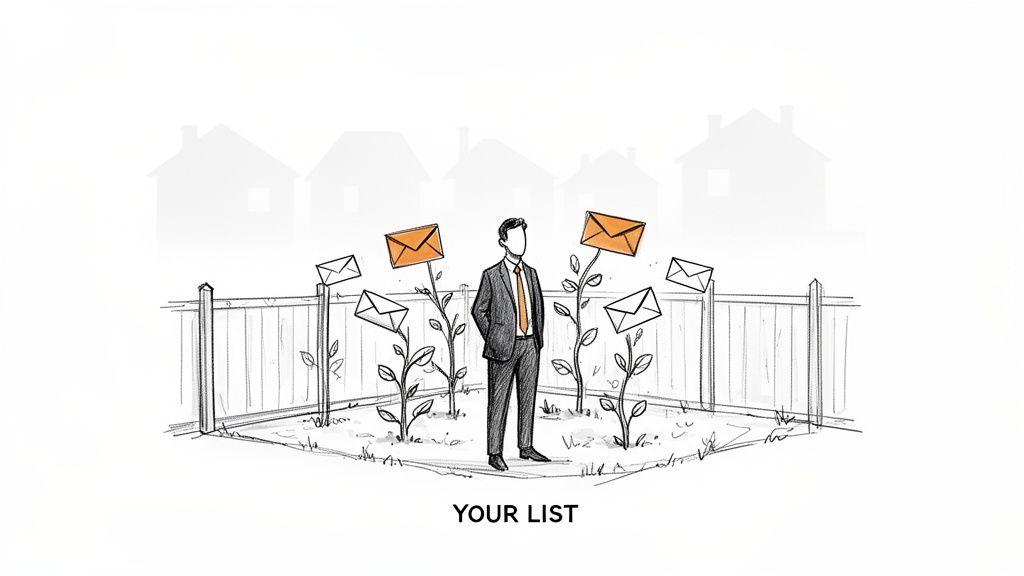
Think of your social media profiles like renting a billboard on a busy highway. It’s great for exposure, but the landlord (the platform) can change the rules, hike up the rent, or even tear it down without warning. An algorithm shift can tank your reach overnight.
Your email list, on the other hand, is your own private property. It’s your digital backyard where you can have real conversations and build solid relationships away from the constant noise. That control is what gives you a stable, predictable engine for growing your business.
An Asset That Appreciates Over Time
Every single email address you collect is a seed for a future transaction. When you consistently send out smart, helpful content, you’re nurturing those seeds. You stay top-of-mind, turning cool internet leads into warm conversations and past clients into a goldmine of referrals and repeat business. It's the difference between shouting into a crowd and having a meaningful, one-on-one chat.
The data doesn't lie. For real estate, email campaigns have an average open rate of a whopping 33.75%, which blows the all-industry median out of the water. Even better, for every $1 you put into email marketing, you can expect an average return of $36. That's an incredible ROI. You can read more about these real estate email benchmarks to see just how powerful it is.
Email marketing isn't just another box to check on your to-do list. It’s a foundational system for building trust at scale. Each email is a chance to prove your expertise, share local insights, and show you care about more than just the next commission.
What Makes Real Estate Email So Effective?
So why does this old-school tool still crush it for agents? The magic of email marketing for real estate is its power to deliver personalized value straight to someone's inbox.
- You control the narrative. No algorithms here. You decide what message your audience sees and when they see it.
- It builds genuine authority. Sharing market updates, neighborhood guides, or home maintenance checklists positions you as the local expert everyone turns to.
- Automation works for you. You can set up systems to nurture new leads around the clock. That means no opportunity falls through the cracks, even when you’re out showing properties or at the closing table.
Building An Email List That Actually Converts
Your email list is the absolute engine of your real estate business, but an engine can't run without fuel. For us, that fuel is a list of real people—qualified, engaged folks who actually want to hear from you. So let’s get the golden rule of email marketing for real estate out of the way first: never, ever buy an email list.
Seriously, don't do it. Buying a list is like trying to build a house on quicksand. Those people never asked to hear from you, so your emails are just spam. This tanks your open rates, gets you marked as junk, and can even get your email address blacklisted. It's a fast track to nowhere.
The only way to win this game is to build your list one person at a time. You earn every single subscriber by offering them something valuable before you ask for anything in return.
Create Irresistible Lead Magnets
A lead magnet is just a fancy term for a freebie you give away in exchange for an email address. Think of it as the handshake that starts the conversation. For it to work, it has to solve a real, specific problem for your ideal client.
What questions are you answering over and over again? What's the one piece of information that would make a buyer or seller's life easier? That’s your next lead magnet.
Here's a quick cheat sheet with some ideas to get you started.
Effective Lead Magnet Ideas For Realtors
This table gives you a few practical ideas for lead magnets that attract specific types of clients and actually get used.
| Lead Magnet Type | Target Audience | Why It Works |
|---|---|---|
| First-Time Home Buyer's Checklist | Buyers (especially millennials/Gen Z) | It breaks down a scary, overwhelming process into simple, actionable steps. |
| Hyper-Local Neighborhood Guide | Buyers (relocating or new to an area) | It shows you're a true local expert, not just an agent who can open a lockbox. |
| Instant Home Valuation Tool | Sellers (top-of-funnel) | It satisfies their curiosity about their home's value instantly and directly. |
| "5 Low-Cost Upgrades" Guide | Sellers (getting ready to list) | It provides immediate, tangible advice that helps them make more money. |
| Monthly Local Market Update | General (past clients, future prospects) | It keeps you top-of-mind as the go-to source for what's really happening in the market. |
The key is to offer something that feels like an insider tip, not a generic brochure.
The best lead magnets are hyper-local and instantly useful. A guide to the best parks and schools in your specific farm area will always outperform a generic national report because it demonstrates true local expertise.
Capture Leads From Every Angle
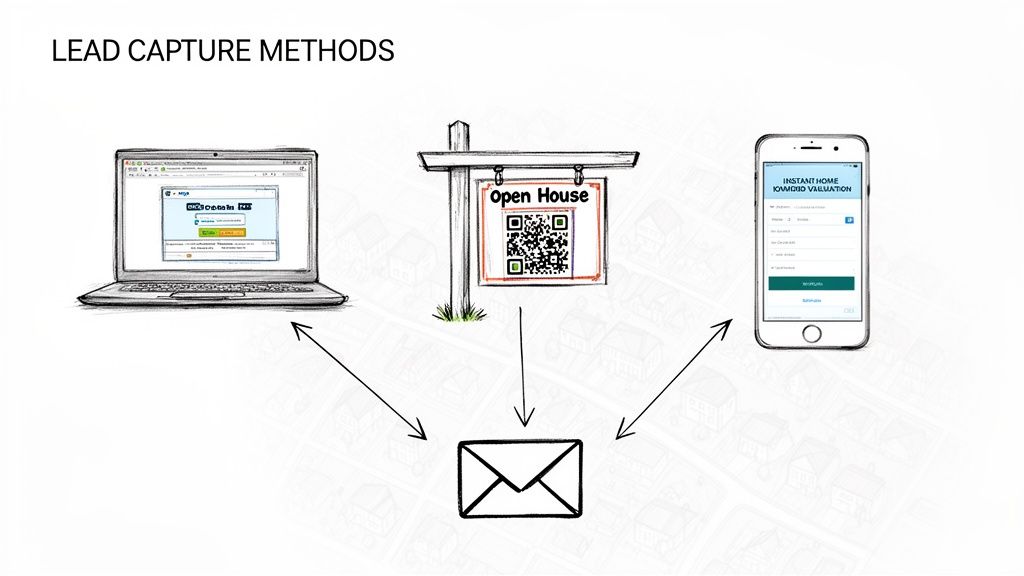
Once you've got a killer lead magnet, you need to put it where people can find it. Your website is your home base, but you should be thinking about how to collect emails from every touchpoint you have.
How can I collect emails for real estate marketing?
The trick is to weave these opportunities into things you're already doing. You don't need a bunch of complicated tools; just a few smart moves will make a world of difference.
- Website Pop-ups and Forms: Use simple, clean forms on your blog and main pages offering your free guide. Keep the call-to-action clear and focused on the benefit.
- Open House Sign-ins: Ditch the clipboard! Use a tablet with a digital sign-in form (I like Open Home Pro) that adds guests right to your email list—with their permission, of course. A QR code linking to the form is even easier.
- Social Media: Your Instagram bio and Facebook "About" section are prime real estate. Drop a link to your lead magnet's landing page right there.
- Live Chat and Chatbots: If you have a chat tool on your site, set it up to ask for an email so you can send a follow-up or a transcript of the conversation.
By funneling all these potential contacts into one system, you stop letting leads slip through the cracks. This consistent, value-first approach is how you build an email list that doesn't just grow—it actually converts.
The Power Of Smart List Segmentation
Sending the same email to everyone on your list is a classic rookie mistake. It’s like trying to sell a sprawling suburban home to a millennial looking for a downtown loft—a total mismatch that wastes everyone's time and kills your credibility. The real power of email marketing for real estate is unlocked when you make people feel like you're talking directly to them. And that's exactly what smart list segmentation does.
Think of your email list like a packed open house. You wouldn't stand in the middle of the living room and shout one generic message at everyone, would you? Of course not. You'd pull small groups aside for conversations tailored to them. You'd talk to the sellers about home equity and market trends, and you'd walk the buyers through the features of that brand-new kitchen.
When you take this targeted approach with your emails, they stop being generic junk mail and start becoming valuable, can't-miss advice. The numbers don't lie: segmented campaigns have been shown to boost revenue by an insane 760%. For you, that translates into more replies, fewer people hitting "unsubscribe," and way more meaningful conversations that lead to closings.
What Is List Segmentation Anyway?
So, what are we actually talking about here? Segmentation is just a fancy word for breaking your big email list into smaller, more focused groups based on what they have in common. Instead of one massive, messy list, you create a handful of mini-lists, each full of people with similar needs and interests.
It’s all about sending the right message to the right person at the right time. When you get this right, your audience feels like you actually get them, not like you're just spamming them.
The point of segmentation isn't just about being organized. It's about creating a personalized experience that proves you’re the expert who's paying attention to their individual real estate journey.
Essential Segments Every Agent Needs
You don't need to overcomplicate this. You can make a huge impact by starting with just a few key groups. Most CRMs let you do this easily with simple tags or labels.
How should I segment my real estate email list?
Here are the four non-negotiable segments every agent should have from day one:
- Prospective Buyers: These are your "lookers." They're hungry for new listings, price drop alerts, and helpful guides on navigating the home-buying maze. Sending them a "How to Stage Your Home" guide is just noise.
- Potential Sellers: This group is thinking about putting a "For Sale" sign in their yard. They want local market reports, home valuation updates, and tips on getting top dollar. New buyer listings are completely irrelevant to them.
- Past Clients: These folks are pure gold—your biggest fans and your best source of referrals! Keep the relationship warm with monthly newsletters, "home-anniversary" check-ins, and updates on their neighborhood's market.
- Sphere of Influence (SOI): Think friends, family, and your favorite local coffee shop owner. They know you, like you, and trust you. They might not be moving soon, but they know people who are. Keep them in the loop with general market news and community updates.
To get even more specific, you can add tags based on where you met someone, like "Open House Guest," "Zillow Lead," or "Website Inquiry." This adds a layer of context that makes your follow-up feel much more personal. To really dig in and get the most out of this, check out this guide on how to segment your email lists for maximum efficiency. Mastering this ensures every email lands with maximum impact, building the trust that drives your business forward.
Automated Campaigns That Nurture Leads 24/7
Picture this: you're in the middle of a showing, and a new lead fills out a form on your website. Instead of that lead sitting in your inbox getting cold, a perfectly crafted email hits their inbox instantly. That's the magic of automation.
It's not about replacing you with a robot; it's about giving you a superhuman ability to be in two places at once. Automation ensures that every single person who shows interest gets a prompt, helpful, and personal-feeling response, making sure no opportunity slips through the cracks.
These automated email series—you might hear them called "drip campaigns"—are the ultimate workhorses for your business. Think of them as pre-built conversations that kick off automatically when someone takes an action, like downloading your free seller's guide or signing in at an open house.
The whole point is to build trust and deliver value on autopilot, gently nudging prospects from "just looking" to "ready to talk." It’s a system that turns a random list of contacts into a pipeline of warm, engaged people who actually want to hear from you.
This flowchart is a great way to visualize how all your contacts can be channeled into the right nurturing funnels.
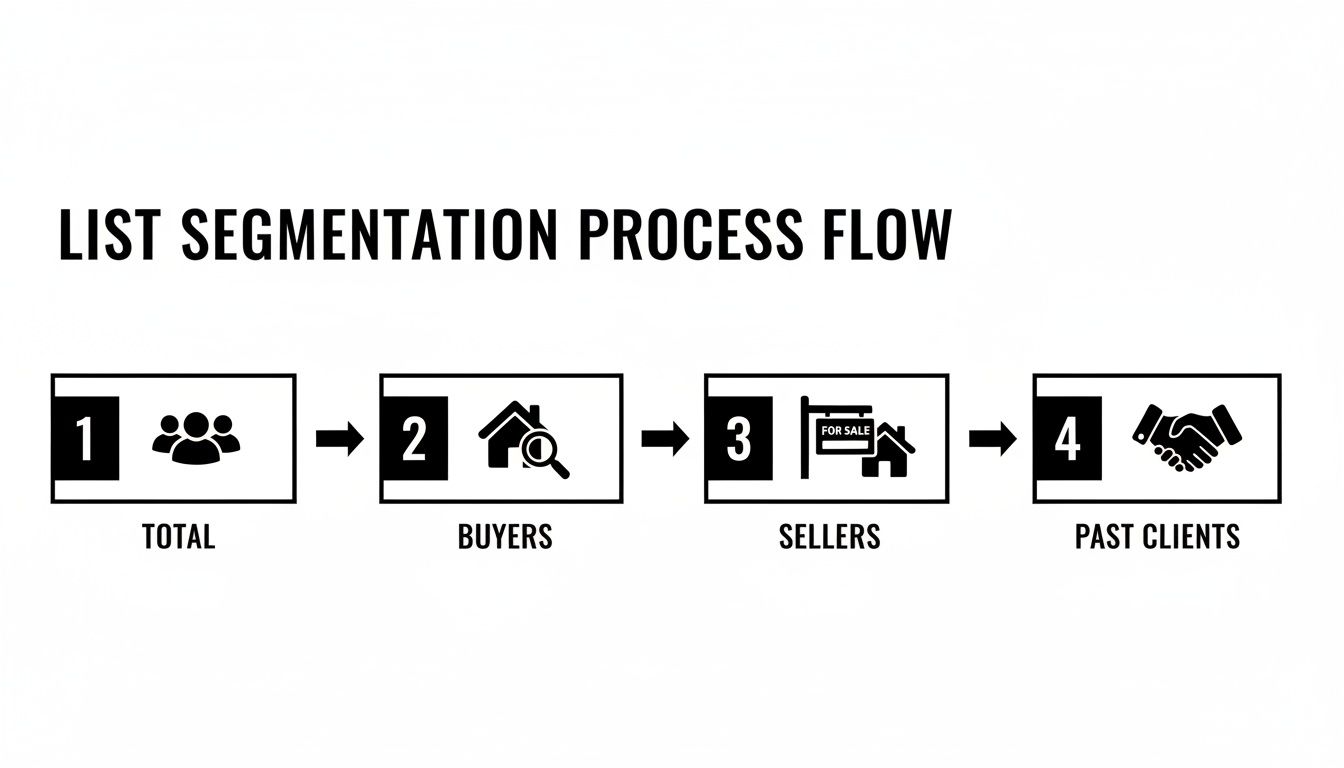
It shows you how a big, general list gets broken down into targeted groups like buyers, sellers, and even past clients—and each of those groups needs its own unique automated campaign.
Critical Automated Sequences For Agents
You could create an automated sequence for just about anything, but a few are absolute must-haves. If you want to scale your business without cloning yourself, start with these three.
- The New Lead Welcome Series: This is your digital handshake. The moment someone requests a home valuation or downloads your buyer's guide, this sequence fires off. It's your chance to introduce yourself, deliver what they asked for, and set the stage for what comes next.
- The Post-Open House Follow-Up: Don't let that sign-in sheet from Sunday gather dust. This sequence should go out right away to thank people for stopping by, give them a link to the property info, and ask what they thought. The next few emails can show them similar homes or share a quick market update for that neighborhood.
- The Long-Term Nurture Campaign: Let's be real—most leads aren't ready to buy or sell today. This is your "slow drip" campaign for folks who are maybe 6-12 months out. It keeps you top-of-mind with monthly market stats, seasonal home maintenance tips, or local news, all without being salesy.
The right real estate marketing automation software makes setting this all up surprisingly simple. The best part? When a lead finally replies to an email or gives you a call, the system can automatically pause the campaign, creating a seamless handoff from your automated assistant to a real, one-on-one conversation with you.
How Many Emails Should A Nurture Sequence Have?
This is probably the most common question I get from agents, and the honest answer is: it depends on the lead. There's no single magic number, but there is a solid framework you can follow to be effective without driving people to the unsubscribe button.
Your goal isn't to send a specific number of emails. It's to build enough trust and provide enough value that the prospect feels comfortable raising their hand and starting a conversation with you.
A good rule of thumb is to match the intensity of your follow-up to the intensity of their interest.
- For Hot Leads (e.g., "Contact Me" form): Keep it short and sweet. A focused sequence of 3-5 emails over a week is perfect. Your goal is a fast connection. The first email must be instant, followed by a couple more that offer help and different ways to chat.
- For Warm Leads (e.g., Open House Guest): A medium-length sequence of 5-8 emails spaced out over a few weeks works great. This gives you enough runway to provide value, share a few more listings, and really establish yourself as the local expert.
- For Cold or Long-Term Leads: Go for the long game. A slower sequence of 10+ emails sent over several months is ideal. Here, the goal is simply to stay on their radar with helpful, no-pressure content until they're ready.
The most successful agents build their business on this kind of smart automation. In fact, research shows that real estate teams of 3-5 people who really commit to their email marketing see a whopping 42:1 ROI. That's a huge jump from the 30:1 for smaller teams. It just goes to show that investing time into building a solid automation system truly pays off in the long run.
Crafting Emails People Actually Want To Read
Getting your automated emails delivered is the easy part. The real trick is crafting messages that people actually open, read, and remember. In a world where everyone's inbox is a battleground for attention, your email has to earn its keep.
The secret? Stop selling and start serving.
Think of every email you send as a piece of genuinely helpful advice you'd give a friend over coffee. When your mindset shifts from "look at this listing I have" to "hey, this could really help you," everything changes. Your emails become a welcome sight, not an intrusion. This is how you go from being just another agent to the go-to local expert.
Writing Subject Lines That Win The Click
Your subject line is the gatekeeper. It doesn't matter if you've written the most brilliant, insightful email in history—if the subject line doesn't hook them, it will never see the light of day. A great subject line is specific, piques curiosity, and hints at a clear benefit for the reader.
Vague, lazy subject lines like "Weekly Newsletter" or "Real Estate Update" are a one-way ticket to the trash folder. You have to do better. Instead of a generic "New Listing Alert," try something with a little more personality, like "The Kitchen You’ve Been Waiting For in Westmoreland." See the difference?
Here are a few plug-and-play formulas to get your creative juices flowing and, more importantly, get your open rates climbing.
High-Converting Subject Line Formulas
Plug-and-play subject line templates to increase open rates for common real estate emails.
| Formula | Example | Best For |
|---|---|---|
| Question + Benefit | Selling this spring? Get your home's updated value | Potential Sellers |
| Urgency + Scarcity | Hot new listing in 90210 won't last long | Active Buyers |
| Hyper-Local Tip | The 3 best coffee shops near your new home in The Gulch | New Leads / Nurture |
| Curiosity Gap | The #1 mistake most local sellers are making right now | Sellers / Long-Term Nurture |
These simple tweaks can make a massive difference in whether your email gets opened or ignored.
Structuring Your Emails For How People Really Read
Okay, they opened it. Great! Now you have about three seconds to keep their attention. Here's a reality check: people don't read emails, they scan them. This is especially true on mobile devices, which is where most of your emails will be opened. Your job is to make your message incredibly easy to digest at a glance.
Break up your text into tiny paragraphs. Seriously, one to three sentences max.
Use bold text to highlight the most important takeaways and use bullet points to break down lists or key features. This creates visual "breathing room" and guides your reader's eye exactly where you want it to go.
The goal of your email's structure is effortless understanding. If a subscriber can grasp your main point in just a few seconds of scanning, you've succeeded.
Content Ideas That Actually Build Trust
So, what should you even be sending? The best email marketing for real estate is a healthy mix of property-specific news and genuinely useful, lifestyle-focused content that has nothing to do with a sale.
Here are a few content pillars that work wonders:
- Weekly Market Snapshots: A quick, easy-to-read summary of what’s happening in a specific zip code. Think key stats like new listings, average days on market, and recent sales prices. Keep it simple and visual.
- Story-Driven Listing Announcements: Ditch the boring spec sheet. Instead of just "3 bed, 2 bath," tell a story. Talk about "the perfect backyard for summer barbecues" or "a kitchen designed for huge family gatherings." Help them picture their life there.
- Helpful Homeowner Content: This is pure value. Send out seasonal maintenance checklists (e.g., "Get Your Home Ready for Winter"), tips for boosting curb appeal, or guides to the best local farmers' markets. This proves you're a resource, not just a salesperson.
Ultimately, your emails need to inspire a response. It’s critical that you write professional emails that get replies and start conversations. By consistently delivering content that helps, informs, and engages, you build an audience that trusts you. And when they’re ready to make a move, you’ll be the first person they think of.
Measuring Success And Scaling Your Results
All this work setting up automated campaigns and writing great emails is great, but how do you know if it's actually working? Firing emails into the dark isn't a strategy. You have to look at the right numbers to figure out what's connecting with your audience and what's getting deleted on sight.
Think of your email metrics as the dashboard in your car. It gives you instant feedback, telling you when to hit the gas, when to ease up, or when you need to pull over and check the map. Ignoring these numbers is like driving blindfolded—sure, you might get somewhere eventually, but it won't be pretty.
Key Metrics You Need To Watch
When it comes to email marketing for real estate, a handful of numbers tell most of the story. Don't get bogged down in a spreadsheet full of data. Just focus on the metrics that actually move the needle.
What are good email marketing benchmarks for real estate agents?
Every agent asks this. While the only numbers that truly matter are your own, it helps to have a target to aim for. Here are some solid industry benchmarks:
- Open Rate: The percentage of people who actually opened your email. For real estate, you want to be in the 25-35% range. A high open rate means your subject lines are grabbing attention and people recognize your name in their inbox.
- Click-Through Rate (CTR): This shows how many people clicked a link inside your email. A good CTR in our industry is around 2-5%. This is your proof that the content was relevant and your call-to-action was compelling.
- Reply Rate: For agents, this is pure gold. There's no official industry number, but any reply is a win. Even a "not right now" is a sign of life, a signal that a real person is on the other end.
Your email metrics aren't just numbers; they're direct feedback from your audience. A low open rate? Your subject lines need work. A low click rate? The content inside isn't hitting the mark. The data is talking to you—you just have to listen.
From Clicks To Conversations
Metrics are nice, but they don't pay your commission. The whole point of this is to turn clicks and opens into actual appointments and closings. This is where the real skill comes in: learning to spot the subtle buying signals that tell you it's time to pick up the phone.
An engaged lead doesn't just open your emails; they take specific actions that signal real intent. Think of it as their digital body language. You just have to learn how to read it.
When To Escalate A Lead From Email To Phone Call
Knowing when to switch from an automated email to a personal phone call is the secret to scaling this whole thing without burning yourself out. You want to pour your energy into the people who are warming up, and their online behavior is the dead giveaway.
Here are a few crystal-clear signals that a lead is "hot" and ready for a personal touch:
- They click on multiple property listings. One click is just browsing. Clicking on three or four different homes in the same email? That's a serious sign they're actively looking.
- They visit your "Schedule a Call" or "Home Valuation" page. This is basically them raising their hand and saying, "Hey, I'm ready!" These should be your absolute first calls of the day.
- They repeatedly open emails about a specific topic. If someone opens every single email you send about "first-time homebuyer tips," you can be pretty sure that's exactly what they are.
- They reply to an email with a question. Any direct reply, no matter how simple, is your invitation to step in. The automation has done its job; now it's your turn to have a real conversation.
Using these engagement triggers ensures you're spending your time talking to the most qualified people in your database, turning your email system from a simple newsletter into a predictable appointment-setting machine.
Your Top Real Estate Email Marketing Questions, Answered
Jumping into email marketing can feel like you're staring at a blank page. You know you should be doing it, but a ton of questions pop up. Let's clear the air and tackle some of the most common ones I hear from agents so you can start building a strategy that actually works.
How Often Should I Email My Real Estate List?
This is the big one, right? The honest answer is that consistency always beats frequency. You don't need to bombard people's inboxes every single day. The goal is to be a reliable, welcome presence, not an annoying one.
The right rhythm really comes down to who you're talking to.
- Your general sphere (SOI, past clients): A weekly or bi-weekly newsletter is the sweet spot. It’s perfect for sharing market stats, local happenings, or a new blog post. This keeps you top-of-mind without overdoing it.
- Brand new leads in a nurture sequence: This is where you can be a bit more aggressive. Sending an email every day or two for the first week helps you make an impact while their interest is high.
- Long-term prospects (the "maybe someday" crowd): After an initial flurry of emails, you can ease off. A monthly check-in with something genuinely useful, like a guide to seasonal home maintenance, is a great way to stay on their radar.
Here's the bottom line: every single email has to deliver value. If you focus on that, your audience will let you know what's working. Keep an eye on those open rates and unsubscribes—they tell a story.
What Is The Best Email Marketing Software For Realtors?
There's no magic bullet here. The "best" tool really depends on your budget, how comfortable you are with tech, and what you're trying to accomplish.
If you're just dipping your toes in, something like Mailchimp is fantastic. Their free plans are generous, and it’s super easy to get a newsletter up and running.
For agents ready to get serious about automation, a platform like ActiveCampaign is a game-changer. It lets you create really smart, behavior-based email sequences. Of course, many real estate-specific CRMs, like Follow Up Boss, have powerful email marketing built right in, which is often the smoothest path since everything is in one place.
My Two Cents: The best software is the one you’ll actually use consistently. Don't overcomplicate it. Look for something with simple list segmentation (tagging is key!) and an automation builder that doesn't make your head spin.
Can I Buy An Email List To Get Started Faster?
Let me make this crystal clear: Absolutely not. I know it sounds like a tempting shortcut, but buying an email list is probably the single worst thing you can do for your marketing.
For starters, you'll be breaking anti-spam laws like the CAN-SPAM Act and violating the terms of service of any email platform worth its salt. This is a quick way to get your account shut down and your domain blacklisted.
But even more importantly, it just doesn't work. The people on these lists have no idea who you are and never asked to hear from you. They'll mark your emails as spam, which completely tanks your sender reputation. Once that happens, even the emails you send to your real, interested clients will end up lost in the junk folder. Building your list one person at a time is the only way to create an audience that trusts you and wants to do business with you.
Ready to stop letting leads fall through the cracks and start building a predictable pipeline? At DB Marketing Co., we set up the automated systems that capture, nurture, and qualify leads so you can focus on what you do best: closing deals. Learn how we can help you grow.